


Adverse reactions to Mounjaro increased by over 300 per cent in 2025 – as fat jab is linked to 71 deaths
Last year saw a 300 per cent increase in adverse reactions linked to Mounjaro – with 71 deaths recorded by health chiefs.
Data collected by the Medicines and Healthcare products Regulatory Agency (MHRA) Yellow Card Scheme, which allows patients to report suspected side effects or adverse drug reactions, reveals that there were 40,245 reactions to Mounjaro in the UK in 2025.
Of these reactions, 6,755 were classified as ‘serious’ and 71 resulted in death.
This is a near 340 per cent increase compared to 2024, which saw a total of 9,153 reactions, including 13 that were fatal.
The most commonly reported reaction in 2025 was ‘gastrointestinal disorders’ with 37,546 reports, 19 of which were fatal.
The NHS lists nausea, diarrhoea, and abdominal cramps as potential side effects of the injection, and thousands of people have spoken out about their experiences of them while taking the weekly jab.
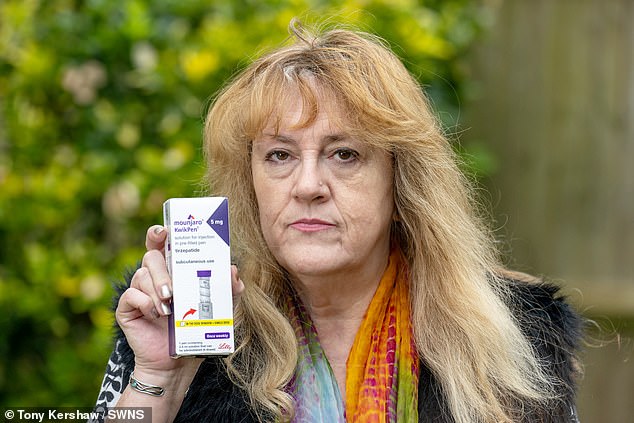
For 60-year-old Karen Coe, these side effects were unbearable, and she compared taking Mounjaro to feeling like being ‘ripped open by a knife‘.
She was prescribed the weight loss jab to lose weight and help combat type two diabetes and took her first injection on March 14 2025.
Karen Coe – pictured – said she felt like she was being ‘ripped open by a knife’ after suffering an extreme reaction to Mounjaro
After her first jab, she recalled experiencing a headache and feeling dizzy.
Three days later, on March 17, she developed ‘excruciating’ stomach pains, extreme diarrhoea, and had to call for an ambulance.
She said: ‘I nearly passed out. I was dizzy and really cold.’
But observations in the hospital showed no issues.
Ms Coe – who only injected herself once – spent the next 24 hours with stomach cramps and passing blood when she went to the toilet.
Her symptoms had eased off, but when she had ‘massive blood clots’ on March 24 2025, she rushed to A&E.
After an examination, she was referred to the urgent two-week pathway to see a colorectal surgeon.
Doctors said her initial symptoms were likely caused by Mounjaro, she claims, but doctors haven’t confirmed the cause of her subsequent clotting complications.
She was told to keep an eye on her symptoms and she was initially left weak and unable to eat.
She said: ‘Every few minutes I would go to the loo and pass blood.’
Ms Coe, who will not be continuing with her Mounjaro injections, said: ‘It can cause severe reactions and severe side effects.
‘People should really think carefully and not take it lightly.’
Side effects of Mounjaro are reported most often by women, accounting for 32,075 reports last year.
While the majority of reactions per age group are unknown, the highest reported age group with 1,397 reports was the 30-39 age category.
Reactions to other weight loss jabs like Semaglutide – commonly known as Ozempic – were trending downwards, indicating a change in choice of jab by users.
Reports from 2024 for Ozempic totalled 8,938, with nine fatal outcomes. In 2025, there was a small decline with 7,146 total reports but an increase on fatal outcomes with 19.
The Yellow Card website states that ‘the information reported should not be interpreted as a list of possible side effects, nor should these data to be used to estimate the frequency of side effects or to compare the safety profile of different drugs.’
Eli Lilly and Company, the sole manufacturer of Mounjaro, said: ‘Patient safety is Lilly’s top priority. We take reports regarding patient safety seriously and actively monitor, evaluate, and report safety information for all our medicines.
‘Regulatory agencies conduct extensive independent assessments of the benefits and risks of every new medicine. Patients taking Mounjaro (tirzepatide), like with any other prescription medicine, may experience adverse events. Adverse events should be reported under the MHRA’s Yellow Card scheme.
‘We encourage patients to consult their doctor or other healthcare professional regarding any side effects they may be experiencing and to ensure that they are getting genuine Lilly medicine.’
Last week, the MHRA updated the product information for Wegovy, Ozempic and Mounjaro to include that there is a ‘small risk of severe acute pancreatitis’, a painful condition which occurs over a short period of time when the pancreas becomes inflamed.
Typical symptoms include extreme pain in the stomach and back, which does not go away. Pancreatitis can also cause a fever and vomiting.
Most patients start to feel better within a week but others can develop complications, including necrosis, where the tissue of the pancreas starts to die.
This can cause infection, sepsis and organ failure – leading to death.
Susan McGowan, who died from multiple organ failure, septic shock and pancreatitis after taking two low-dose injections of tirzepatide
The death certificate for the 58-year-old nurse from North Lanarkshire, who died in September 2024, listed acute pancreatitis as one of the immediate causes of death. Her use of Mounjaro (or tirzepatide) was recorded as ‘a contributing factor’.
It was the first death officially linked to the drug in the UK.
At the time, Dr Alison Cave, chief safety officer for the MHRA expressed sympathy for Susan’s family, but insisted: ‘On the basis of the current evidence, the benefits [of these drugs] outweigh the potential risks when used for the licensed indications.’
In England, Wales and Scotland 1.6 million people are thought to have used fat jabs in the last 12 months.
First Appeared on
Source link






