


After 50 Years, Scientists Discover a New Blood Group That Changes Transfusion Medicine
fter over five decades of mystery, a team of scientists from the UK and Israel have made a groundbreaking discovery in the field of hematology. In their study published in Blood in 2024, they unveiled a new blood group system, offering new insights into rare genetic mutations and blood types. This discovery arose from a puzzling case that began in 1972, when a pregnant woman’s blood sample was found to be missing a critical surface antigen. This long-awaited finding, now known as the MAL blood group, could revolutionize the way we understand and treat patients with rare blood types.
The Discovery of the MAL Blood Group
In 1972, a pregnant woman’s blood sample was collected for routine tests. It was here that something unusual was discovered: her blood lacked a surface antigen, known as the AnWj antigen, which was found in almost every other red blood cell. This curious absence marked the beginning of a decades-long investigation into a new blood type. It wasn’t until 2024, when a dedicated team of researchers published their findings in Blood, that the mystery was finally solved.
The newly identified blood group, now called the MAL blood group, was a result of mutations in the MAL gene. This gene codes for a protein that is crucial in maintaining cell membrane stability and aiding in the transport of various molecules across cells. While this discovery brings clarity to a rare condition, it also opens doors for more precise care for patients with this unique blood type. Researchers, such as hematologist Louise Tilley from the UK National Health Service, have emphasized how significant this breakthrough is for medical science:
“It represents a huge achievement, and the culmination of a long team effort, to finally establish this new blood group system and be able to offer the best care to rare, but important, patients.”
The Complexity of Identifying a New Blood Group System
The MAL blood group was not easy to uncover. The antigen that defines it, the AnWj antigen, was incredibly difficult to identify due to the nature of the protein it’s associated with. As Tim Satchwell, a cell biologist at the University of the West of England, explained,
“MAL is a very small protein with some interesting properties which made it difficult to identify and meant we needed to pursue multiple lines of investigation to accumulate the proof we needed to establish this blood group system.”
The complexity of this small protein required researchers to take various investigative approaches, including manipulating the MAL gene to identify its role in red blood cells. The breakthrough came after scientists were able to successfully insert the normal MAL gene into cells that were missing the AnWj antigen, which confirmed the role of this protein in the blood group system.
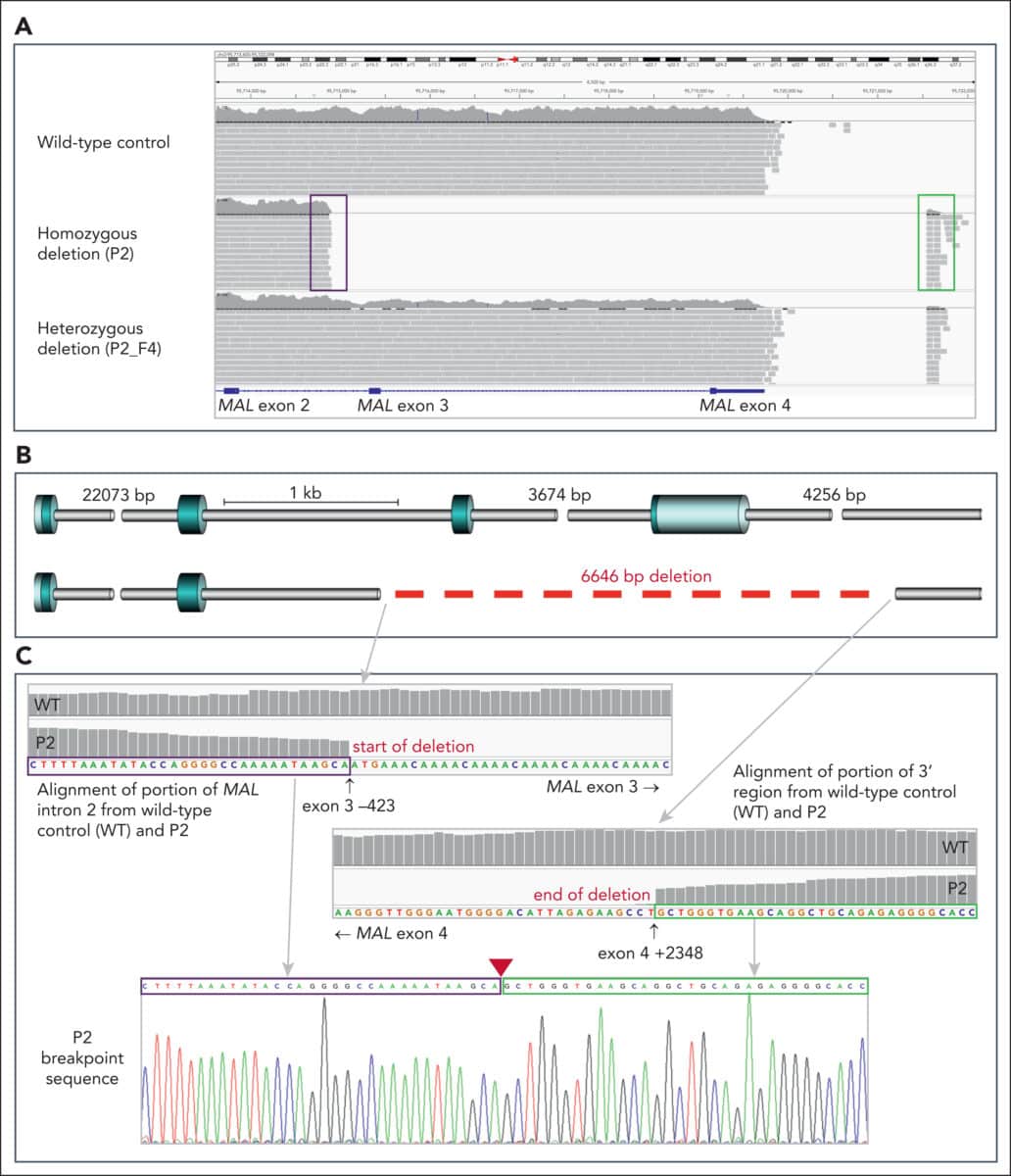
(Blood) (A) Portion of chromosome 2 sequence, spanning MAL exons 2 to 4, from next-generation sequencing (NGS) targeted–panel sequencing of 3 representative individuals. Wild-type sequence is shown in the upper panel, whereas individual P2 (middle) shows no sequencing reads mapping to exons 3 and 4, with reads spanning the deleted area mapping to intron 2 (boxed in purple) and in the region downstream from exon 4 (boxed in green). The bottom panel shows a deletion heterozygote (P2_F4), with only ∼50% of expected reads mapping to MAL exons 3 and 4, and the end of sequencing reads spanning the deleted area is clearly visible, mapping in the same region as with the homozygous deletion sample above. (B) Gene schematic showing deletion break points. Wild-type MAL (top) consists of 4 coding exons (blue cylinders), whereas the AnWj-negative individuals lack exons 3 and 4 and parts of the adjacent introns (gray cylinders). Deletion (6646 bp) represented by dashed red line. (C) Details of portions of MAL intron 2 (upper left) and 3′ region downstream from MAL (lower right) sequence alignment in representative AnWj-negative individual (P2) compared with wild-type control. Sanger sequencing of P2 across the deletion break points is shown in bottom panel; sequence boxed in purple derives from intron 2, whereas sequence boxed in green derives from the 3′ region downstream from exon 4.
The Role of the MAL Gene in Blood Transfusions
Understanding the MAL blood group system has significant implications for blood transfusions. In situations where a patient requires a transfusion, matching blood types is critical to avoid immune reactions, which can be life-threatening. With the identification of the MAL blood group, doctors now have a better understanding of what makes certain patients’ blood unique, allowing for more precise matching in transfusions. For those with the rare MAL blood type, their AnWj-negative status could have previously gone undetected, increasing the risk of adverse reactions during transfusions. This discovery promises to improve patient care, particularly for individuals who may have suffered from mismatched transfusions in the past. As hematologist Louise Tilley pointed out, the new blood group will enable healthcare providers to offer the best care to these patients.
Genetic Mutations and the Impact on Blood Group Systems
The discovery of the MAL blood group system also sheds light on the role of genetic mutations in blood group determination. The case of the 1972 patient who was missing the AnWj antigen was one of the first signs that something unusual was occurring. Over time, researchers realized that genetic mutations in the MAL gene were responsible for this absence. These mutations result in individuals having an AnWj-negative blood type. However, the study also revealed that other blood disorders could suppress the AnWj antigen, suggesting that this genetic variation might not always be inherited but could also be influenced by certain medical conditions.
For the first time, scientists can now test for the presence or absence of the MAL gene to confirm whether a patient’s AnWj-negative blood type is due to inheritance or suppression. This opens up new avenues for diagnosing and treating blood disorders that could lead to antigen suppression, potentially improving patient outcomes and preventing harmful transfusion reactions.
The Importance of Studying Rare Blood Types
While most of us are familiar with the ABO blood group system, which determines whether a person has type A, B, AB, or O blood, there are actually many other lesser-known blood group systems. Some of these, like the MAL blood group, are extremely rare, affecting only a small percentage of the population. Understanding these rare blood types is crucial because they can have a major impact on patient care, particularly in situations involving blood transfusions. The discovery of the MAL blood group underscores the importance of continued research into these less common blood types, as even small variations can have life-altering consequences for those affected. The rare cases that have been studied so far have provided critical information that could save lives, emphasizing the need for further exploration.
First Appeared on
Source link






