


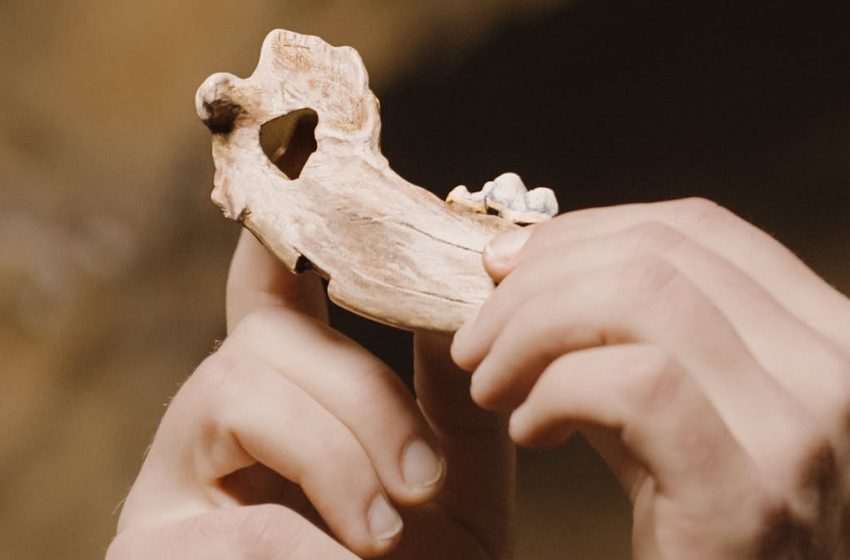
Ancient bones show dogs have been woven into human life for nearly 16,000 years
Odin was a kelpie. Attentive and protective, with a happy smile and an endless hope for food, he succumbed to a terminal disease late last year. At his death, a deep sense of grief ripped through the household of one of us (Andrew): while Odin was not human, he was an irreplaceable member of the family.
Our new research, published in Nature this week, helps explain the unique and striking way dogs like Odin fit into the human world – whether reading our moods, following our movements or becoming part of the rhythm of everyday life.
Based on international collaborations lasting decades, the two new studies have unlocked previously unavailable information from the bones of dogs long dead. Yet these papers are not just about the dusty old bones found in our archaeological sites, or the cutting-edge science applied to them.
They shine light on a relationship that has been part of the human social world for at least 16,000 years.
Andrew Fairbairn
The earliest known dog
Dogs are the earliest known animals to be both tamed and separated from their wild relatives over generations by humans. This process is known as domestication.
It has long been thought that dogs were domesticated from wolves, their closest relatives, during the last Ice Age. Solid evidence to test this has been hard to find in archaeological sites as dog bones are difficult to tell apart from those of wolves using their shape alone.
It has taken the successful extraction of ancient DNA (aDNA), a recently developed technique, to provide definitive identification of dogs, which differ genetically from wolves.
One of the new studies confirmed the earliest known dog is now from Pınarbaşı, a rockshelter site in Karaman, central Turkey. This dog lived around 15,800 years ago.
Excavated in 2004, the bones could have been from either dog pups or wolf cubs. But aDNA analysis confirmed their identity as dogs 20 years later, following 10 years of analysis and comparison with other aDNA results.
The dog pups were buried carefully and treated in death similarly to the humans buried nearby. This continued a close relationship with people during life, as shown by chemical analyses suggesting the dogs and humans shared similar foods, including small fish from the local wetlands. Dogs were not just animals lingering around the edges of campsites. They were already an integral part of human societies.
Integration of dogs into the human social world could have resulted from close cooperation during hunting. Dogs may also have acted as guardians and sentinels for their communities who lived in a world with many dangerous predators such as wolves and leopards.

Kathryn Killackey
Moving with people
The same analysis found dogs genetically similar to those at Pınarbaşı at Gough’s Cave in Britain around 14,300 years ago. This suggests a group of closely related dogs spread rapidly from Eurasia all the way to the far end of Europe, moving with people but also moving between different human communities.
These dogs were not related to European wolves and evidence from the second new study, suggests that European dogs were not domesticated separately to those elsewhere, rejecting a long held hypothesis. Their difference to east Asian dogs is due to the spread into Europe with farmers 8,500 years ago from Turkey of dogs which had interbred with local wolves.
We know this because of the DNA of a dog from our site of Boncuklu, an 11,000-year-old village, near Konya in central Turkey. Our excavations showed that pups were buried in the graves of people directly related to those earlier communities at Pınarbaşı, located 30 kilometres to the southeast, though they lived a very different life in permanent houses supported by small-scale farming.
Genetically related farmers from this region spread into Europe around 8,500 years ago, with dogs also genetically related to those at Boncuklu at their heels. The incoming dogs interbred with those already in Europe, but didn’t replace them entirely.
From the deep past to the present
Together, the studies show that dogs were already living alongside people across a surprisingly wide area from Anatolia to the far edge of western Europe in the last Ice Age, long before farming began, and that their history is older, more mobile and more entangled with human history than we once thought.
The detailed archaeological evidence from Boncuklu and Pınarbaşı show just how close dogs and humans had become and the larger scale analysis sees them repeatedly moving through human networks that crossed cultural boundaries.
We still do not know exactly where and when dog domestication began, and the patient research that will answer that question is already under way in excavations across the world.
But these two new studies make one thing very clear: by the end of the Ice Age, dogs were already deeply woven into human life and had become part of the community, forging deep bonds that continue to this day.
First Appeared on
Source link







