


Ancient Fossils from Southern China Reveal Startling New Clues About Life’s Origins
Fossils from the Weng’an Biota in Southern China, previously thought to be remnants of early animal embryos, are instead traced to entirely different multicellular organisms. This revelation forces a major reevaluation of the timeline for the emergence of animal life, suggesting it occurred later than previously thought. The research, led by a team from the University of Bristol and the Chinese Academy of Sciences, offers new clues about the rise of complex life forms more than 600 million years ago.
Decoding the Mystery of Ancient Fossils
For decades, the fossils found at the Weng’an Biota have been the subject of intense debate. These ancient specimens, some of which resemble early animal embryos, were originally considered the earliest evidence of animal life. However, the new study led by Kirsten Flett challenges these long-standing assumptions.
“The affinity of the embryo-like fossils that we studied, originating from Weng’an in China, has been a topic of debate for decades. We wanted to help resolve this by studying the development of these fossils to discover whether they follow typical development patterns of animal embryos,” explained Flett.
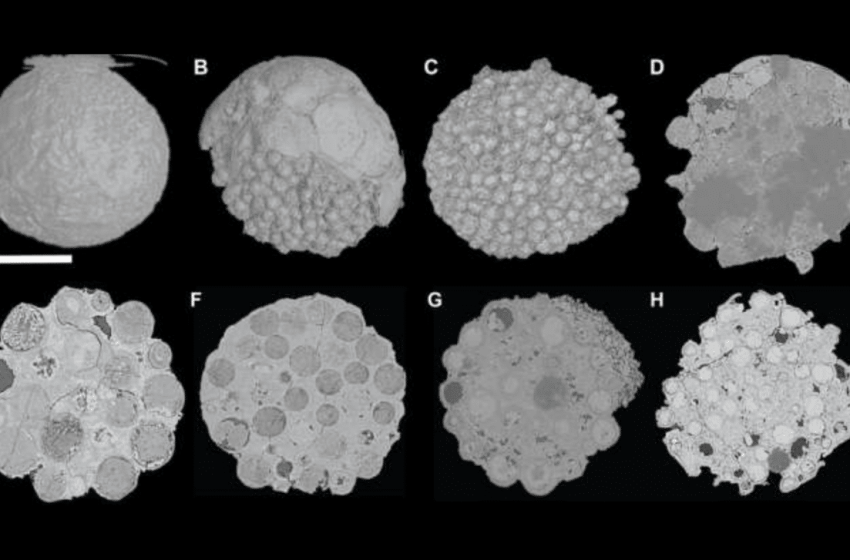
By re-examining the fossils through cutting-edge imaging technology, Flett and her team were able to gain new insights that would have been impossible just a few years ago. Using synchrotron tomography, a powerful imaging technique that produces detailed 3D models, they were able to map the internal structure of the fossils in unprecedented detail. These new scans showed that the embryos did not follow the typical patterns of development observed in known animal embryos, leading the researchers to conclude that these specimens were not the early stages of animal life at all.
Groundbreaking Techniques Reveal New Findings
To reach their conclusions, Flett and her colleagues conducted thorough scans of hundreds of specimens using synchrotron tomography at the Paul Scherrer Institute in Switzerland. The technology allowed the researchers to build detailed 3D models of each fossil and count the number of cells within them.
“After collecting and prepping the specimens, we scanned hundreds of embryos at the synchrotron at the Paul Scherrer Institute, Switzerland,” Flett explained. “Using a technique called computed tomography, I was able to make a 3D model of each specimen and count every cell within 15 specimens to make a training dataset as well as calculate their volume.”
By analyzing the cell division patterns and volume, the researchers were able to detect discrepancies between the fossilized specimens and typical animal embryos. The study, published in Biology Letters, found that the cell division patterns in the Weng’an fossils did not align with those observed in the embryos of known animals or their extinct ancestors. This key finding casts doubt on the theory that these fossils represent early multicellular animals and points instead to a different class of ancient organisms.
What This Means for the History of Animal Life
The implications of these findings are profound. Previously, the Weng’an fossils were seen as strong evidence for a diverse array of animals already existing in the early Ediacaran period, more than 600 million years ago. However, Flett’s study suggests that the true emergence of animal life came later.
“These embryo-like specimens from Weng’an were considered the main evidence for a diversity of animals already existing in the early Ediacaran. However, our results refute this interpretation and instead suggest that animal diversification must have occurred after the deposition of the Weng’an Biota,” said Flett.
This revelation forces a reevaluation of the timeline for the emergence of animal life. Instead of showing an early explosion of animal diversity, the Weng’an fossils now appear to belong to a completely different branch of ancient life. This finding has the potential to reshape our understanding of life’s earliest stages and when animals first began to emerge on Earth.
Next Steps in the Search for Early Life
The study of ancient fossils is far from over. Flett and her team are already planning further research to deepen their understanding of early life.
“I am currently working on a second paper which carries out a comparative analysis between these embryo-like specimens from Weng’an and accepted animal embryos from elsewhere in China to help us distinguish similarities and differences in the preservation of the two,” she revealed.
With more studies on the horizon, the ongoing exploration of these ancient fossils will continue to provide vital clues about how life evolved on Earth, and when the first true animals appeared.
This exciting discovery opens up new pathways for researchers and promises to refine our understanding of the origin and evolution of complex life on Earth, pushing back the timeline for the rise of animals and offering a glimpse into the rich, complex world of ancient multicellular organisms.
First Appeared on
Source link






