


Ancient Weed Contains Water So Strange That Scientists Thought It Came From a Meteorite
Researchers at the University of New Mexico have discovered that a common, prehistoric plant distills water to such an extreme degree that its chemical signature resembles that of meteorites.
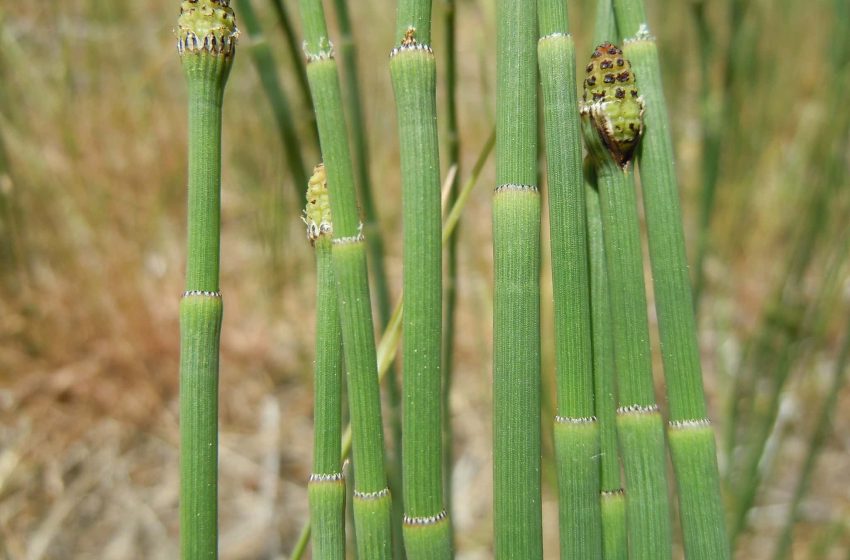
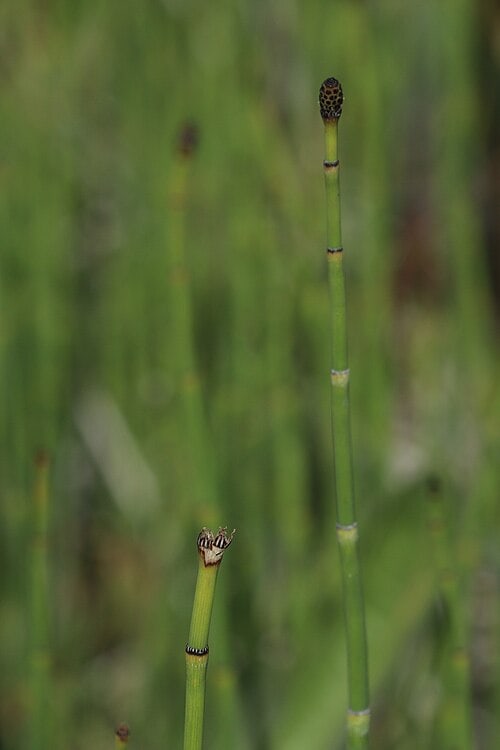
Led by Earth and Planetary Sciences Professor Zachary Sharp, the team investigated the smooth horsetail, formally known as Equisetum laevigatum. This peculiar, hollow-stemmed plant belongs to a lineage that has thrived on our planet since the Devonian period, roughly 400 million years ago.
As water travels up the plant’s segmented stem, it evaporates relentlessly through millions of microscopic pores. This process leaves behind a highly concentrated pool of heavy oxygen isotopes at the plant’s tip.
This intense natural distillation solves a long-standing mystery regarding perplexing oxygen isotope data found in modern desert plants and animals. Furthermore, because ancient horsetails preserved these isotopic records in durable, fossilized silica structures called phytoliths, the discovery provides researchers with a highly sensitive new gauge to reconstruct the humidity and climate of the Earth millions of years ago.
The Ultimate Biological Distiller
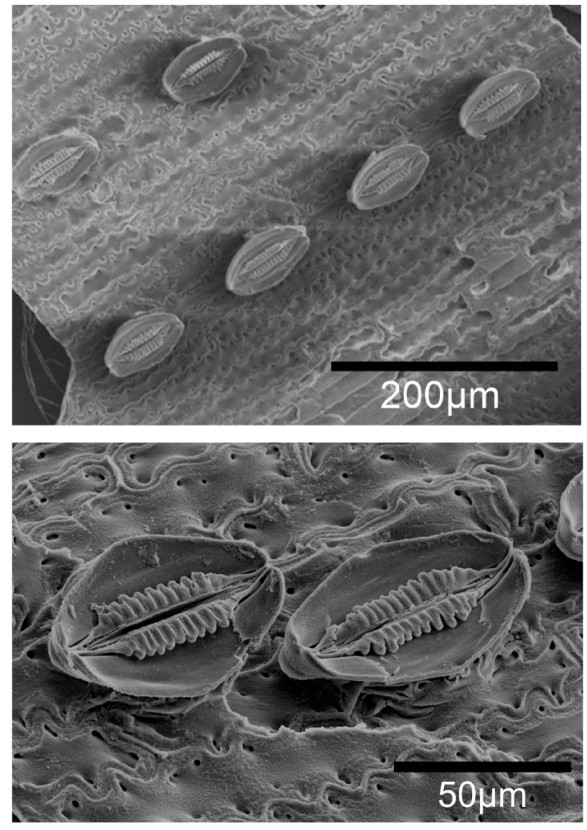
rows, showing prominent silicified thickenings in the subsidiary cells. Credit: PNAS, 2025.
Horsetails grow upright as a series of jointed, hollow segments. Each individual segment contains rows of tiny pores called stomata running along the entire length of the plant.
“It’s a meter-high cylinder with a million holes in it, equally spaced. It’s an engineering marvel,” Sharp said. “You couldn’t create anything like this in a laboratory.”
As the horsetail pulls water up from the soil, it continuously loses moisture to the air through these millions of microscopic pores. This process, called transpiration, fundamentally changes the chemical makeup of the water left inside the plant.
How exactly does this work? It comes down to isotopes. Almost all oxygen atoms in a standard drop of water have eight neutrons, but a tiny fraction of them are heavier isotopes containing nine or ten neutrons. When water evaporates through the horsetail’s stomata, the lighter, easier-to-vaporize water molecules escape into the atmosphere first.
Because the horsetail is essentially a leaky pipe for vapor, this evaporation happens relentlessly in every single segment. By the time the water reaches the uppermost tip of the plant, almost all the light oxygen has vanished. And what is left behind is an incredibly concentrated pool of heavy oxygen isotopes.
Alien Chemistry in a Common Weed
Oxygen isotopes are an important tool in scientists’ kit. By measuring the ratio of heavy to light oxygen in a sample, researchers can determine where water came from, track the humidity of an environment, and reconstruct ancient weather patterns.
However, heavier isotopes occur in vanishingly small amounts. This makes it incredibly difficult for scientists to accurately model how these ratios change under extreme natural conditions, especially in hot, arid environments. Previously, when scientists measured the water inside desert plants and animals, the numbers often made no sense. They simply did not fit the standard laboratory models.
Now, the horsetails growing along the Rio Grande finally clear some things up. Sharp’s team measured the plant’s water from its roots all the way to its tip. They found that the water at the top of the plant reached extreme isotopic values never before documented in any terrestrial material.
“If I found this sample, I would say this is from a meteorite,” Sharp said during the Goldschmidt Geochemistry Conference. “But in fact, these values do go down to these crazy low levels.”
By capturing this extreme natural distillation in action, the researchers successfully refined the mathematical constant that dictates how these isotopes behave during evaporation. When they applied this updated model to their old, confusing data from desert plants, the baffling observations suddenly made perfect sense.
Trapping Time in Nature’s Glass
While explaining modern desert ecology is a major victory, the true power of this discovery lies in explaining the past. Ancient ancestors of today’s horsetails grew into towering behemoths up to 30 meters tall.
As these prehistoric giants pumped water up their massive stems, they actively deposited solid, glassy structures inside their tissues called phytoliths. These microscopic pieces of amorphous silica trap the isotopic signature of the plant’s water as they form. Because the silica resists decay, phytoliths can survive in the fossil record for millions of years, acting as tiny time capsules.
Because the isotope ratios inside the plant are directly tied to the evaporation rate, which is dictated by how dry the surrounding air is, these fossilized phytoliths provide a direct record of ancient climate up to millions of years ago.
“We can use this as a palaeo-hygrometer [humidity measurer], which is pretty cool,” says Sharp.
Scientists must be careful, as the study notes that phytoliths trap an integrated average of the water over time rather than a perfect, instant snapshot. Still, armed with their newly corrected isotopic model, researchers now possess a highly sensitive tool for looking back into deep time.
“We can now begin to reconstruct the humidity and climate conditions of environments going back to when dinosaurs roamed the Earth,” he said.
The findings appeared in the journal PNAS.
First Appeared on
Source link







