


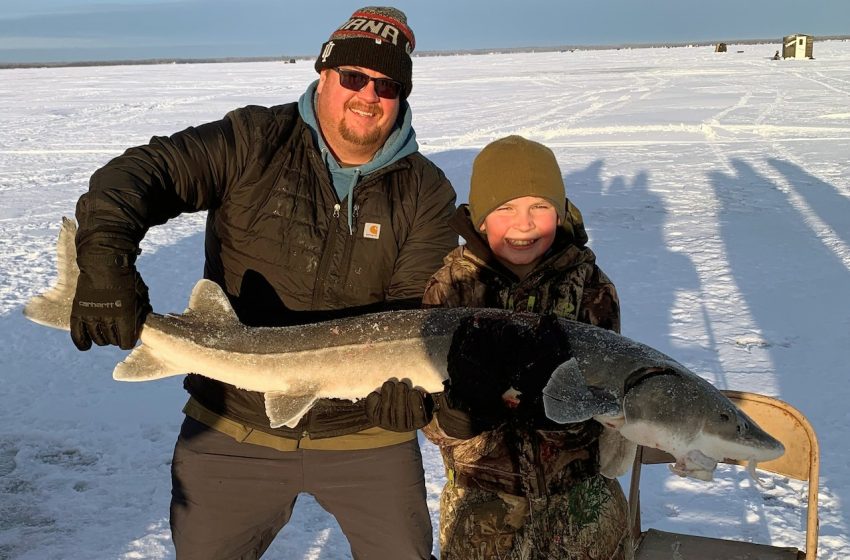
Anglers to race for chance to pull dinosaur fish from Northern Michigan lake
CHEBOYGAN, MI – This famously short fishing season is more race than relaxation.
In 2025, Michigan’s Black Lake sturgeon season was open for just 17 minutes. That’s how long it took for the season limit – six fish – to be reached.
Hundreds of anglers make their way onto the ice each winter, hoping to take home one of these dinosaur-age fish. This year’s season is scheduled for Saturday, Feb. 7. The Michigan Department of Natural Resources again set the season limit at six fish.
Native lake sturgeon are prehistoric fish evolved more than 100 million years ago, widely considered living fossils of the dinosaur age. They can grow up to seven feet long and weigh more than 300 pounds, living as many as 100 years and more in the Great Lakes watershed.
The 2026 season will end when the sixth fish is harvested, when five have been harvested at the end of any fishing day or at 2 p.m. on Wednesday, Feb. 11. Fishing hours are 8 a.m. to 2 p.m. each day. The season has not required a second day in recent years.
The low harvest limit is driven by decades-long conservation and rehabilitation of the prehistoric species.
All anglers must register online by Feb. 6 to participate; those 17 and older must have a valid Michigan fishing license. Get more registration and season information at Michigan.gov/Sturgeon.
Anglers will be notified via text message and on the ice by DNR personnel that they must immediately stop fishing for lake sturgeon.
Participating anglers must bring their own bright red flags (1-foot diameter or larger) to hang on their fishing shanties. Anyone harvesting a lake sturgeon must immediately contact DNR personnel on the ice.
Official registration of each harvested fish will take place at a DNR trailer located on or near the ice at the end of Zollner Road in the northwest part of Black Lake.
Harvest registration may include an examination of the fish’s internal organs and removal of a piece of fin tissue for DNA analysis or aging.
Lake sturgeon rehabilitation efforts in Black Lake over the last two decades have been a collaboration between the DNR, Sturgeon for Tomorrow, tribal agencies, Michigan State University and Tower-Kleber Limited Partnership. This population has increased in the past 20 years due to lake sturgeon rearing and stocking efforts, research and protection of spawning adults; this trend is expected to continue.
First Appeared on
Source link






