


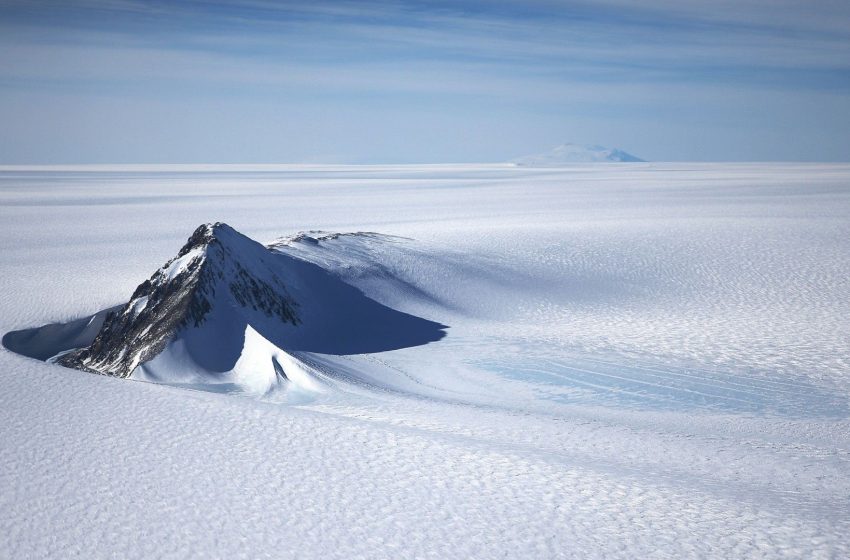
Antarctica’s ‘gravity hole’ reveals the evolution of Earth’s deep interior
A “gravity hole” beneath Antarctica is offering scientists a rare glimpse into Earth’s deep interior, a dynamic record of slow-moving processes that have been reshaping our planet for tens of millions of years.
This immense, gentle low in Earth’s gravity field, formally known as the Antarctic Geoid Low, reflects how mass is distributed deep inside the planet. In a new study led by researchers at the University of Florida, scientists reconstructed how this gravity anomaly has evolved over the past 70 million years, revealing the feature is not a fleeting oddity but a persistent, changing imprint of slow, powerful currents of rock churning thousands of miles beneath Antarctica.
Hidden beneath Antarctica’s ice sheet, the anomaly is not a void, but a signature — a long-lived imprint of Earth’s slow internal engine, continually reshaping our understanding of the dynamic planet below. “It’s a window into deep Earth movements over tens of millions of years, and it shows how processes far beneath our feet can reshape the planet’s gravity field in ways that are surprising and that we can measure today,” study co-author Alessandro Forte, Ph.D., a professor of geophysics at the University of Florida, told Space.com in an email.
The term “gravity hole” can sound alarming, suggesting a local hazard, when in fact the effect on people is imperceptible: a 198-pound (90-kilogram) person would weigh only about 5 to 6 grams less there. Scientifically, however, the anomaly is profound, revealing how material is arranged deep within Earth and how that distribution has evolved over geological time, Forte explained.
“What people call a ‘gravity hole’ is not a literal hole in the ground, and it’s not a place where gravity disappears,” Forte said. “It’s a very broad, gentle low in Earth’s gravity field.”
Gravity varies slightly across the globe because Earth’s interior is not uniform. Hotter, buoyant mantle rock rises; colder, denser slabs of ancient seafloor sink. These slow but massive motions redistribute mass inside the planet, subtly reshaping its gravity field. Where Earth’s gravitational pull is slightly weaker, like Antarctica, the ocean’s gravity-defined “level surface,” called the geoid, sits closer to the planet’s center.
If Earth were covered in a perfectly calm ocean with no winds or currents, the water would settle into broad hills and valleys defined purely by gravity. The Antarctic Geoid Low is one of those valleys — and in geodynamic models, it is the deepest long-wavelength valley on the planet, according to the study.
Reconstructing Antarctica’s gravity low
Using seismic images of Earth’s present-day mantle — built from earthquake waves traveling through the planet — the researchers ran physics-based models backward in time on high-performance computers. Because scientists can only directly observe the mantle as it exists today, reconstructing its past requires simulating how rocks flow over millions of years and testing different assumptions about properties like viscosity, or how resistant mantle rocks are to deformation.
“What surprised me most is how coherent the long-term story appears to be. The gravity low is not a random, short-lived feature,” Forte said. “In our reconstructions it persists through much of the last ~70 million years, but its strength and geometry evolve in ways that are consistent with major reorganizations of the flow of rocks deep beneath Antarctica.”
That persistence is what makes the finding so intriguing. The Antarctic gravity low appears to have intensified around the same time Antarctica transitioned into a permanently ice-covered continent about 34 million years ago. The timing suggests a potentially testable hypothesis: long-wavelength changes in Earth’s gravity field could subtly alter the baseline of regional sea level, potentially influencing ice-sheet boundary conditions.
Today, in the Antarctic geoid low, the gravity-defined sea surface sits about 394 feet (120 meters) below the global average — a striking difference in geophysical terms. Over millions of years, gradual changes in that gravitational landscape could shift how regional sea level is measured relative to the land.
However, Antarctic glaciation was driven by multiple forces, Forte explained, including falling carbon dioxide levels, shifting ocean circulation patterns, and tectonic changes. While the new study does not directly link gravity changes to ice growth, it highlights an internal-Earth process that occurred at the right time and over the right spatial scale to potentially influence the shape of the sea surface.
“Our study shows how deep Earth dynamics can reshape the gravity field over geological time,” Forte told Space.com. “Whether that translated into a measurable influence on climate/ice is a separate question that requires additional coupled modeling and evidence. That, indeed, is the next project we are working on now.”
A window into Earth’s interior
Earth has other large gravity anomalies, but what makes Antarctica’s gravity hole stand out is its unusually large, long-wavelength amplitude and persistence over tens of millions of years. In models that isolate mantle-driven signals, it forms the deepest long-wavelength low on the planet. Forte explained that depending on how Earth’s elliptical shape is accounted for, satellite data can sometimes show the “largest” gravity low elsewhere, but the Antarctic feature remains unmatched in its mantle-driven signature.
Beyond Earth, the study carries implications for planetary science. Long-wavelength gravity anomalies are fingerprints of interior dynamics — clues to how heat escapes a planet, how dense material sinks and how buoyant material rises. On worlds such as Mars and Venus, spacecraft tracking data reveal gravity variations that hint at interior structures and ancient geologic activity.
Earth is unique because gravity measurements can be cross-checked against seismology and the geological record, allowing scientists to reconstruct not just what exists today, but how it evolved — and that evolutionary perspective is the most interesting story, Forte said.
Their findings were published Dec. 19, 2025 in the journal Scientific Reports. The study represents roughly a decade of work, jointly led with first author Petar Glišović, and builds on a long-standing collaboration with UT Austin seismologists, who helped develop the crucial imaging of Earth’s interior, Forte explained.
First Appeared on
Source link






