


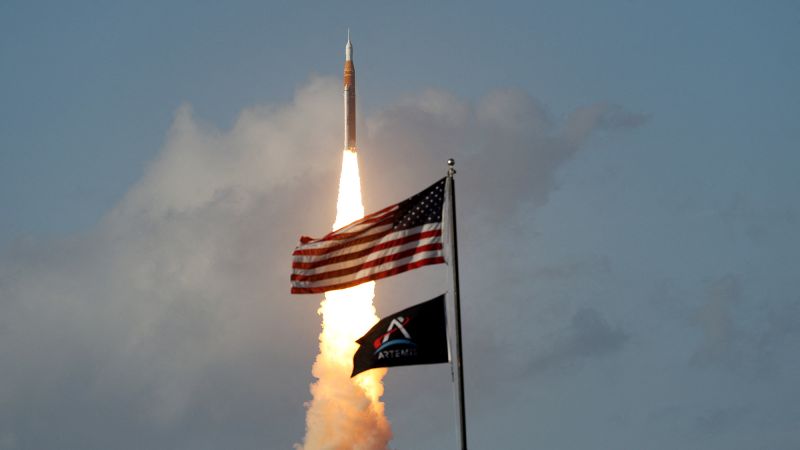
Artemis II launch live updates: Moon mission lifts off
We’ve spent a lot of time worrying about winds, lightning and clouds at the launch site. But weather isn’t just an issue on the ground — it’s also a problem in space.
Along various stretches of Earth orbit, dangerous radiation lingers. And the levels fluctuate, depending on how the sun is behaving.
Our home star occasionally spits out solar flares and coronal mass ejections (CMEs), both of which are responsible for raining that radiation across our solar system.
“Solar flares are the most powerful eruptions in the solar system, the strongest unleashing more energy than a billion hydrogen bombs,” according to NASA.
And it just so happens the sun is currently in a phase called the “solar maximum” — a time of peak activity.
In fact, a massive solar flare spawned over the weekend. But officials says it was fortunately not headed in a direction that poses a threat to the astronauts.
“No or minimal impact for us out of that, as most of the energy is not earthward facing,” said weather official Mark Burger during a Tuesday briefing.
But additional flares — or a coronal mass ejection, in which the sun’s outer atmosphere expels plasma — could be an issue. And one wildcard factor: “Forecasting space weather beyond about three days is quite difficult because coronal mass ejections (CMEs) and other events can have a major impact and cannot be predicted in advance,” said Mike Bettwy, the operations chief at the Space Weather Prediction Center at NOAA.
NASA’s Joe Westlake, the heliophysics division director, told CNN that NASA is actively working to make forecasting better. And NOAA will work alongside NASA mission managers to monitor the sun’s behavior at all times. In case of an issue, the astronauts do have a special shelter they can tuck into, shielding them from a particularly dangerous event.
First Appeared on
Source link






