


Ask Ethan: Do signals degrade as they travel through space?
Here on Earth, signal degradation is a real problem whenever we transmit information to one another. Signals like sound, light, and gravity spread out through space in three dimensions, becoming weaker and weaker as you travel farther from the source. The medium that the signal travels through alters the signal’s properties as well, as an oncoming train sounds different from the air, with your ear to the ground, or from submerged in a body of water. And if there are interfering signals to contend with — like sound or light from additional sources — that “noise” can also degrade the quality of the signal, at least from the perception of the signal’s recipient.
Surely these factors, as well as potential other factors, affect signals as they travel through the expanding Universe, particularly across billions of light-years. But how severe is it? How big of a problem is signal degradation, and is there anything we can do to improve the information we can glean about the original source that generated it? That’s the question of Viraji Ogodapola, who wants to know:
“When light and/or gravitational waves travel such large distances (billions of light years), don’t they ‘deteriorate’ in some way? As in, won’t the strength and the quality of the signal fade over time and distance?”
Signals do change, but the act of traveling through the Universe won’t lead to any sort of deterioration; just an alteration, and one we can usually account for. Here’s the science of what’s going on.
This simplified animation shows how light redshifts and how distances between unbound objects change over time in the expanding Universe. Note that the objects start off closer than the amount of time it takes light to travel between them, the light redshifts due to the expansion of space, and the two galaxies wind up much farther apart than the light-travel path taken by the photon exchanged between them.
In order to arrive at our eyes (or instruments), a signal has to go through a wide variety of environments. From across the distant Universe, there are many potential effects it can encounter: sources of matter and energy, fields of a variety of types and strengths, environments that change, including by gravitationally growing or shrinking over time, and even the expansion of the Universe. From the moment a signal is emitted to the moment it’s observed, an enormous number of factors can affect it, imprinting themselves upon the original signal, and distorting or degrading it from the initial state it possessed when it was first emitted.
However, it’s also possible that whatever signal was emitted will also decay or deteriorate in some fashion above and beyond the details predicted by the physics and astrophysics effects that we know about. That idea was put forth way back in 1929 by Fritz Zwicky, the same Fritz Zwicky who coined the term supernova and was the first to theorize the existence of dark matter. Known as tired light, it was originally an alternative explanation for cosmic redshift: perhaps the wavelength of light isn’t stretching because the Universe is expanding, as illustrated above, but rather because the very act of propagation through space causes it to lose energy very slowly over time.

This animation showcases what happens when a relativistic, charged particle moves faster than light in a medium. The interactions cause the particle to emit a cone of radiation known as Cherenkov radiation, which is dependent on the speed and energy of the incident particle. Detecting the properties of this radiation is an enormously useful and widespread technique in experimental particle physics, and also in astronomy for detecting atmospheric cosmic rays.
This is analogous to an effect that’s known to happen when fast-moving massive particles travel through a medium: they emit radiation due to interactions between the particle-in-motion and the medium itself. There are many types of radiation that charged particles experience:
and it’s conceivable that photons themselves might experience a similar effect just by traveling through the fabric of space itself. That would, if it occurred, mean that some or even all of what we ascribe to being a cosmological redshift would instead be due to a spontaneous deterioration of the initial signal as it traveled through space.
But there would be consequences of light getting tired that would lead to observable effects: effects that are distinct from what would happen in the case of cosmic redshift. One effect would be an energy-dependence on the stretching of light’s wavelengths: shorter wavelengths would lose energy at a different rate than longer wavelengths, leading to a wavelength dependence of the observed light after journeys of hundreds of millions or billions of light years: analogous to the dispersion we see when we pass white light through a prism. Another effect would be the progressive “blurring” of distant sources: where the longer light traveled through the Universe, the less “focused” distant objects appeared. Yet, when we look for both of these effects, we don’t see them. Distant objects appear just as crisp as nearby ones, and light of all wavelengths redshifts by identical factors. Tired light, as a deterioration effect, is ruled out.
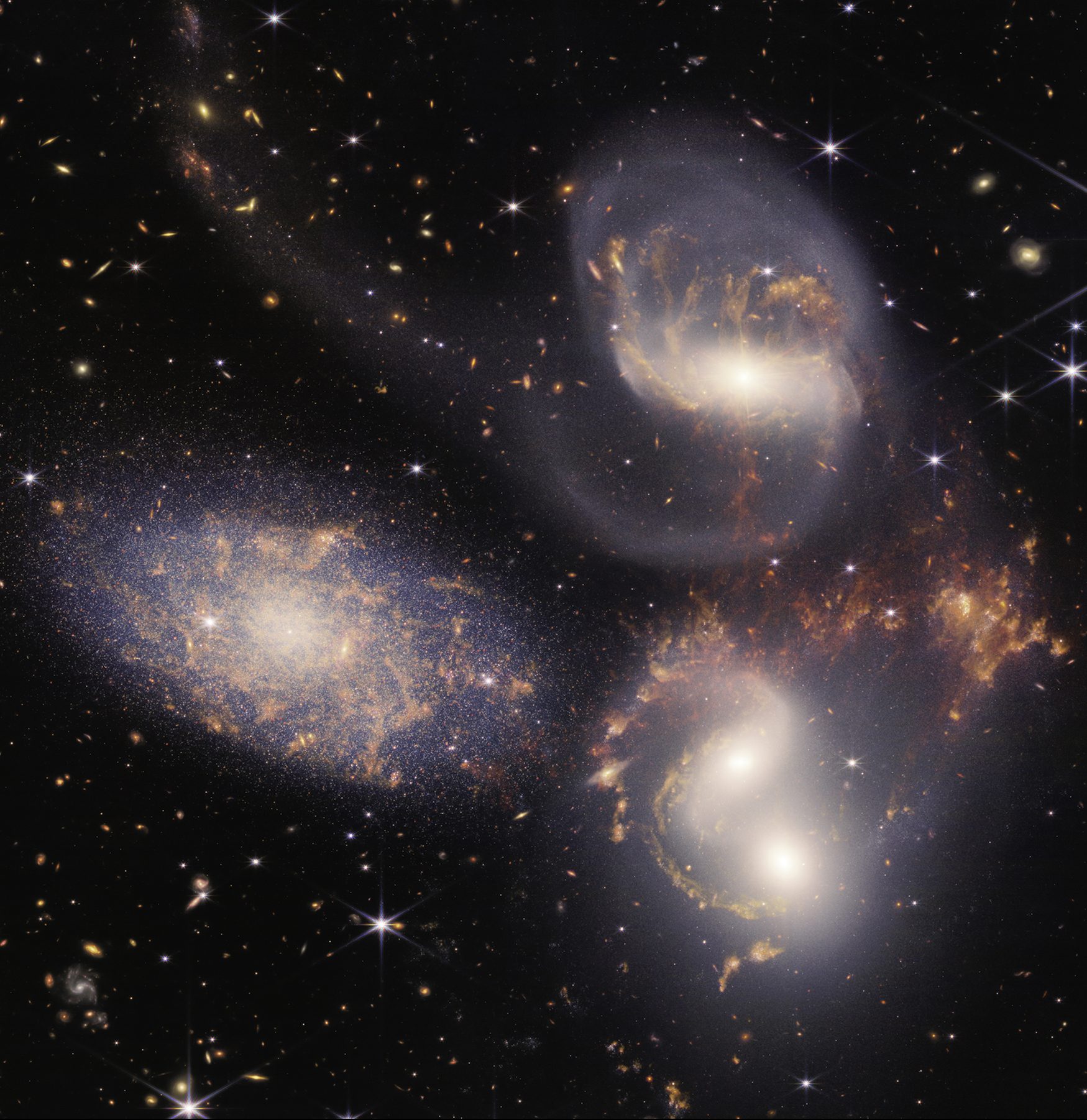
The main galaxies of Stephan’s Quintet, as revealed by JWST on July 12, 2022. The galaxy on the left is only about ~15% as distant as the other galaxies of the quintet, while the background galaxies are many scores of times farther away still. And yet, they’re all equally sharp to JWST’s eyes, demonstrating several factors. Sure, we learn that the Universe is full of stars and galaxies practically everywhere we look, but we also learn that light does not get “tired” in the sense of Zwicky’s tired light scenario; the lack of greater blurring with distance rules that out.
Credit: NASA, ESA, CSA, and STScI
However, the signal that one does observe from a distant object does indeed exhibit a number of important effects. Whether it “degrades” the original signal or causes the original signal to “deteriorate” is a matter of perspective; it depends on what you’re looking for. If you expected the arriving signal to be pristine — identical in strength and properties to the emitted signal — then of course it does degrade substantially. The farther away you are, even if there were no other imprints or alterations, the signal would arrive in a much weaker fashion than how strong it was when it was generated.
That’s for a simple reason: a signal has a certain amount of strength, or total energy, inherent to it. That signal spreads out as it propagates away from a source.
- If it’s a source of particles, those particles spread out in 3D space, with a spherical “pulse” of particles spreading out like the surface of a sphere, with particle densities decreasing as 1/r², where r is the distance from the initial source.
- If it’s a source of light, like a supernova, a star, or an explosive event, that light also spreads out in 3D space, again like a sphere, propagating away from the source, and with the flux density decreasing as 1/r².
- And if it’s a source of gravitational waves, it’s the same thing: the energy spreads out like a sphere. However, because gravitational waves aren’t detected by their energy, but rather by a property known as the strain amplitude, the detectable signal strength doesn’t fall off like 1/r², but rather simply as 1/r.
This effect is illustrated, for light, in the diagram below.
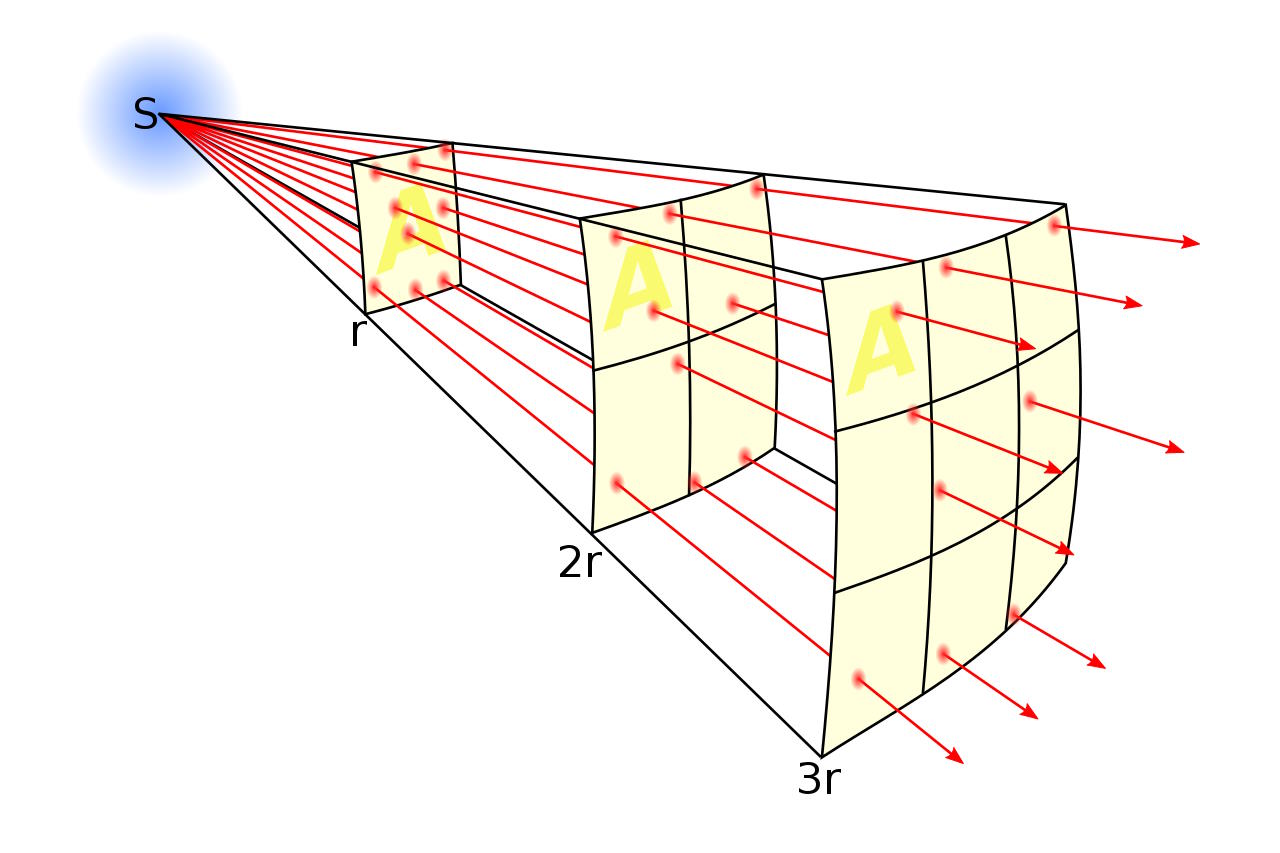
The way that light spreads out as a function of distance means that the farther away from a power source you are, the energy that you intercept drops off as one over the distance squared. This also illustrates, if you view a certain specific angular area (illustrated by the squares) from the perspective of the original source, how larger objects at greater distances will appear to take up the same angular size in the sky. Each time you double your distance between a source and observer, the brightness you observe gets quartered. In general, photons (and all light) propagate spherically outward away from the emitting source.
But that’s not really a signal degrading or deteriorating over time and space, it’s just getting fainter due to the fact that it spreads out as it travels through our three-dimensional Universe. If our Universe had a different number of dimensions, it would spread out differently, which actually provides meaningful constraints on the existence of extra dimensions! The signal gets weaker because of our distance from it, which might make it difficult to detect above the noise floor of the Universe, but that usually just requires longer observation times — what we call longer integration times — to make the “signal” stand out from the noise, assuming it’s a continuously emitted signal.
However, what arrives still won’t be identical to what was emitted, because of all of the effects of “stuff in the way” that have measurable impacts on the (eventually) observed signal. Perhaps the best way to illustrate this is to imagine what happens to that signal, from the moment of its emission through every step along its journey until it arrives at the observer’s eyes or in the observer’s instruments, in a sequential fashion. Even though, again, it’s not necessarily a signal degrading or deteriorating, it is a signal “losing its original quality” because of all of the interfering effects that it experiences along the way.
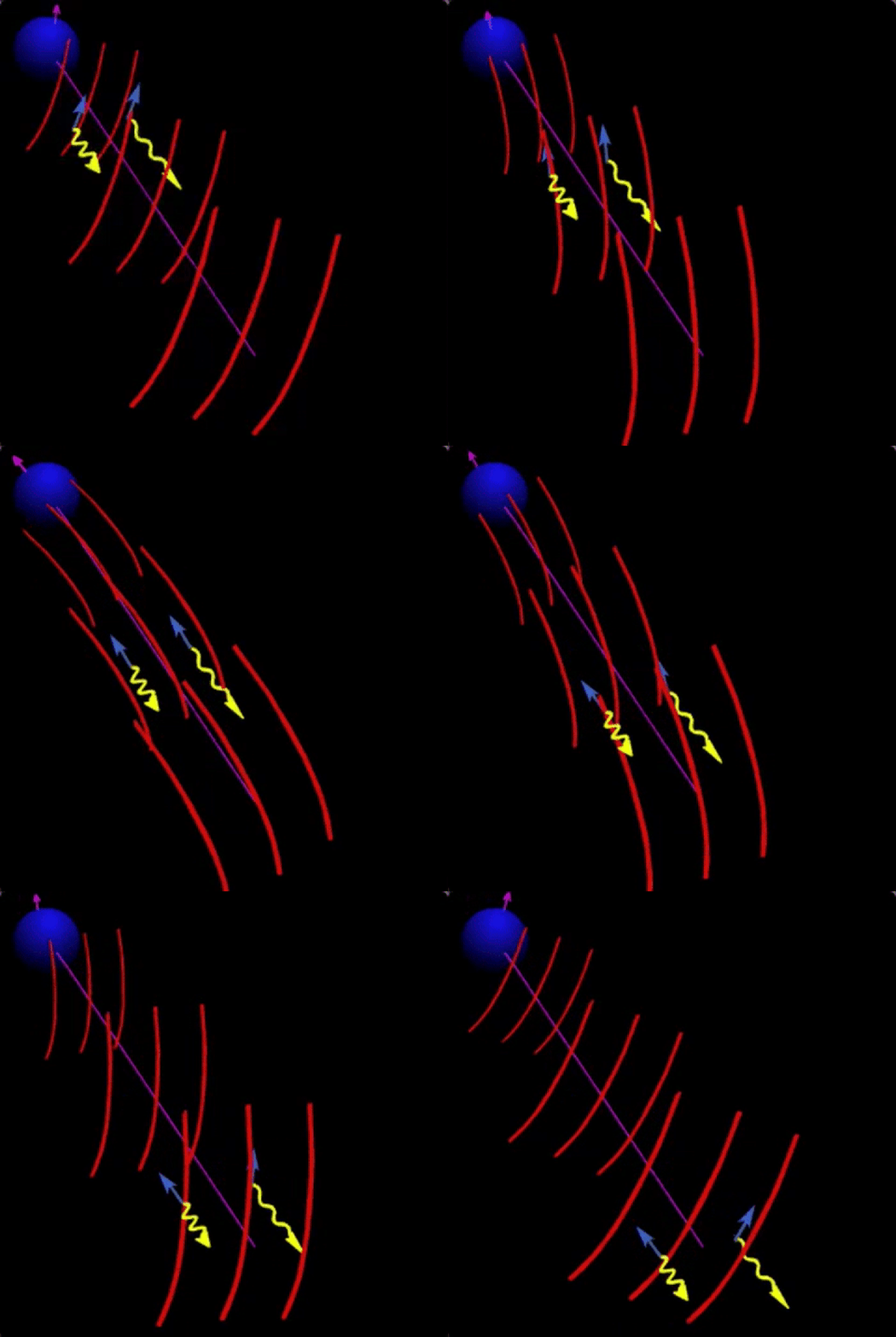
As electromagnetic waves propagate away from a source that’s surrounded by a strong magnetic field, the polarization direction will be affected due to the magnetic field’s effect on the vacuum of empty space: vacuum birefringence. By measuring the wavelength-dependent effects of polarization around neutron stars with the right properties, we can confirm the predictions of virtual particles in the quantum vacuum.
We can begin with the emitted signal itself. The first thing it will encounter, immediately upon being emitted, is the environment around the emitting source. This includes, in order as you propagate away from it:
- the electric and magnetic fields surrounding the emitting source, including the fields generated by the source itself,
- the medium of particles that surround the source, including the imprints of their temperature and ionization state,
- and the strength of the gravitational potential, which causes the outgoing signal, the wavelength of light, gravitational waves, or the kinetic energy of massive particles to lose energy, either redshifting (if massless) or slowing (if massive) as they climb out of it.
That’s three particular and separate imprints on the emitted signal before it ever begins its journey through intergalactic space. This can have effects on things like the signal’s polarization, absorption lines that show up in the spectrum of the signal, by stretching the wavelength of the signal through gravitational redshift, and even, if the medium is hot enough, to boost the energy of the signal through the Sunyaev-Zel’dovich effect: causing it to appear colder in the expected (emitted) wavelengths, but hotter at shorter wavelengths.
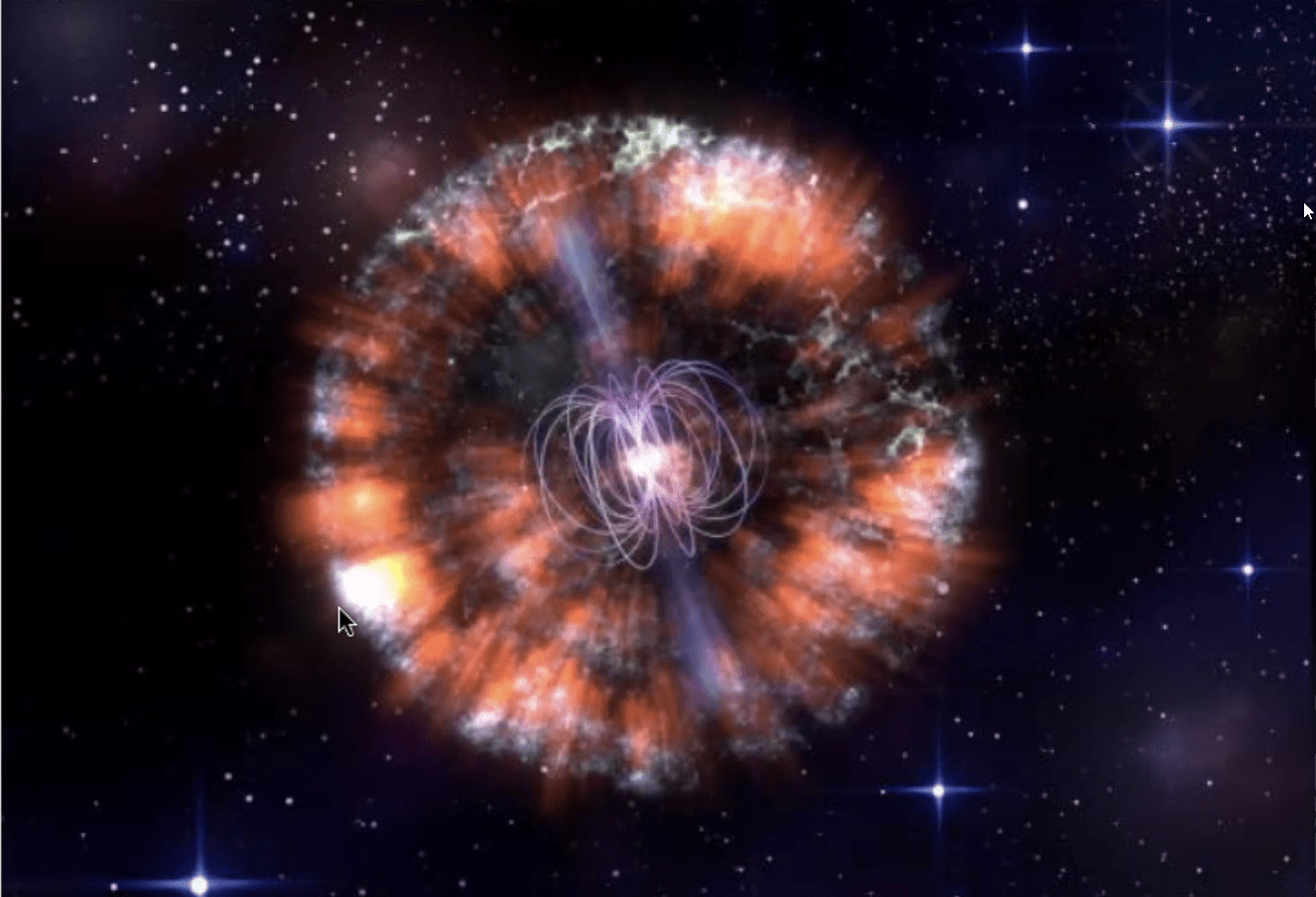
An event like AT2018cow, now known as either FBOTs or Cow-like events, is thought to be the result of a breakout shock from a cocooned supernova. With five such events now discovered, the hunt is on to uncover precisely what causes them, as well as what makes them so unique. In order to understand the light we’re observing from this class of objects, we have to accurately model the environment around it, so that we understand which components of the observed signals are from the explosion and which ones are imprinted from the surrounding material.
Credit: Shanghai Astronomical Observatory, China
Then, as that signal travels through intergalactic space, it’s going to do a number of things. First, it’s absolutely going to redshift. Once you leave a gravitationally bound system, whether it’s a galaxy, a group of galaxies, a cluster of galaxies, or a bound cosmic filament or any other bound portion of the cosmic web, you’ll find yourself not just in the abyss of intergalactic space, but in a region where space itself is expanding. As it expands, the wavelength of any light or gravitational waves traveling through it will lengthen: a cumulative effect that keeps piling up as it propagates from the source to the observer. We know that, particularly at large distances, nearly all of this observed redshift is cosmological, with gravitational redshifts and the redshifts due to peculiar velocities (the relative initial motions of the source and the observer) making up the rest.
But there are plenty of other entities in space, with the most common ones being galaxies, protogalaxies, dark molecular clouds of gas, and the ionized warm-hot intergalactic medium. These signatures typically absorb or emit light in a wavelength-dependent fashion, and so those absorption or emission features can then be imprinted onto the traveling light, but not onto gravitational waves, as these are electromagnetic interactions, and gravitational waves don’t possess those in any way at all. When there’s an intervening cloud of neutral matter in the way, for example, the original signal will be partially absorbed at a specific set of wavelengths by that matter.
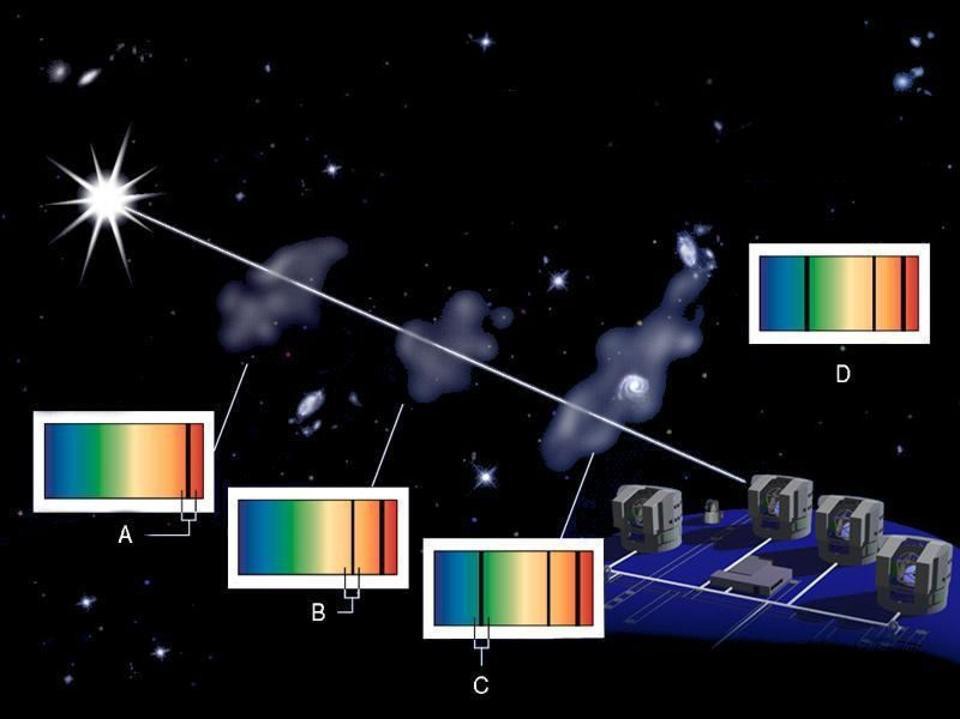
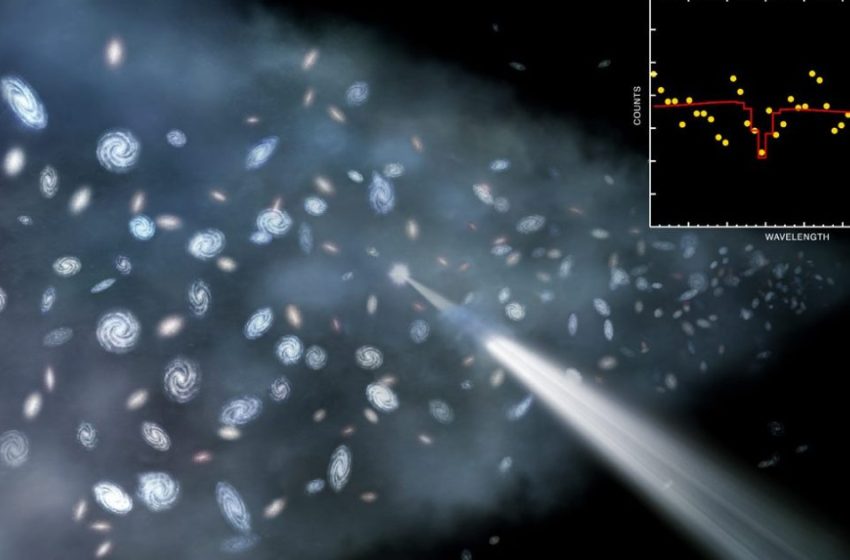
Distant sources of light — from galaxies, quasars, and even the cosmic microwave background — must pass through clouds of normal matter. The absorption features we see enable us to measure many features about the intervening gas clouds, including the abundances of the light elements inside and the degree of ionization.
If there are multiple clouds in the way, you’ll see multiple, independent absorption features, with each unique feature corresponding to the properties of the intervening matter at the specific location — and hence, at a specific redshift and wavelength — it’s found at. This shows up in quasar and galactic absorption lines, as illustrated above, in what’s known as the Lyman-α forest. It’s named as such because quasars are so distant that the sheer number of intervening molecular clouds, and the sheer number of absorption features, means that there are so many of them that instead of a “tree” of an absorption line, what shows up imprinted on the observed spectrum actually looks more like a “forest.”
Of course, there are also regions that have hot, ionized material in the way, such as around active galaxies or in passing through galaxy clusters that have hot, X-ray emitting intracluster mediums. That triggers the thermal Sunyaev-Zel’dovich effect, where the overall spectrum of light gets boosted to higher energies: causing an apparent “coldness” in the expected wavelengths but a “warmness” at shorter wavelengths. (There’s also a kinetic Sunyaev-Zel’dovich effect due to the motions of the particles inside those gas clouds.)
And as these signals, whether light or gravitational wave signals, pass through any region of space that has a significant amount of mass in it, the curvature of space causes them to gain energy, or to gravitationally blueshift. As they exit again, and climb out of that gravitational potential again, they gravitationally redshift. If the structure maintains the same mass and mass distribution, i.e., the same gravitational potential, then these two effects will cancel. But if the structure grows or shrinks, the difference in those potentials will imprint themselves onto the signal: an imprint known as the integrated Sachs-Wolfe effect.
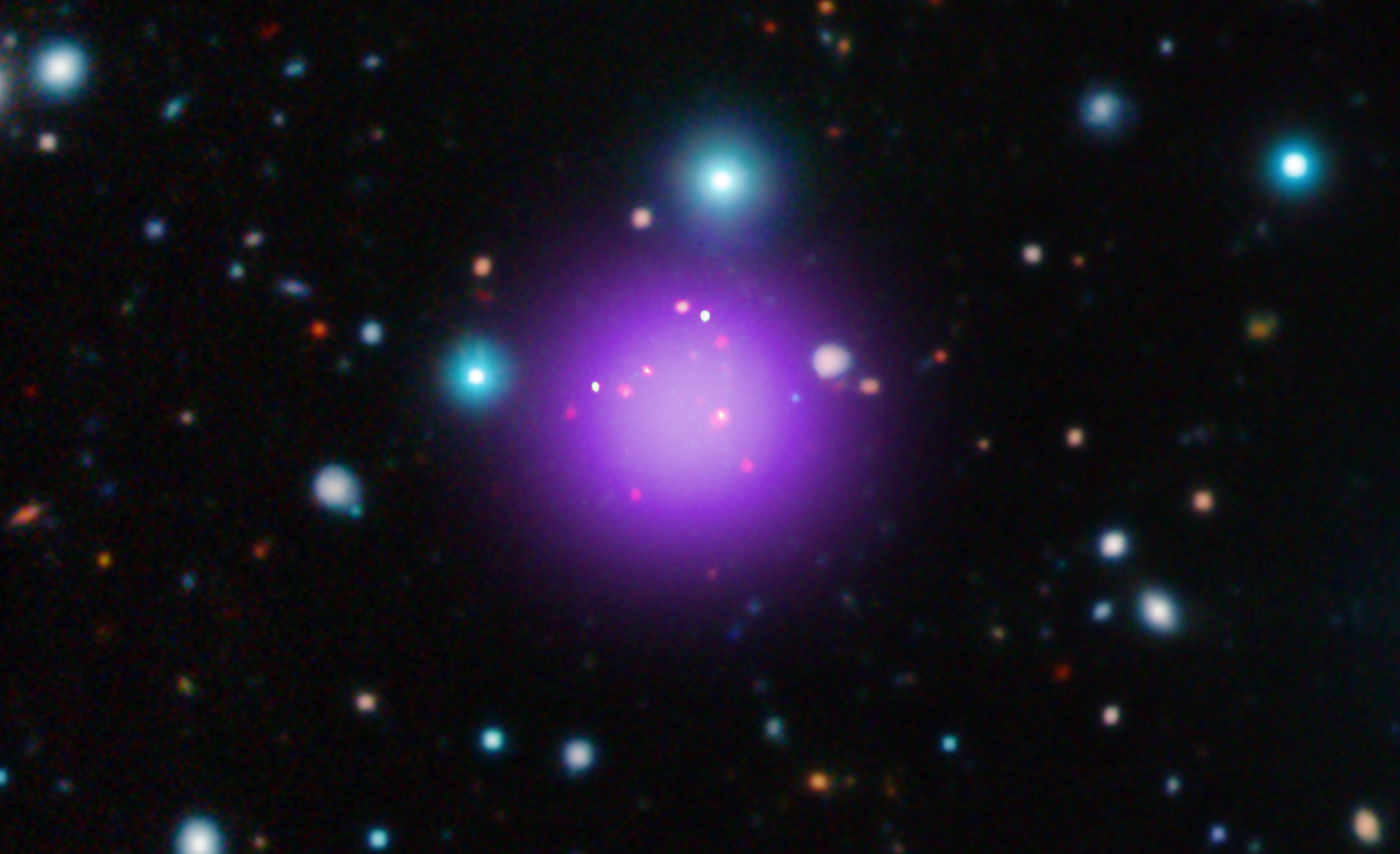
This X-ray/infrared composite image shows galaxy cluster CL J1001+0220, the earliest known mature, X-ray emitting galaxy cluster. Although this was the earliest known galaxy cluster of any type in 2016, several younger protoclusters have since been identified. The light from background objects behind this cluster will be boosted to higher energies on account of the hot, ionized medium that the background light must travel through: the thermal Sunyaev-Zel’dovich effect.
Credits: X-ray: NASA/CXC/Université Paris/T.Wang et al; Infrared: ESO/UltraVISTA; Radio: ESO/NAOJ/NRAO/ALMA
Finally, after all of those effects, the light makes it to the Local Group, the Milky Way, and all the way to us in the Solar System. But once again, there are all sorts of things in the way that affect that signal once more. For gravitational waves, it’s just the gravitational potential, which again creates a gravitational blueshift as the signal “falls into” it. But for electromagnetic signals, like light, there’s:
- the neutral material in gas clouds,
- the light-blocking dust at a specific set of wavelengths,
- the configuration and temperature of atoms, molecules, and ions in the galaxy’s interstellar medium,
and similar effects along these lines. This can induce all sorts of changes, from the average temperature observed to the polarization of the arriving light. In general, the intervening material will imprint itself onto your light, no matter where it comes from, and it’s up to you — the observer who receives and analyzes this data — to disentangle the various effects.
By the time you observe this light, it is no longer identical, in all of these ways, to the original light that was emitted by the source. It is fainter, it is more susceptible to the various sources of noise in our instruments and that are associated with our modern measurement techniques, and it has potentially all of these aforementioned effects imprinted on it. We have to be able to properly account for all of them, wherever it’s relevant, if we wish to extract correct information about the source. When there are limits to how well we can disentangle these effects, there are induced uncertainties: including in the location and properties of every distant object we observe.
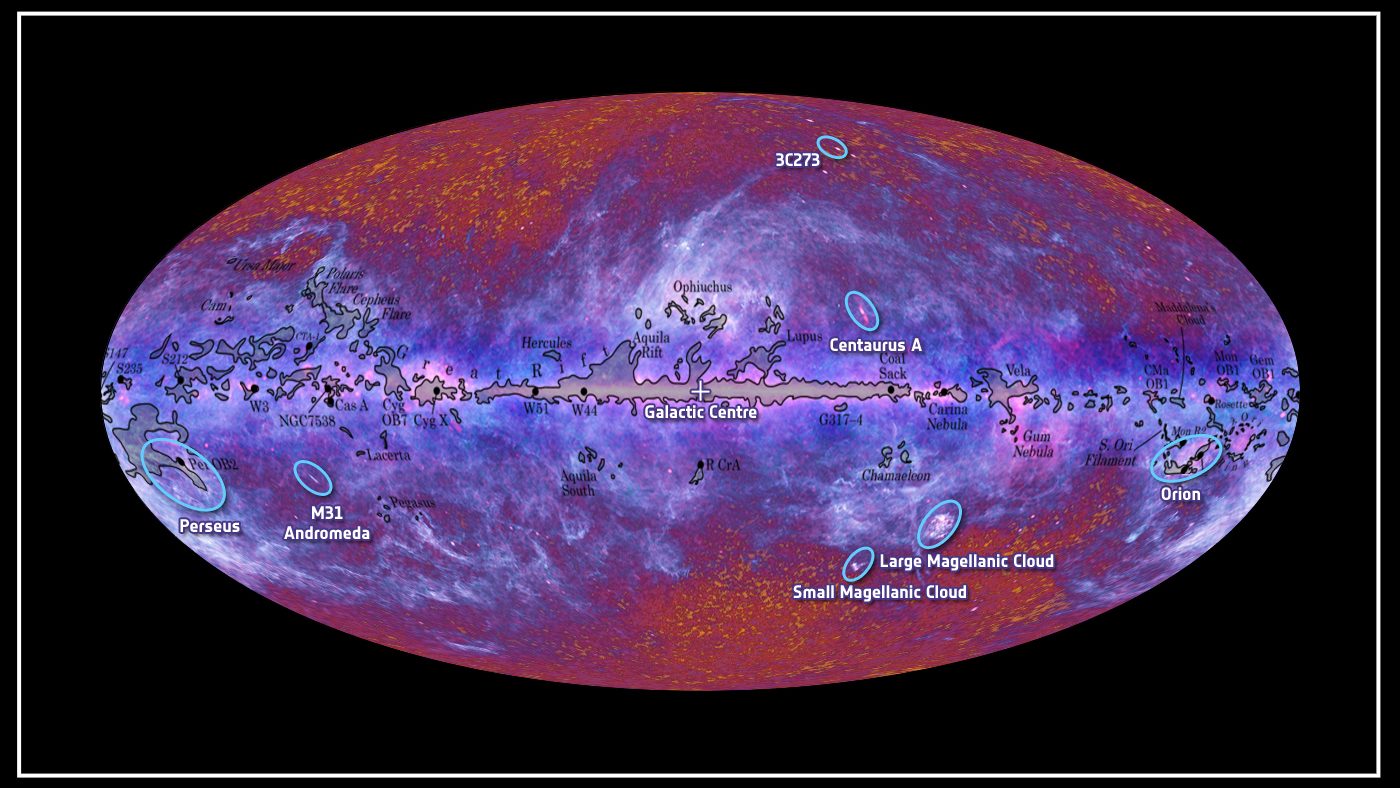
When the entire sky is viewed in a variety of wavelengths, certain sources corresponding to distant objects beyond our galaxy are revealed. This first all-sky map from Planck includes not only the cosmic microwave background, but also extragalactic contributions and the foreground contributions from matter within the Milky Way itself. All of these must be understood to tease out the appropriate temperature and polarization signals.
And yet, it’s a testament to how far we’ve come, scientifically, that we can do precisely this for a wide variety of astronomical objects. We have an old saying in astronomy: that one astronomer’s signal is another astronomer’s noise. Different sub-fields are often pitted against one another for a variety of reasons, but the truth is that we need astronomers studying all of these various aspects — because they’re interested in them and because they want to untangle and solve all of the mysteries within their particular field — in order to improve our ability to extract meaningful, correct information about all aspects of the Universe.
If you want to understand the CMB, the relic radiation from the Big Bang, then you have to understand the foreground emission of the galaxy and the properties of the interstellar medium. If you want to understand the abundances of the light elements from pristine gas clouds, you need to understand the specifics of quasar absorption in the intergalactic medium. If you want to understand the nature of various classes of supernovae, you need to understand the physics of the dust that enshrouds them. These are not “sub-fields at war” with one another; these are complementary sub-fields, and improving the uncertainties in any one of them helps us reveal the deeper truth underlying all of the others.
Sure, you can view a journey through the Universe as the “degradation” or “deterioration” of the emitted signal, because it gets less powerful and less pristine at every step along its cosmic journey. However, the way that it gets less powerful and obtains more imprints throughout its travels teaches us not just about the source, but about everything that lies between it and ourselves. That provides useful information about the Universe that we couldn’t get in any other way, and that’s how I prefer to view it!
Send in your Ask Ethan questions to startswithabang at gmail dot com!
First Appeared on
Source link






