


Ask Ethan: Does dark energy curve the Universe over time?
Whenever you have a Universe like ours — governed by general relativity and full of different types of energy — there are many different possible outcomes. Your Universe could tear itself apart, driving objects away from one another faster and faster, with no limit in sight: a Big Rip. Your Universe could expand forever, leading to an eventual cold, empty fate. Your Universe could exist in perfect harmony, where the expansion rate drops to zero, but never reverses course and recollapses. Or your Universe could reach a maximum size, begin contracting, and eventually meet its demise in a catastrophic Big Crunch.
However, despite the wildly different possibilities that reflect your Universe’s ultimate cosmic future, there’s only one major factor that determines that fate: the sum total of all the different forms of energy present in your Universe, and how it compares to the initial expansion rate. For a long time, we thought that measuring the curvature of the Universe would reveal the answer to that question, but all of that changed with the discovery of dark energy. So how does dark energy alter the story? That’s the question of Dominik Kruppa, who asks:
“I guess the dark energy, as we measure it now, makes the curvature a bit more negative as time goes by. So if we want to know what flavor of inflation actually occurred (this depends on curvature), we must subtract the exact effect of dark energy. This should be possible. Is it true?”
It’s a fascinating and deep question: one that takes us into the heart of the physics that governs the expanding Universe. Let’s start way back at the beginning, and come forward, step-by-step, to discover the answer.
A photo of Ethan Siegel at the American Astronomical Society’s hyperwall in 2017, along with the first Friedmann equation at right. The first Friedmann equation, an exact solution in general relativity, details the Hubble expansion rate squared on the left hand side, which governs the evolution of spacetime. The right side includes all the different forms of matter and energy, along with spatial curvature (in the final term, which can be ignored in a flat Universe), which determines how the Universe evolves in the future. This has been called the most important equation in all of cosmology and was derived by Friedmann in essentially its modern form back in 1922.
What you see, above, is known as the first Friedmann equation: often called the most important equation in all of cosmology. Derived by Alexander Friedmann all the way back in 1922, the Friedmann equation applies to any Universe that is both isotropic and homogeneous. What that means is as follows.
- Isotropic: a Universe that is the same in all directions. Whether you look up, down, left, right, forward, or backward, you see the same Universe with the same properties. In other words, an isotropic Universe has no preferred direction.
- Homogeneous: a Universe that is the same in all spatial locations. Wherever you happen to be located, regardless of where you move yourself to, you’ll see a Universe with the same properties that you see exactly where you are. In other words, a homogeneous Universe has no preferred location.
If you have a Universe that is both isotropic and homogeneous — the same in all directions and the same at all locations, especially in terms of energy density — then that Universe cannot be both static and stable. Instead, that Universe must evolve over time (the idea that perhaps it was homogeneous in time as well has long since been discredited), and the specific type of evolution that is mandated is either expansion or contraction.
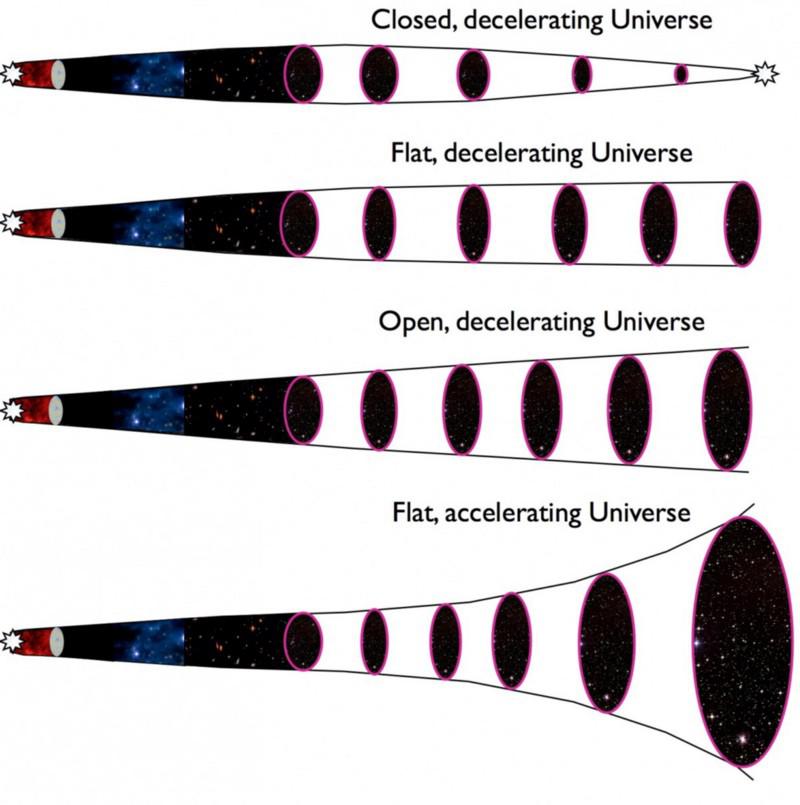
The expected fates of the Universe (top three illustrations) all correspond to a Universe where the matter and energy combined fight against the initial expansion rate. In our observed Universe, a cosmic acceleration is caused by some type of dark energy, which is hitherto unexplained. All of these Universes are governed by the Friedmann equations, which relate the expansion of the Universe to the various types of matter and energy present within it.
The equations themselves don’t tell you which solution is the correct one, mind you. If I were to ask you what the square root of the number 4 is, you could rightfully give me two answers: +2 or -2, as both could lay equal claim, mathematically, to being correct. Physics is not mathematics, however, and any Universe will indeed only have one correct answer as to whether it’s expanding or contracting: an answer that must be determined observationally, by measuring the Universe itself.
What the equations do tell you, however, is whether the “total amount of stuff” in the Universe, including everything that has energy in any form, is greater than, less than, or equal to the rate of expansion (or contraction) at any particular moment in time. That’s because the equation represents the relative balance — or, potentially, imbalance — between:
- what’s on the left-hand side of the equation, which is the rate of expansion or contraction of the Universe,
- and what’s on the right-hand side of the equation, which is the sum total of all the different forms of energy in the Universe combined together.
If the two sides are exactly equal, then there’s no problem: the Universe balances, and the spatial curvature remains flat.
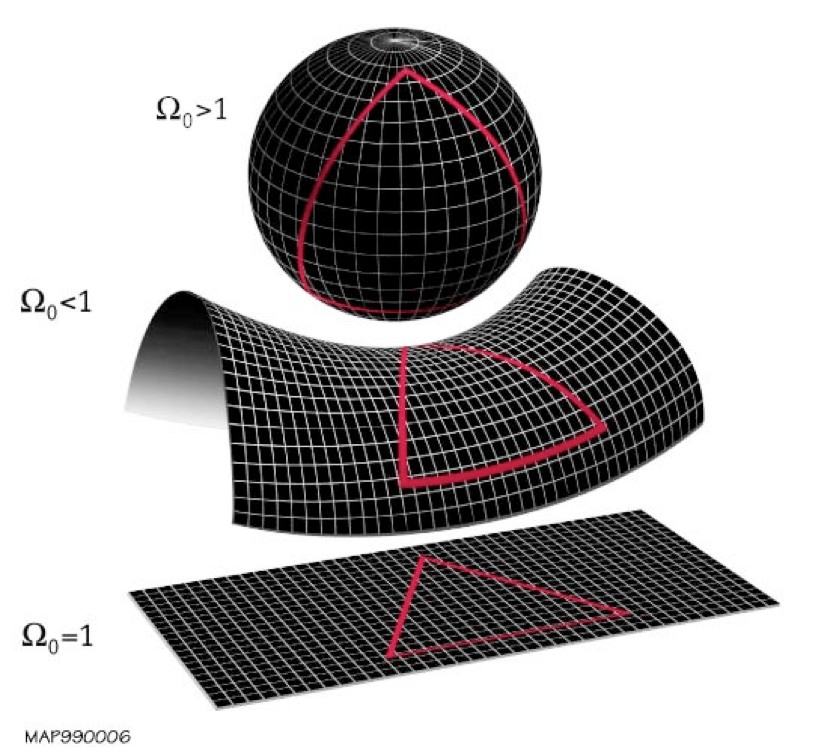
The angles of a triangle add up to different amounts depending on the spatial curvature present. A positively curved (top), negatively curved (middle), or flat (bottom) Universe will have the internal angles of a triangle sum up to more, less, or exactly equal to 180 degrees, respectively. Advances in non-Euclidean geometry preceded their application to physics.
However, there are two other options besides flat that can occur. (Because we’ve observationally verified that, at least right now, our Universe is expanding, we’re going to proceed by assuming that the Universe we’re considering is expanding, rather than contracting.) If the expansion rate (the left-hand side) and the total energy density (the right-hand side) don’t exactly match, then you have another term that arises in the equation: a term representing spatial curvature, as illustrated above.
- You could have a Universe where the expansion rate is deficient compared to the total amount of energy within it. If that’s the case, then the curvature term that comes in to the right-hand side has to be positively curved, which corresponds to the higher-dimensional analogue of a sphere: a surface of positive curvature.
- You could, alternatively, have a Universe where the expansion rate exceeds the corresponding total amount of energy within it. That case corresponds to the curvature term that enters the right-hand side being negatively curved, which corresponds to the higher-dimensional analogue of a saddle or a Pringles chip: a surface of negative curvature.
You can construct these surfaces yourself simply with a piece of paper. Cut a pizza slice out of one sheet of paper and tape the two edges of your cuts together: you now have a surface of positive curvature, where if you draw a triangle on it (where the triangle includes the pasted cut), the sum of the three angles of the triangle will be greater than 180°. If you then take another piece of paper and make just one cut and insert the slice you made earlier into it, you’ll now arrive at a surface of negative curvature. This time, if you draw a triangle on it (including the insert), your triangle’s three angles will sum to less than 180°.
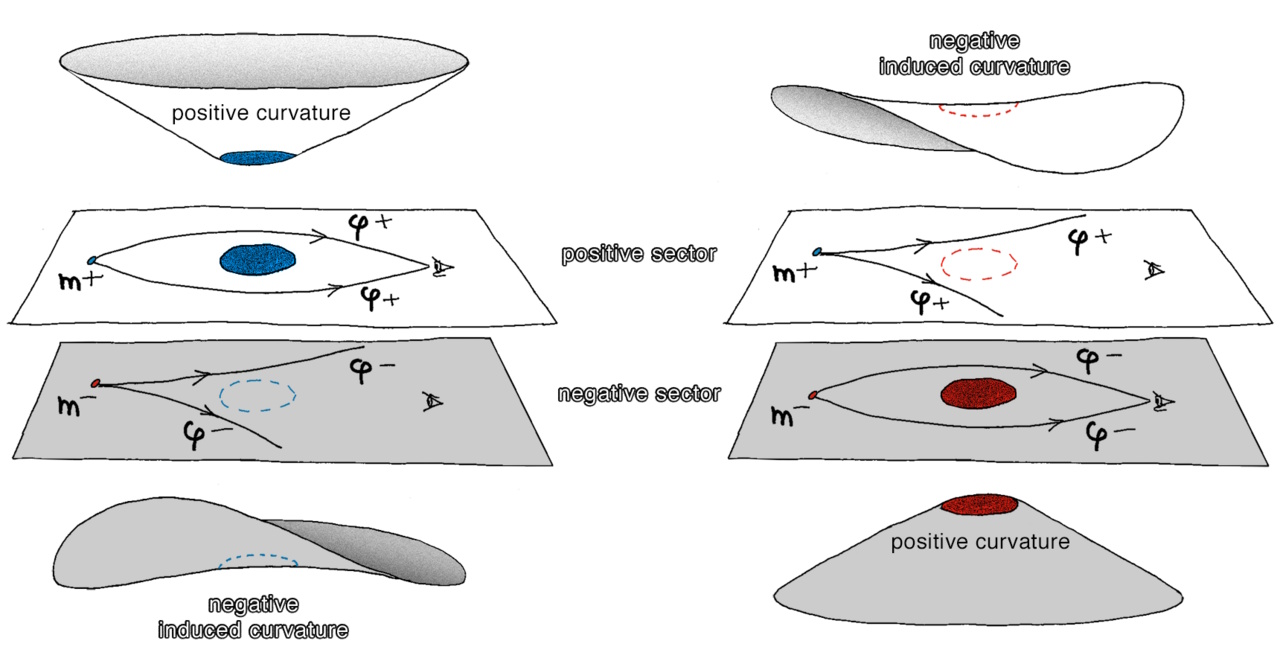
If you take a flat piece of paper and cut out a pizza-slice-shaped slice from the middle and tape the cut-out edges together, you’ll get a surface of positive curvature, where the angles of a triangle sum up to more than 180 degrees. If you then take that cut-out slice and cut a slice in a new sheet of paper and paste the slice into it, you’ll arrive at a surface of negative curvature. If you draw a triangle on that surface, its angles will sum to less than 180 degrees.
That’s how spatial curvature works. Back during most of the 20th century, there was an assumption we made that made sense at the time, but didn’t necessarily account for the full suite of what was possible in our Universe. We assumed that the allowable forms of energy in our Universe were made of matter and radiation, and potentially antimatter, and maybe some form of dark matter, but that it was all matter and radiation of some type or another. That’s why, for generations during the 20th century, it was often said that modern cosmology was a quest to measure two numbers: the expansion rate of the Universe, also known as the Hubble constant, and what we called the deceleration parameter, or a measure of how the expansion rate changed (and specifically, decreased) over time.
The reason is this: we measure that the Universe is expanding, today. If you extrapolate that expansion farther into the future, the matter and radiation densities will both dilute. Matter gets less dense because the number of matter particles remains fixed, but since the Universe is expanding, the volume that those particles occupy increases. Since density is the total amount of energy (or, equivalently via E = mc², mass) per unit volume, an expanding Universe dilutes the matter density. For radiation, the situation is even more severe: not only does the number of photons-per-unit-volume dilute, but the wavelength of each quantum of radiation gets stretched as it travels throughout the expanding Universe.
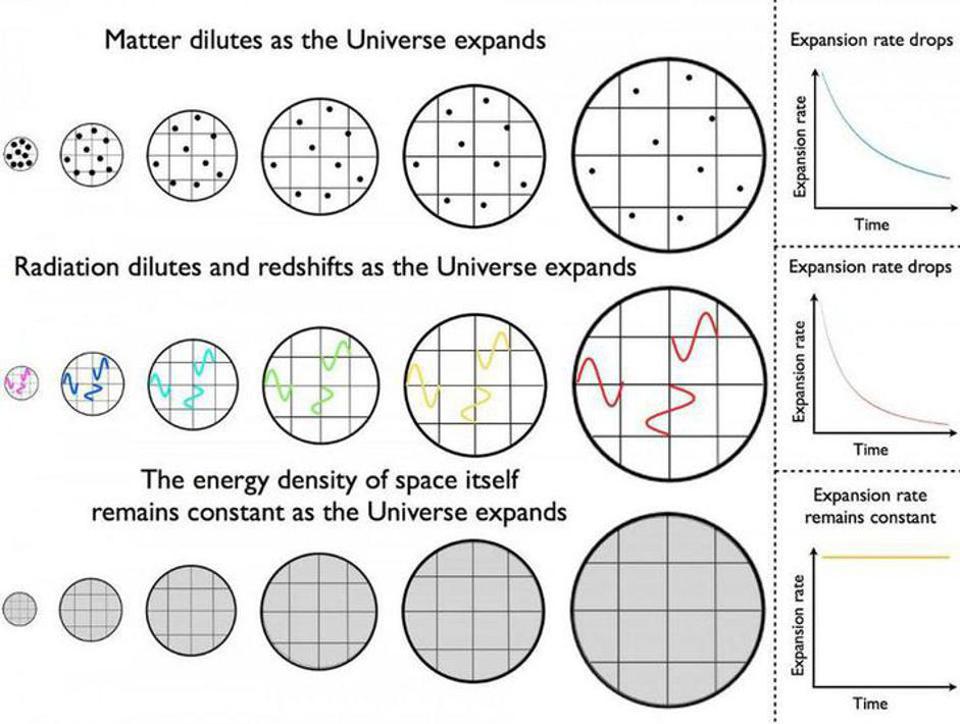
While matter and radiation become less dense as the Universe expands owing to its increasing volume, dark energy is a form of energy inherent to space itself. As new space gets created in the expanding Universe, the dark energy density remains constant.
Therefore, you might think that the fate of the Universe depends on that initial expansion rate, and whether it was larger, equal to, or smaller than the initial matter-and-radiation density. That’s what we expected to find for a very long time. Therefore, when we finally began making very good measurements of the matter and radiation densities in the Universe, which finally occurred in the 1980s and 1990s, we got a bit of a surprise. The matter density turned out to be only about 30% of the critical density, and radiation — so important when the Universe was young, hot, and dense — was negligible by today, hanging out at only around the ~0.1% level.
Did this mean that the Universe was actually curved, and specifically, negatively curved (with the total density below the value it would have needed to match the expansion rate), instead of flat?
If there were only matter and radiation as the meaningful forms of energy in the Universe, then yes, that’s what it would have implied. Early on, close to the hot Big Bang, when densities, temperatures, and energies are large, the expansion rate and the energy density must match, or if they don’t match, they must come extremely close to matching one another. If they don’t, then:
- either the energy density is much lower than the expansion rate, which would swiftly drive all particles apart from one another, creating a Universe where no galaxies, stars, or even atoms could form,
- or the energy density is much greater than the expansion rate, which would lead to a swift cessation of the expansion, followed by a reversal (contraction) and recollapse, culminating in a Big Crunch.
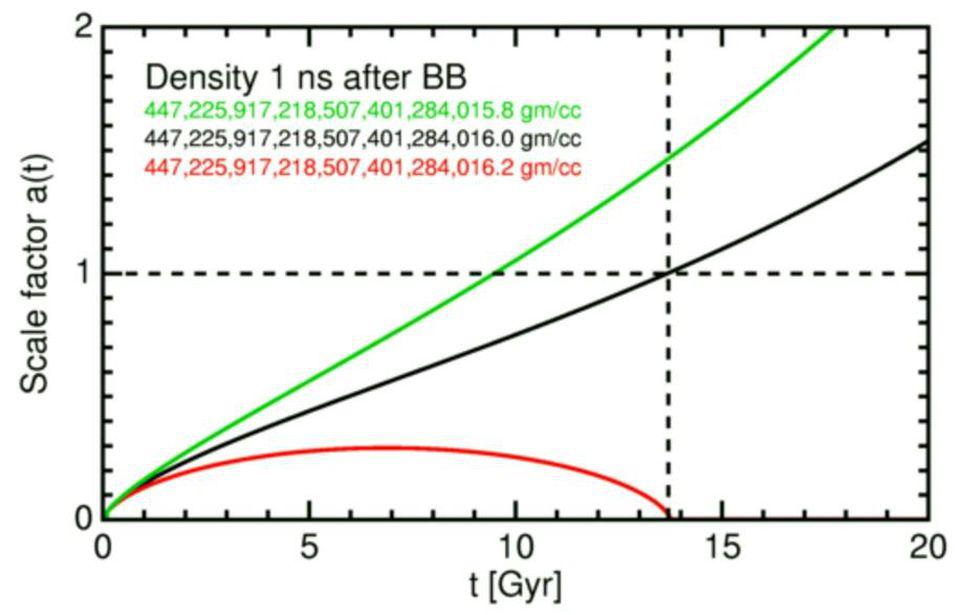
If the Universe had just a slightly higher matter density (red), it would be closed and have recollapsed already; if it had just a slightly lower density (and negative curvature), it would have expanded much faster and become much larger. The Big Bang, on its own, offers no explanation as to why the initial expansion rate at the moment of the Universe’s birth balances the total energy density so perfectly, leaving no room for spatial curvature at all and a perfectly flat Universe. In regions that are overdense, the expansion can be overcome.
The fact that the Universe has survived for so long — and 13.8 billion years is indeed a long time — teaches us that the overall energy density and the expansion rate matched very closely, at least, initially. However, as the Universe expands and the matter and radiation densities dilute, then any curvature that did initially exist, even if it was initially extremely tiny, would eventually appear and become important. If the Universe is diluted enough, that curvature term could even someday become dominant!
However, our version of the cosmic story that favored an underdense, negatively curved Universe never fully caught on, and even if it had, it wouldn’t have lasted long. That’s because in the late 1990s, just as the matter density was finally becoming firmly established as being significantly below 100% of the energy density, we measured something that indicated that the Universe wasn’t expanding as though it were being dominated by a mix of spatial curvature and matter. If all you have are matter, radiation, and spatial curvature, your Universe will always decelerate, which means that if you observed a distant galaxy over time, you’d watch it recede from you, but its recession speed would appear to drop and drop over time.
Instead, as first shown by distant supernovae in the late 1990s by two independent teams, the recession speeds of objects beyond about 18 billion light-years away increases over time: the Universe is accelerating. And that means, instead of being a mix of radiation, matter, and curvature, our Universe was instead dominated by dark energy, which — along with matter and radiation — made up the entirety of the cosmic energy budget.
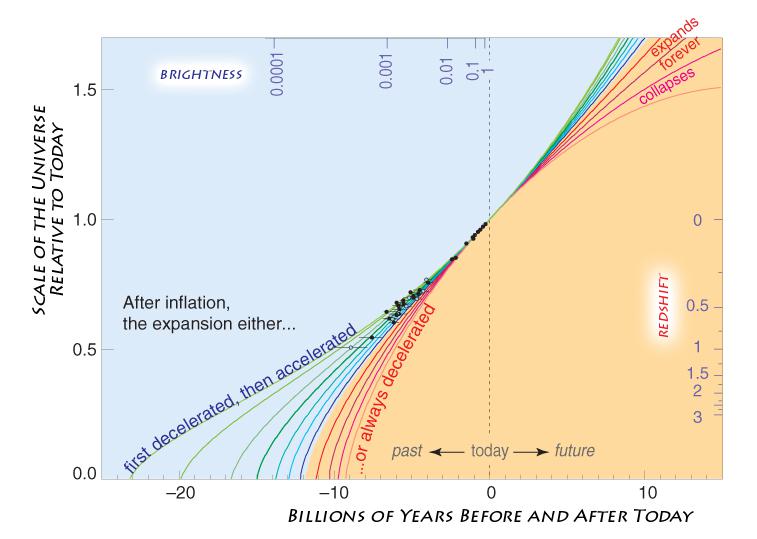
Measuring back in time and distance (to the left of “today”) can inform how the Universe will evolve and accelerate/decelerate far into the future. By linking the expansion rate to the matter-and-energy contents of the Universe and measuring the expansion rate, we can come up with an estimate for the amount of time that’s passed since the start of the hot Big Bang. The supernova data in the late 1990s was the first set of data to indicate that we lived in a dark energy-rich Universe, rather than a matter-and-radiation dominated one; the data points, to the left of “today,” clearly drift from the standard “decelerating” scenario that had held sway through most of the 20th century.
Now, here’s the fun thing, which enables us to get back to the original question. If all we had was a mix of radiation, matter, and curvature, what we would have found is the following:
- Early on, the radiation would dominate the cosmic expansion and be primarily responsible for determining the expansion rate. However, radiation would dilute the fastest, meaning its energy density drops faster than the other components.
- Once the radiation density drops sufficiently, matter becomes dominant, with the matter density then dominating the cosmic expansion rate. After a while, however, the matter density drops sufficiently that if there are any other components, their (more slowly-decreasing) effects will begin to appear.
- And then, if there were curvature present in significant amounts, curvature would begin to dominate the Universe’s expansion rate, taking over where matter left off.
This all assumed that radiation, matter, and curvature were the only allowable components to the Universe. But other possibilities aren’t forbidden as well: topological defects like monopoles, cosmic strings, domain walls, or cosmic textures, for one, and — more relevant to our Universe — dark energy, for another. Assuming dark energy is a cosmological constant, there’s another step we need to add in.
- Because dark energy’s density doesn’t dilute, then as the next-slowest component of the Universe dilutes, dark energy eventually takes over, and begins dominating the expansion rate itself.
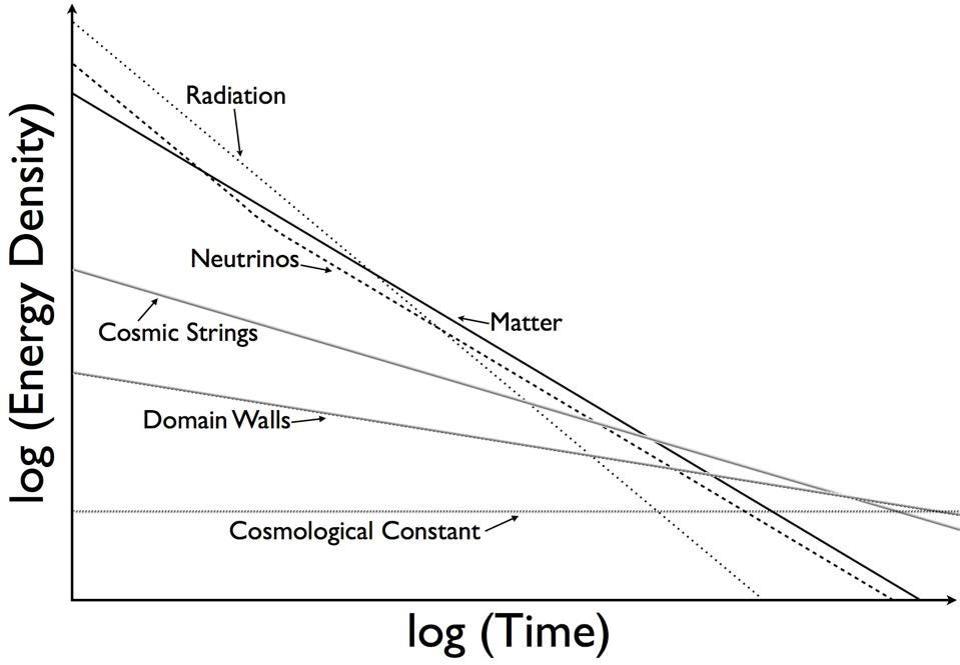
Various components of and contributors to the Universe’s energy density, and when they might dominate. Note that radiation is dominant over matter for roughly the first 9,000 years, then matter dominates, and finally, a cosmological constant emerges. (The others, like cosmic strings and domain walls, do not appear to exist in appreciable amounts.) However, dark energy may not be a cosmological constant, exactly, but may still vary with time by up to ~4% or so. Future observations will constrain this further.
This has an absolutely remarkable implication for a hypothetical Universe that has all of the components we’ve been considering in it:
- radiation,
- matter (both normal and dark),
- spatial curvature (even though it appears our Universe doesn’t have this in any significant amounts),
- and dark energy (which we’re still assuming is a cosmological constant).
It means that as the matter density drops, spatial curvature becomes more and more important, and could eventually become the dominant factor in the Universe, as the matter (and radiation) densities continue to drop more and more significantly.
But as the Universe keeps on expanding, the spatial curvature still dilutes, the same way that a small Pringles chip has a greater amount of curvature than a large horse’s saddle. As that spatial curvature becomes less and less important relative to the component that doesn’t dilute — dark energy — the importance of the curvature begins to decrease, and the expansion rate begins to more and more closely match (and be determined by) the dark energy density. In other words, dark energy doesn’t curve the Universe once it becomes dominant, but instead actually flattens it!
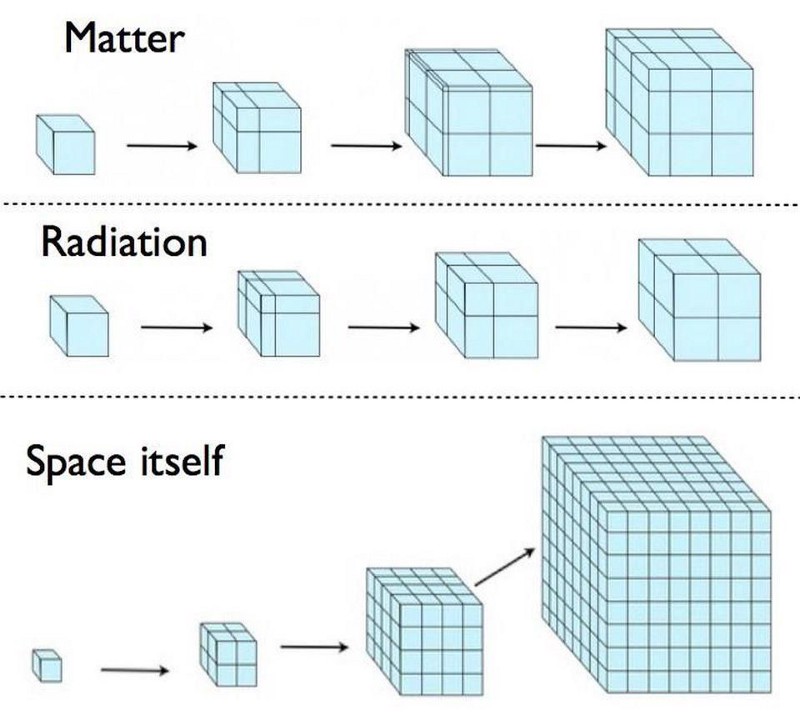
This diagram shows, to scale, how spacetime evolves/expands in equal time increments if your Universe is dominated by matter, radiation, or the energy inherent to space itself (i.e., during inflation or dark energy dominance). The bottom-most scenario corresponds to exponential expansion via both dark energy (today) and inflation (at early times). Note that visualizing the expansion as either ‘the existing space stretching’ or ‘the creation of new space’ won’t suffice in all instances.
If you think about it, this makes a lot of sense. After all, the type of expansion that a cosmological constant induces is exponential expansion: where, after a given amount of time elapses, the length, width, and depth of the Universe all double, and when that amount of time elapses again and again, the length, width, and depth all double again and again, in a fashion that compounds. This phenomenon isn’t just taking place now, in our dark energy-dominated era, but took place early on in cosmic history, during the period known as cosmic inflation. If you ever heard that cosmic inflation stretches the Universe to be indistinguishable from flat, this is how!
It’s kind of remarkable that if we had a Universe with a significant amount of curvature — and we don’t; our best measurements indicate that we just have radiation, matter (normal and dark), and dark energy — that the curvature would have appeared only when the matter density had dropped below a certain amount, and then, once dark energy prose to prominence, curvature would diminish and fade into oblivion, albeit more slowly than either matter or radiation did. But based on the Universe we observe, whereas we’re already some 6 billion years into the era of dark energy domination, the matter density of the Universe still remains significant, at 30% or so of the cosmic energy budget, while curvature is constrained to be no more than about 0.4% of the energy budget: consistent with zero and no bigger than that minuscule amount. Curvature never dominated the Universe and never will, and the existence of dark energy, the great “flattener” of the modern Universe all but ensures it!
Send in your Ask Ethan questions to startswithabang at gmail dot com!
First Appeared on
Source link







