


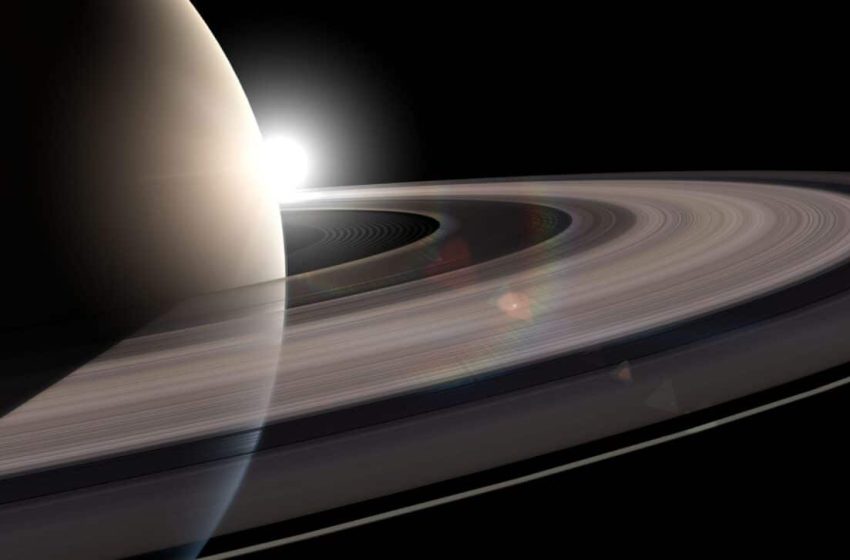
Astronomers Detect a Dozen New Moons Around Saturn, Creating a Record Gap With Jupiter
A new set of tiny moons has been identified around Jupiter and Saturn, quietly increasing their already vast satellite systems. With these additions, the total number of known moons in the solar system now stands at 442, a figure that continues to climb as detection methods improve.
These objects are not the large, familiar moons often highlighted in planetary science. They are extremely small and faint, requiring some of the most powerful telescopes on Earth to be detected and confirmed.
The discoveries also underline a broader trend: the outer solar system still holds a significant number of undiscovered bodies.
Tiny, Dim Moons at the Edge of Detection
The newly discovered moons, four orbiting Jupiter and 11 orbiting Saturn, are each only about 3 kilometers (1.9 miles) in diameter. Their brightness falls between magnitude 25 and 27, making them far beyond the reach of backyard telescopes. According to EarthSky.org such faint objects can only be detected through repeated observations with large ground-based instruments.
For Jupiter, the discoveries were made by Scott Sheppard and David Tholen using the 6.5-meter Magellan-Baade telescope in Chile and the 8-meter Subaru telescope in Hawaii. These facilities allow astronomers to track extremely faint points of light moving slowly against the background of stars.
Saturn Pulls Further Ahead In The Moon Count
With the addition of 11 new moons, Saturn now hosts 285 moons, far surpassing Jupiter’s 101. The Minor Planet Center stated, which officially records such findings, these moons were announced in circulars including MPEC 2026-F14 for Saturn and MPEC 2026-F09 through F12 for Jupiter.
The gap between the two gas giants has widened significantly in recent years. The same source reports that Edward Ashton and his team had already discovered 128 Saturnian moons in 2025, contributing heavily to Saturn’s growing lead.
Elsewhere in the solar system, the distribution remains uneven: Uranus has 28 moons and Neptune 16, while Earth and Mars have only one and two respectively.
A Tight-Knit Team Driving Hundreds of Discoveries
Much of this rapid increase in known moons can be traced to a handful of researchers. As stated by Space.com, both Scott Sheppard and Edward Ashton have each been involved in discovering more than 200 moons.
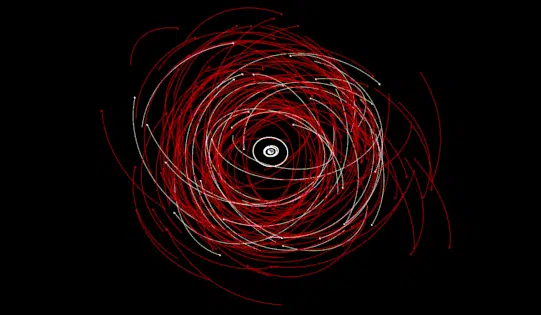
Their work relies on systematically scanning regions far from the planets, where these irregular moons follow wide orbits. Confirming a discovery requires tracking the object over time to ensure it is gravitationally bound to the planet.
First Appeared on
Source link






