


Astronomers Spot Previously Unknown Space ‘Cavity’ That’s Quietly Protecting the Moon
Earth has a particularly strong magnetosphere—a bubble-shaped capsule of magnetism—shielding the planet and its inhabitants from solar weather and other space badness. These protective perks extend to the Moon, whose orbit enters and exits Earth’s magnetosphere. But new research suggests we’ve underestimated how good the magnetosphere is at its job.
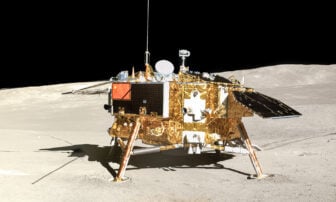
In a Science Advances paper published today, researchers say they’ve found strong evidence that an energetic particle “cavity” shaped by Earth’s magnetosphere shields the Moon from harmful cosmic rays—even when the Moon’s orbit is outside the magnetosphere. The findings come from analyzing recent data collected by China’s Chang’e-4 Moon lander and could inform future space missions, for which radiation exposure remains a threat for astronauts.
“We had expected that the radiation on the lunar surface would be constant when the Moon is not inside the Earth’s magnetosphere,” Robert Wimmer-Schweingruber, the study’s corresponding author and an astrophysicist at Kiel University in Germany, told Gizmodo. “What we found, however, is that the magnetosphere provides some more shielding than expected.”
Precarious space weather
Solar weather often makes the news for triggering geomagnetic storms and disrupting the grid. But for astronauts in space, galactic cosmic rays are the greatest contributors to radiation exposure, according to Wimmer-Schweingruber. When powerful events like supernovas propagate shockwaves into space, tiny particles like protons or helium atoms get energized to such an extent that they travel at nearly the speed of light.
They “have so much energy that they penetrate deep into the solar system,” Wimmer-Schweingruber explained. “Some even penetrate the Earth’s magnetosphere, the ‘shield’ provided by the Earth’s magnetic field.”
On the other hand, the Moon enters and exits Earth’s magnetosphere during its 27-day orbit. Up until now, researchers assumed that radiation on the lunar surface would be relatively constant while the Moon wasn’t under the magnetosphere’s protection.
A far-reaching shield
That understanding shifted for the team when Chang’e-4’s data showed a 20% decrease in radiation on the lunar surface during a “pre-noon” period, or when the Moon’s orbit takes it opposite to Earth’s magnetosphere. To investigate, the team conducted statistical tests on radiative particles in Earth-Moon space for 31 lunar cycles while adjusting for any fluctuations in solar weather.
In addition to Chang’e-4’s data, the researchers also examined trends from NASA’s Lunar Reconnaissance Orbiter, whose observations “exhibit a qualitatively similar pattern,” according to the paper. As a result, they found that an extension of the magnetosphere’s influence (shaded in white in the figure below) offered extra protection for the lunar surface.
“We were, in fact, quite surprised when we saw [the additional shielding],” said Wimmer-Schweingruber. “But in retrospect, it makes absolute sense. We found such an effect, which we had not expected—that’s what research is about.”
Hiding in the cavity
The team believes the findings could have key implications for future space missions. According to Wimmer-Schweingruber, that 20% decrease in radiation refers to low-energy ions—a “major contributor to skin dose” for astronauts. “After all, our skin is our biggest ‘organ,’” he added.
With the new findings, researchers planning space missions could exploit these extra shielding zones to reduce the impact of radiation on astronauts. Having said that, Wimmer-Schweingruber told Gizmodo that near the end of Chang’e-4’s mission, the spacecraft captured several solar particle events that increased radiation by “more than a factor of 10.”
Clearly, space weather is complex, and there are more details to be worked out, but the new study is an insightful one, especially as missions like NASA’s Artemis strive to return humanity to the Moon.
“I think it is cool that we are preparing to go back to the Moon,” Wimmer-Schweingruber said. “In some years we will be able to look at it and wonder what the astronauts or taikonauts are doing there right now. We will probably even be able to follow their activities remotely. This will give us all the possibility to experience the exploration of our nearest neighbor, the Moon.”
First Appeared on
Source link






