


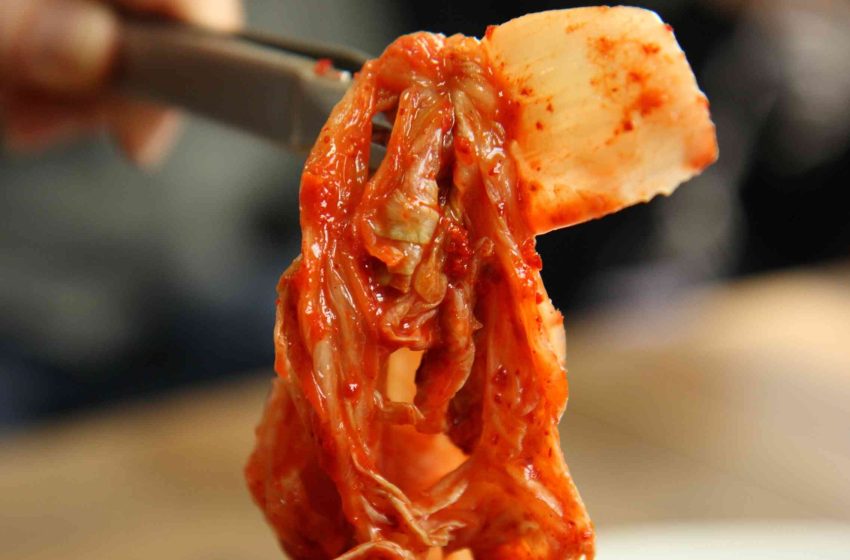
Bacteria found in kimchi helps rid your body of microplastics
Researchers have found that a bacterium isolated from kimchi can bind to nanoplastics in the gut and carry them out of the body.
The finding reframes fermented-food microbes as potential tools for limiting how much plastic remains inside people.
An intestinal test
Inside fluid meant to mimic the human intestine, the kimchi microbe kept holding particles that other bacteria largely released.
At the World Institute of Kimchi (WiKim) Dr. Se Hee Lee and colleagues found that 57% of the particles.
Lee’s group watched a comparison strain drop to 3% under the same gut-like conditions, after reaching 85% in standard tests.
The comparison strain’s collapse made the kimchi microbe look less like a curiosity and more like a serious option inside the intestine.
Why plastic sticks to kimchi
Bacteria commonly found in fermented foods like kimchi, Leuconostoc mesenteroides, relied on biosorption, a surface binding process that traps pollutants before they pass deeper into tissue.
Chemical groups on the bacterium’s outer layers appeared to help the plastic stick, so the contact stayed stable.
Before digestion was simulated, the kimchi-derived bacterium had already bound 87% of the particles, slightly ahead of a comparison strain at 85%.
Performance across changing temperatures, acidity, and particle loads suggested the effect was sturdy enough to deserve animal testing.
Plastic and kimchi in mice
Using germ-free mice, animals raised without their usual gut microbes, the team tested the strain without interference from other gut microbes.
Male and female mice given the kimchi-derived bacterium produced more than twice as many nanoplastics in their feces as untreated controls.
More particles leaving in waste suggested more plastic had been caught inside the intestine before crossing into the body. Mouse data did not prove a human effect, but they showed the idea could work in living animals.
Why size matters
Because nanoplastics, plastic fragments smaller than about 0.00004 inch, can sometimes cross biological barriers, researchers worry they may linger.
Human autopsy work found far higher plastic concentrations in brain samples than in liver or kidney samples.
Higher plastic levels in brain tissue still did not prove harm by themselves, leaving major questions about dose, timing, and risk.
Uncertainty about harm is exactly why any safe way to keep particles inside the gut deserves close attention.
How exposure happens
People do not need to eat plastic directly, because tiny fragments already turn up in food, water, and air.
Sunlight, friction, heat, and time keep breaking larger debris apart, which steadily increases the number of particles people can swallow.
The intestine matters first because that is where these particles meet digestion, mucus, and the cells lining the body.
Edible microbes looked attractive for use in the gut, since they might intercept contaminants at the entry point instead of after wider spread.
Why kimchi matters
Kimchi carries lactic acid bacteria, microbes that drive fermentation and sour flavor, giving researchers a large pool of food-safe candidates.
Unlike many environmental bacteria, kimchi microbes came from a food people have eaten for generations, which changed the practical stakes.
A long history of eating fermented-food microbes helped the researchers avoid building a gut strategy around strains that might carry their own risks.
The result hinted that familiar fermented foods may contain useful microbes with jobs beyond flavor and preservation.
Limits of this result
Polystyrene served as the test plastic, so nobody yet knew whether the same strain would bind every common polymer.
Human digestion is also messier than lab fluid, with mixed meals, enzymes, bile, and countless resident microbes.
Longer studies will need to test real microbial communities and ask whether binding changes absorption, inflammation, or normal gut ecology.
Without human trials and longer follow-up, the work remained promising but preliminary rather than a direct answer for plastic exposure.
Plastic pollution and kimchi
Plastic pollution now touched food science and gut biology at once, making this finding matter beyond one fermented dish.
“Plastic pollution is increasingly recognized not only as an environmental issue but also as a public health concern. Our findings suggest that microorganisms derived from traditional fermented foods could represent a new biological approach to address this emerging challenge,” Lee said.
The interpretation fit the evidence, because the particles were caught in the intestine before movement through the body could occur.
What happens next?
Nobody should treat a serving of kimchi as proof of plastic removal, because the strain tested here was isolated and carefully measured.
Controlled doses in a lab or mouse study do not mirror whatever amount ends up in an ordinary meal.
Screening fermented foods for stronger binders now looks like a practical next step, followed by careful human studies.
A screening approach could turn familiar microbes into targeted tools against contaminants people already take in during daily life.
Most plastic research has focused on pollution once it reaches oceans, soil, or organs, but this work stayed in the intestine.
By showing that one food microbe can hold nanoplastics where exposure begins, the study offers a modest, concrete kind of prevention.
The study is published in Bioresource Technology.
—–
Like what you read? Subscribe to our newsletter for engaging articles, exclusive content, and the latest updates.
Check us out on EarthSnap, a free app brought to you by Eric Ralls and Earth.com.
—–
First Appeared on
Source link






