


Bad Bunny and jingoism lite: was this the Super Bowl where woke roared back? | Super Bowl LX
Roger Federer smiling wolfishly to the crowd: a return to woke? Adam Sandler hangdog in the Levi’s Stadium stands, Jon Bon Jovi mooching on the sideline like a retired dentist on a cruise, Billie Joe Armstrong belting out American Idiot during the pre-game show under his motionless meringue of fogey-blond hair: were they a sign? A New England Patriots team who were neither favored to win nor widely reviled, then promptly repaid a grateful public by losing: was this the Super Bowl which proved that history really can move on, that America is not fated to remain hostage to the tremors and hatreds of the past? Well, yes and no.
A year after Donald Trump made American football’s showpiece all about him, Sunday’s game in Santa Clara always promised a sort of correction – a cooling of the mood, perhaps even an end to the manipulation of sport for political ends. As always the best way to gauge the success of this mission was as the gods intended: through a TV screen. Trump – saddled with historically low approval ratings, facing a massacre in this year’s midterms, and no doubt wary of risking a public appearance in the deep blue sea of the Bay Area – was absent on this occasion, and he kept the F-22 fighter jets that were scheduled to be part of the pre-game flyover away from Levi’s Stadium too. (Unspecified “operational assignments” were the reason offered for the jets’ withdrawal, which means there’s probably a low-ranking member of the Trump administration putting big money on a US military strike somewhere in Latin America as we speak.) And yet, the absent autocrat still weighed on proceedings, his curdling influence turning every moment and gesture on Sunday into a referendum on the prospects for a post-Trumpian sporting future. Could football be normal again?
The Seahawks and the Patriots did their part by offering up a game of punishing defense and attritional offense that had all the carefree charm of a medieval torture procedure. Can football be normal again? That remains unclear, but on this evidence it can certainly be boring, which is maybe a form of progress. Despite the best efforts of professional jaw surgery patient Jake Paul, the pre-game chatter was mostly about de-escalation: even the ESPN host Pat McAfee felt moved to point out, on his first visit to San Francisco, that the city was nothing like the urban hell described by the catastrophizers of Fox News and other rightwing media outlets. Perhaps, for once, the Super Bowl would not be dragged into America’s tedious and interminable culture wars. Between Paul’s racist critique of the half-time show and the alternative spectacle offered by Turning Point USA, maybe all the right can do now is squawk impotently into the void.
On the field, Joe Montana, Peyton Manning and a bunch of other footballing legends got things moving by throwing out peace signs through a pre-game honor guard of young women with violins, and from there the tone of this Super Bowl as a grownup affair, all strings and restraint, was set. Even the pre-game ceremony to mark this year’s 250th anniversary of the signing of the Declaration of Independence had a shrugging, almost apologetic quality to it, the sermonizing brief and symbolism feathery: this was jingoism, but on Ozempic. YouTuber Charlie Puth was a surprise choice to sing the national anthem, and no one seemed more shocked than the man himself: dressed in the style of a fun dad on his way to parent-teacher night – button-down shirt, tie, brown leather jacket and straight-leg jeans – Puth dispensed with the standard bombast and delivered The Star-Spangled Banner in a feline whisper. Perhaps more than any other recent installment of American sport’s biggest day, this Super Bowl seemed determined not to draw attention to itself. “I know we won the Super Bowl, but we could have been a little bit better on offense,” victorious quarterback Sam Darnold told sideline reporter Melissa Stark after the game. Even in triumph there were learnings to glean, takeaways to digest, improvements to plan. This was the Super Bowl as corporate retreat, a moment to pause, reflect and reset for the year ahead.
In Mike Tirico and Chris Collinsworth, NBC boasted two play-by-play announcers with the character to meet the soporific moment. Collinsworth, calling his sixth Super Bowl, offered a clinic in stating the obvious, noting midway through the second quarter that “this is shaping up as a defensive game”. He’s certainly not Tom Brady bad, but then no one apart from Brady is. Meanwhile Tirico, realizing the dream that fired his defection from ESPN in 2016 to call his first ever Super Bowl, had to juggle duties at Levi’s Stadium with his role anchoring NBC’s coverage of the Winter Olympics, a fact viewers were reminded of approximately once every 30 seconds on Sunday night. “Champion will be crowned in 30 minutes,” Tirico announced at half-time with a theatrical pause, before adding with an elongating flourish: “Mmmmaybe more.” It’s a good thing NBC has the big man locked down to a long contract, because it’s unclear whether anyone else working in media today has the talent to produce material this strong. Tirico is the most white-collar commentator in American sports; he has an unparalleled skill for making every in-game call and on-set interjection sound like something your accountant might say to you as he’s walking you through your tax return. In that sense he was the perfect on-air complement to this turgid encounter, an anti-hype guy to suit the times.
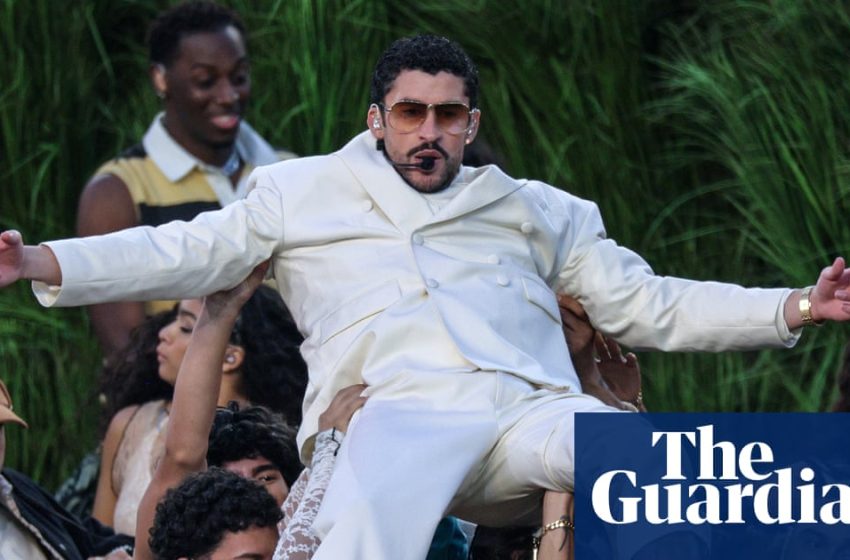
Yes, but was it woke? Was the stagecraft behind this Super Bowl, both in the stadium and on TV, some kind of “statement” about America Today? Is progressive culture now “back” in any meaningful sense? The choice of Bad Bunny to headline the half-time show may have been ragebait for Red America, but however convincingly the field at Levis’s Stadium was terraformed to resemble the hinterland of San Juan (it was not very convincing), the Super Bowl did not ultimately herald some permanent “turn” on the part of the NFL toward cultural progressivism. No one, not even Benito Antonio Martínez Ocasio himself, “libbed out”; however welcome or unexpected it might have been, the half-time spectacular saw no big protest about ICE or lament of the country’s rapid descent into authoritarianism. After last year’s Super Bowl turned into a Trumpified debacle, Sunday was all about evening up the ledger, about welcoming the sport’s non-Maga contingent back into the tent – a project in which the inclusion of Bad Bunny, the day’s lack of on- or off-field drama, and the bipartisan shock over $180 burgers all played a galvanizing role.
As always it was the ads, rather than events in the stadium, that said the most about the state of the world today. Apart from a few outliers – Guy Fieri as “some guy” in an ad for Bosch power tools, Adrien Brody going method for TurboTax, William Shatner as a near-incontinent ambassador for Raisin Bran named “Will Shat” – this year’s commercials advertised products that fit a dependable number of recurring categories: AI, gambling, food delivery and insurance. Here, in taxonomical miniature, was a brilliant summary of what culture has in store for us: slop, speculation, a retreat from the commons, and indemnification – if we’re lucky – against the disasters that await. Amid the tedium of action on the field, this Super Bowl offered a powerful advertisement for the theater and violence of capitalism as usual.
First Appeared on
Source link






