


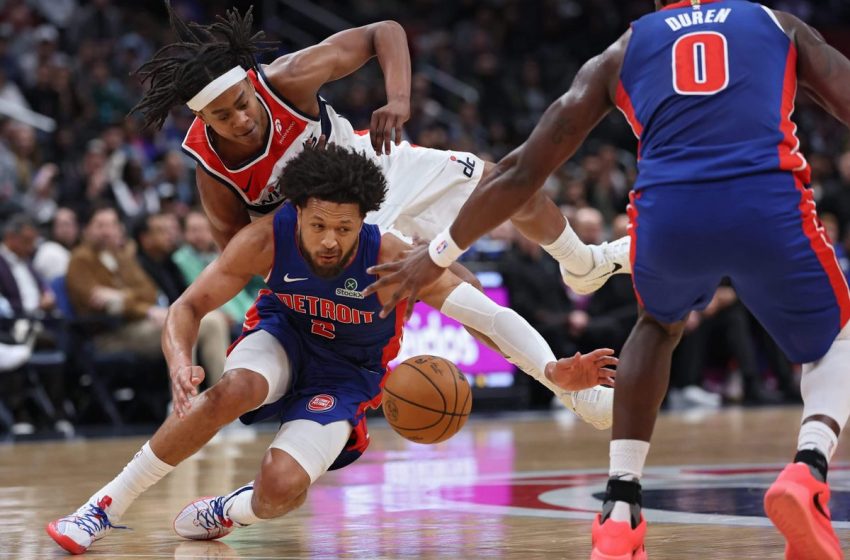
Cade Cunningham’s injury casts pall on NBA MVP chances thanks to 65-game rule
On Thursday afternoon, Cade Cunningham departed the nation’s capital in atypical fashion. He took a car service some 530 miles, all the way home.
His Detroit Pistons were set to face the Washington Wizards that night. Following the game, they would fly back to Michigan on the team’s charter jet. But Cunningham couldn’t join.
Two nights earlier, he collided with Wizards rookie Tre Johnson, absorbing a shot to the ribs. His lung collapsed, an injury a league source called “mild” but that will, of course, keep him away from basketball. The Pistons haven’t put a timeline on Cunningham’s return, other than announcing he will be re-evaluated in two weeks.
The team’s most trusted local doctors have yet to check him out, though they knew enough not to put him on the team plane — not with a collapsed lung, which would respond poorly to drastic changes in air pressure. So not long before tipoff in D.C., Cunningham entered a car, ready for the eight-hour drive back to Detroit, uncertain of both his and the Pistons’ immediate futures.
Shai Gilgeous-Alexander and Nikola Jokić remain the favorites to finish atop MVP ballots, but Cunningham’s entrance into the top five until now appeared a guarantee, if only because of that letter in the middle of the acronym.
Valuable.
Cunningham isn’t the NBA’s greatest player, but he is its most irreplaceable. These next couple of weeks, and hopefully only the next couple of weeks, will show that.
The Pistons (50-19) are one of this season’s feel-good stories, vaulting from the dregs of the league a mere two years ago to 44 wins in 2024-25 to the best record in the Eastern Conference today. Their identity has flipped from pushover to pusher. Do you aspire for a sore back and broken soul? If so, play a basketball game in Detroit.
But inside this gritty, physical group is a flaw. And no, it’s not the inexperience. Instead, it’s the reliance on one guy to create just about everything.
Detroit has hovered around the top 10 in points per possession this season in spite of its unconventional offense. The Pistons can’t shoot, but they are a battering ram, so they make up for inaccurate jumpers by getting on the break, gobbling up offensive rebounds and attacking the basket nonstop, which forces free throws aplenty.
Cunningham is the glue that holds the attack together.
The Pistons will play lineups with two, three, sometimes even four shooters the defense doesn’t care to close out on aggressively, which cramps the middle of the court. It’s Cunningham’s job to slice to the paint and create from there, to run a pick-and-roll and get someone open, even when the opponent locks in on him and only him.
And so, more often than any other driver of a team with high playoff hopes, Cunningham must be his squad’s offensive savior.
The scoring. The dribbling. The passing. Essentially, whatever the Pistons do that could show up on a highlight reel starts with their All-Star point guard.
He averages more touches per 100 possessions than any other qualifying player in the NBA, according to Second Spectrum. He’s run the most pick-and-rolls in the league. Only the great Jokić has whipped more passes that lead to shots.
No one — not Gilgeous-Alexander, not Jokić, not Luka Dončić or Victor Wembanyama — carries a heavier offensive burden than Cunningham does.
It’s a great argument for why low efficiency can be overstated out of context. Cunningham’s shooting numbers aren’t equal to those of the other stars with an argument to make MVP ballots, but no one else is compelled into such difficult shot selection, the difficult pre-buzzer heaves or late-clock double-teams or something-out-of-nothing pull-ups that hurt elite creators in his situation.
A season ago, the Pistons found success splicing a second ballhandler, Dennis Schröder, next to Cunningham. This season, that guy hasn’t fully emerged. Every once in a while, coach J.B. Bickerstaff will toss the young Daniss Jenkins alongside him. Now, Jenkins, a second-year spark plug who was on a two-way contract earlier this season, is the starter. Marcus Sasser — who gets into a game every couple of weeks, nails four 3-pointers in two minutes, then fades back to the bench — will now catch fire more regularly.
Jalen Duren will rely on his face-up game more than ever. The Pistons’ handsy defense will presumably try to swipe steals, then take off in the other direction. But offense won’t be easy, especially once the game slows. Those are the moments when Cunningham’s composure shows most.
The shame is that his value might not receive the recognition it deserves. He’s played in only 61 games, which would disqualify him from postseason award eligibility. Unless his recovery moves as quickly as possible, Cunningham just went from a plausible third-place MVP finish to off the ballot completely, from a shot at All-NBA First Team to falling short of the top 15.
Because the 65-game rule includes minutes requirements, too, Cunningham must play in at least five more games to maintain award eligibility. Two weeks from Thursday is April 2, when the Pistons will have only six games left on their schedule. Presumably, he will need to ramp up his conditioning after a collapsed lung.
And thus, voters might have to cross another contender off the list.
The purpose of the 65-game rule was never to preserve the sanctity of awards. In fact, the NBA implemented the policy a few years ago, understanding the opposite would occur. The legitimacy of its awards would take a hit, which would become collateral damage in the league’s mission to solve another problem: too many top-notch performers sitting out too many games. Encouraging players to play 65 times would fight against the culture of load management, the league figured.
It came to that number in an unscientific fashion. Sixty-five seemed reasonable. And thus, it became law.
“I’m just saying that you’re still allowed to miss 17 games,” the NBA’s at-the-time head of basketball operations, Joe Dumars, told The Athletic’s Mike Vorkunov in 2024. “You’re still allowed to miss 20 percent of the season. I don’t know how that could even remotely be considered to put your finger on the scale when you only have to play in 80 percent of the games.”
But in the age of injuries, collateral wreckage is accumulating.
Jokić and Wembanyama are on the cusp of ineligibility. Gilgeous-Alexander and Dončić each have a smidgen of leeway. Cunningham appears as if he won’t qualify. Fortunately for him, this didn’t happen last season, when landing a spot on All-NBA, which he did, meant earning tens of millions extra.
Surely, Cunningham has grander goals, such as a deep postseason run.
According to NBA injury expert Jeff Stotts, the average time missed because of a collapsed lung is 26 days, which would set Cunningham for a return just before the playoffs. The Pistons will need him then more than they do during the close of the regular season. Playoff defenses, even low-seeded ones, lock in on weaknesses. If Detroit can neither shoot nor create, the offense could turn to sludge. And maybe an upset could follow.
But 26 days is also beyond the regular-season finale.
It means Cunningham’s injury could affect the way the public remembers the 2025-26 season. All-NBA and MVP provide a glimpse into a season’s most important players. Awards tell a story. And if Cunningham’s name isn’t somewhere on the list, then the list won’t properly depict these 82 games, when the Pistons sprouted up beyond expectations because Cunningham carried them there.
First Appeared on
Source link






