


Cairn Review + Steam Deck Performance
Cairn was provided by The Game Bakers for review. Thank you!
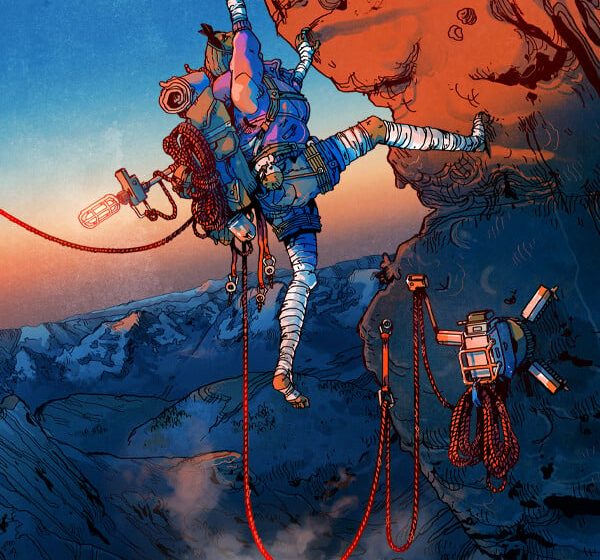
Last year at Day of the Devs, I got to look at many different titles, but none stuck with me like Cairn. It was a short, simple demo of just climbing up a rock wall, but the amount of care needed to control each limb, the physics of the protruding rocks and cracks, and how they affect our body, and the need to watch over our food and water, while using special tools to help our climb, lured me right in. And now that I have played the full game, I can say that joy I felt playing last year is still there in its entirety.
The story of Cairn follows Aava, a well-known climber who decided to tackle her most difficult mountain yet: Kami. As she goes up, she will encounter a unique cast of characters and confront her own demons while digging deep into her own psyche to discover why she can’t stop climbing. It’s quite an intriguing story overall, and I was very interested to figure out why Aava has this mentality. Combine that with a recurring Marco and his more “chill” attitude with climbing and the lore of Kami itself, and I was pretty satisfied. Ultimately, I felt it was worthwhile to stop at caves that were out of the way, finding documents and supplies to further push the story along in a neat way.
The beauty of Cairn comes from learning the most efficient ways to climb the mountain face and knowing what to do in dangerous situations. There are so many factors that can drastically affect your climax, like depleting stamina, needing food and/or water, and even weather conditions like rainfall. So, not only do you have to take some time to plan your route and ensure your path will have enough protruding rocks to get a grip on, but you’ll have to plan ahead of time for worst-case scenarios. Do you have enough pistons to use if worst comes to worst? Do you have a solid footing when your stamina starts to drop, and your entire body shakes? Do you have water and food on hand in case you start to get dehydrated? These will be constant questions that pop into your mind and can make or break your climb.
The balance of strategy and survival is key here. On one hand, you have to plan every single step of your journey. The location you place your hands and feet will factor into how you climb, and choosing spots to put less stress on your limbs will make or break your climb. Constantly looking around the mountain to discover cracks or protruding rocks will become an enjoyable norm. There’s something so satisfying about finding a good foothold and watching Aava extend upwards to gain some solid momentum.
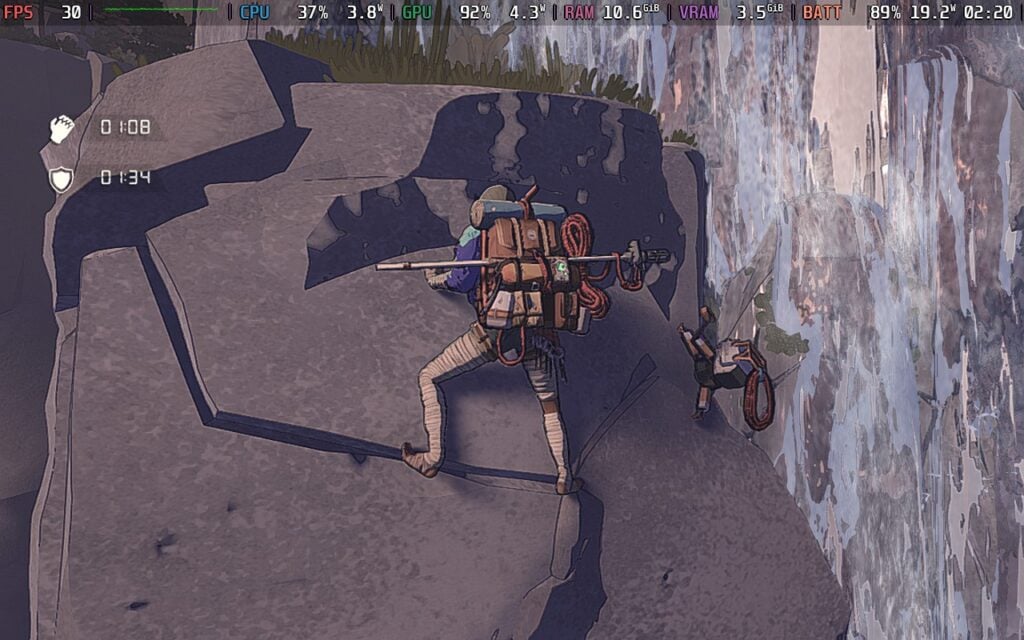
However, going too quickly or not finding footholds can lead to falling off the mountain quickly. This isn’t a race to the top; taking your time is rewarded with the chance to actually stay on the mountain. We aren’t completely left to our own vices either. We can put Chalk on our hands to increase grip strength (essential for spots without footholds, but cracks for grabbing on with our hands exist), and we have a limited number of Pistons to use. Pistons can act as checkpoints on the mountain, making it so that when we fall, our rope will latch onto the Piston instead of us falling to our deaths.
On the other hand, we will have to manage our health, hunger, thirst, and temperature using the assortment of foods and medicines available on the mountain. They can be found all across the mountain in leftover backpacks, cooling pots, and we can even find plants to eat. Most of what we find can be cooked in our tents to boost their effects, giving us extra buffs and more.
And, as with any survival game, supplies are limited. You can only carry a certain amount in your backpack, and you have a set amount of pistons, adding extra challenge and decisions that need to be made. It could end up being very helpful to go off the beaten path, maybe even going down to a new platform that has food or other items you can pick up. Scavenging for resources will give an edge, and it becomes necessary to stock up and prepare.
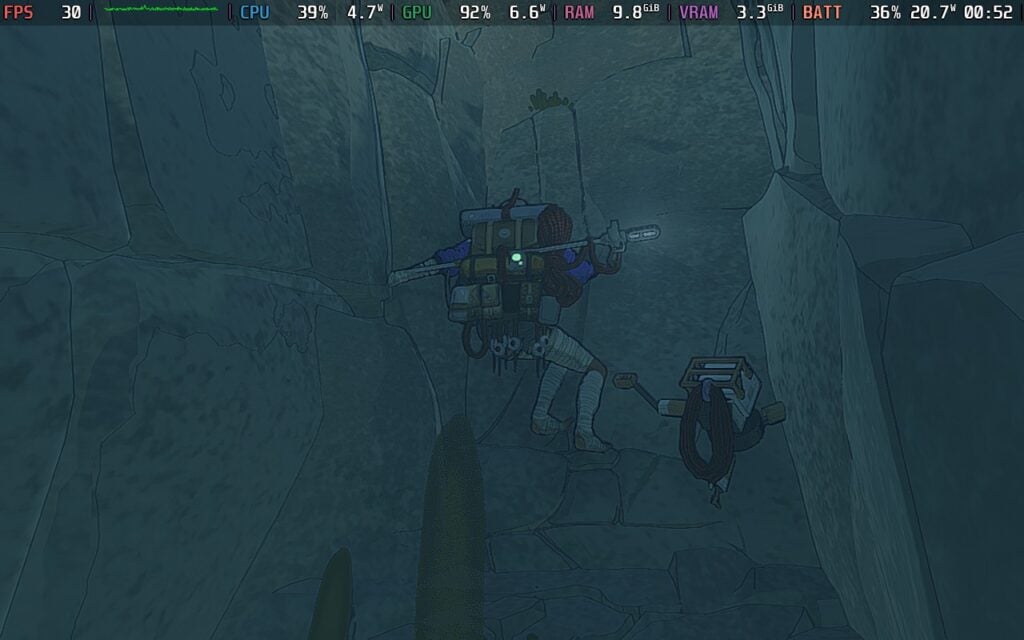
Kami is a huge mountain, and it would be tough to climb it without being able to save while going up. There are save points we can find throughout the caves and edges on the mountain, and it’s at these points that we can set up our tent, sleep to regain health and pass through the night, cook food, tape up our fingers to increase our grip, repair our Pistons, and manage our backpack.
The save system is a hit or miss for me. There’s a lot we can do at each point, which I appreciate, but there were more times than I could count that I died and was sent back so far. It could be devastating to lose all of that progress, and it reminded me of how I felt losing progress for games like Baby Steps or Getting Over It with Bennett Foddy. It can really suck, and it made me wish for a little more forgiving system. There are some cutscenes where we are hanging on the mountain in our tents, so I wish I could do that for cooking or saving mid-climb. It would make sense if this were limited to however many Pistons I have to keep the difficulty up, but the points can just feel a little too far from each other in some parts of the mountain.
Still, all of the gameplay elements work together nicely and create this wonderful combination of strategic survival that I found worthwhile. Taking the time to carefully plan out each move, one foot or hand at a time, became my favorite aspect of Cairn. I would sometimes even spend 5-10 minutes just inspecting the mountain to decide the route I would take to go up, and watching it work out (with careful Piston placement) became this euphoric experience.
Cairn – Steam Deck Performance
Cairn may be Verified for the Steam Deck, but it does have some larger problems I didn’t expect. The game can drop significantly when looking at more of the mountain than what’s in front of us. Even with the game on the lowest settings, which is the default, it will drop below 30 FPS, sometimes even going down to 15 or 20, depending on how much of the mountain is in view. It’s a little bit of a bummer, though I am thankful that the bulk of the gameplay will stick to 30 FPS when it needs to. The game doesn’t really need a high framerate, which helps a lot, too.
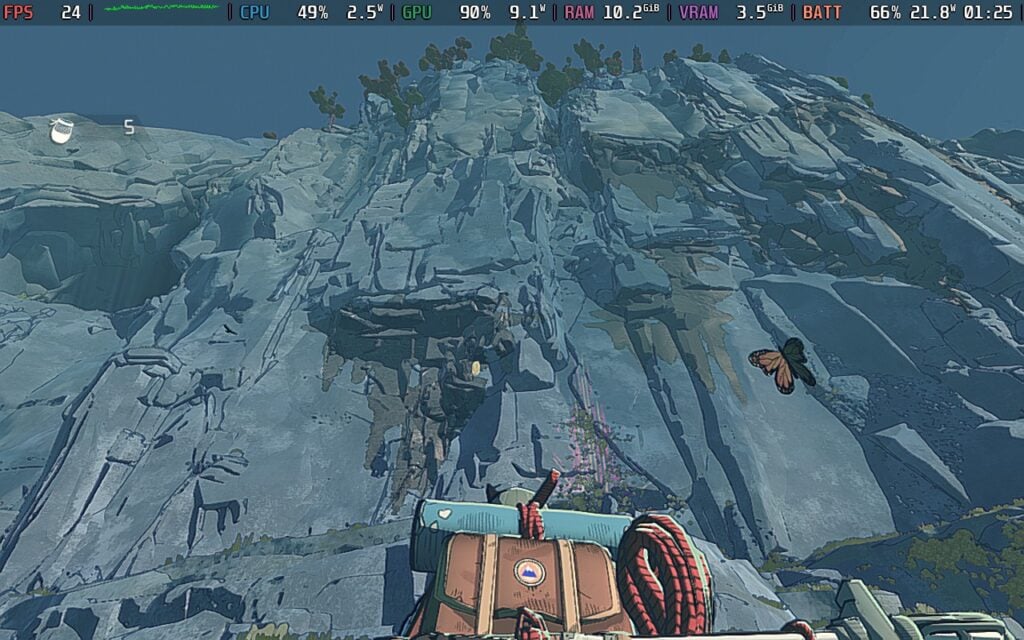
Still, I couldn’t help but be a little disappointed with Cairn’s performance. It seems to be rendering a little too far, so looking out at the mountain or in certain angles will bring performance way down. Climbing is more stable, since we are only looking at the mountain face in front of us, but even at the lowest settings possible, looking towards the mountain would bring performance down. Still, to stabilize it as much as possible, I do recommend bringing down the resolution and using SteamOS’ FSR upscaling to supplement. The visuals make it blend in nicely, and it boosts performance enough to stay stable where it counts.
Compare
1152×720 Resolution With SteamOS Sharp Upscaling
1280×800 Resolution
This also brings battery drain down when not climbing, without changing visuals too much. There is some extra detail on the rock faces and more foliage on the ground, but I wouldn’t say the visuals suffer enough from High to Low to justify the extra battery drain and performance drops. And with there being throttling and framerate drops when looking at the whole mountain, even on Low, I would rather keep it at lower settings to minimize the moments of drops during actual gameplay.
Compare
Low Preset
High Preset
Accessibility
There isn’t a specific accessibility tab for Cairn, but it does have some nice assist options to help with our ascent, like fall rewinding, infinite gear, auto-saving, and turning off the survival elements. But we also have other settings, like manual limb selection, highlighting limbs, skipping quick reaction mini-games, displaying the in-game time, changing subtitles size, and remapping controls.
We do have 16:10 resolution support, as well as controller and cloud save support. There are no HDR settings.
Conclusion
Cairn combines strategy and survival to create a unique experience that I want to keep coming back to. The combination of strategy and survival in climbing a treacherous mountain is well-balanced, keeping gameplay engaging and fun throughout. It can be brutal and unforgiving with how quickly you can fall, and save points are a little too scattered in some areas, but it was hard to find any moment that didn’t make me want to try climbing again.
I do wish it ran better on the Steam Deck, but I would still consider it playable since it doesn’t need high framerates to be fully enjoyed. Still, I had a great time playing it in bed, and I can happily recommend it.
Our review is based on the PC version of this game.
If you enjoyed this review, be sure to check out the rest of the content on SteamDeckHQ! We have a wide variety of game reviews and news that are sure to help your gaming experience. Whether you’re looking for news, tips and tutorials, game settings and reviews, or just want to stay up-to-date on the latest trends, we’ve got your back.
First Appeared on
Source link






