


Can apes make believe? A new study looks at animals’ ability to imagine : NPR
Kanzi, whose name means “treasure” in Swahili, was born in 1980 and died in 2025 at the age of 44. His favorite food was onions and his favorite game was chase.
Great Ape Trust
hide caption
toggle caption
Great Ape Trust

Kanzi, whose name means “treasure” in Swahili, was born in 1980 and died in 2025 at the age of 44. His favorite food was onions and his favorite game was chase.
Great Ape Trust
The ability to imagine things that aren’t real — to make believe — is a fundamental part of being human.
What starts as imaginary friends and playing pretend develops into an ability, over time, to step out of reality. To daydream and plan a summer vacation. To invent a new recipe. To put oneself in another’s shoes.
It’s long been thought that this ability to imagine is unique to humans.
But now, a series of sterile tea parties with a remarkable ape named Kanzi suggests some of our closest ancestors may have the ability too.
“It tells us, for one, that the roots of our imagination were present in the common ancestors that we share with [great apes], which lived 6 to 9 million years ago,” says Chris Krupenye, a cognitive scientist at Johns Hopkins University. “It also tells us there’s much more interesting mental life out there in the world than we previously thought.”
Krupenye is co-author of a new study, published in the journal Science, that aimed to test — for the first time in a controlled experiment — whether apes have the cognitive ability to play pretend.
The subject of the study was Kanzi, arguably the world’s most famous bonobo — an endangered species of ape that’s a smaller cousin to chimpanzees. Raised in captivity, Kanzi had an amazing ability to communicate with humans using symbols and a broad understanding of the English language. (He died last year at the age of 44.)
When asked questions, Kanzi could answer.
“And one of the ways he could respond is through pointing — and that’s not a common behavior for apes,” Krupenye says. “They don’t typically point in the way that humans do.”
That ability allowed Krupenye and his co-author, Amalia Bastos, a cognitive scientist at the University of St. Andrews in Scotland, to ask Kanzi questions like they would a human child.
YouTube
So to test whether he had the cognitive ability to imagine, they modeled their experiments off a series of developmental psychology studies that were conducted with children in the 1980s. Those studies used a pretend tea party to see if kids could track an imaginary object, like a cup of pretend juice.
“With Kanzi, we were able to do more or less the exact same thing,” Krupenye says.
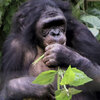
At Kanzi’s home, the Ape Initiative in Des Moines, Iowa, Krupenye and Bastos set up a series of recorded tea parties.
In one of the experiments, the researchers would set two empty, transparent cups on a table between them. They’d then take an empty, transparent pitcher and pretend to pour juice in both. They’d then pick up one cup and pretend to pour the nonexistent juice back in the pitcher.
“At that point, there’s only one bit of imaginary juice left in the remaining cup,” Krupenye says. “So [we’d] push the table forward and ask Kanzi: Where’s the juice?”
Roughly 70% of the time, Kanzi pointed at the correct place.
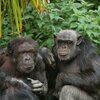
For decades, scientists have observed apes doing things in the wild and in captivity that look like pretend play. Young female chimpanzees have been seen carrying around a stick or log and treating it like a baby or doll. But it’s difficult to know if that’s what they’re pretending.
The new study shows that apes — or at least one, in Kanzi — could do more than just play pretend, says Kristin Andrews, a professor of philosophy at City University of New York, who was not involved in the study.
“[Kanzi’s showing] pretense and imagination, which takes it to another step,” says Andrews, who focuses on animal cognition and minds.
Pretense and imagination is the ability to hold in mind a version of the world that isn’t real, while pretending that it is. Andrews says it’s a valuable cognitive skill, in part because it allows an individual to play out different scenarios in their head before making a decision.
“It helps them make choices,” she says.
Whether bonobos and chimpanzees are actively doing this in the wild is difficult to say, she says, “But what I think the study with Kanzi tells us is that great apes have the capacity to hold these alternative representations” in their mind. And it’s possible, she adds, other animals can too.
First Appeared on
Source link






