


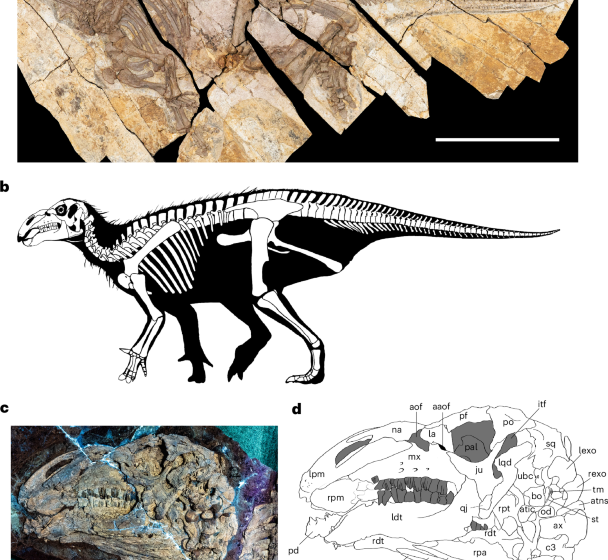
Cellular-level preservation of cutaneous spikes in an Early Cretaceous iguanodontian dinosaur
Bell, P. R. Standardized terminology and potential taxonomic utility for hadrosaurid skin impressions: a case study for Saurolophus from Canada and Mongolia. PLoS ONE 7, e31295 (2012).
Bell, P. R. in Hadrosaurs (eds Eberth, D. A. & Evans, D. C.) 572–590 (Indiana Univ. Press, 2014).
Langston, W. Jr. Nonmammalian Comanchean tetrapods. Geosci. Man 8, 77–102 (1974).
Manucci, F., Bertozzo, F., Maganuco, S. & Godefroit, P. Old Iguanodon remains shed new light on the evolution of ornithopod integument. In 17th Conference of the EAVP, Program and Abstracts 66 (Royal Belgian Institute of Natural Sciences, 2019).
Godefroit, P. Les Iguanodons de Bernissart: Des Fossiles et Des Hommes (Académie royale de Belgique, 2024).
Bonsor, J. A., Lockwood, J. A. F., Leite, J. V., Scott-Murray, A. & Maidment, S. C. R. The osteology of the holotype of the British iguanodontian dinosaur Mantellisaurus atherfieldensis. Monogr. Palaeontogr. Soc. 177, 1–63 (2023).
Zhong, Y. et al. High-precision geochronological constraints on the duration of ‘Dinosaur Pompeii’ and the Yixian Formation. Natl Sci. Rev. 8, nwab063 (2021).
Marshall Faux, C. & Padian, K. The opisthotonic posture of vertebrate skeletons: postmortem contraction or death throes? Paleobiology 33, 201–226 (2007).
Benton, M. J., Zhou, Z., Orr, P. J., Zhang, F. & Kearns, S. L. The remarkable fossils from the Early Cretaceous Jehol Biota of China and how they have changed our knowledge of Mesozoic life. Proc. Geol. Assoc. 119, 209–228 (2008).
Brochu, C. A. Closure of neurocentral sutures during crocodilian ontogeny: implications for maturity assessment in fossil archosaurs. J. Vertebr. Paleontol. 16, 49–62 (1996).
Wang, X. L., Pan, R., Butler, R. J. & Barrett, P. M. The postcranial skeleton of the iguanodontian ornithopod Jinzhousaurus yangi from the Lower Cretaceous Yixian Formation of western Liaoning, China. Earth Environ. Sci. Trans. R. Soc. Edinb. 101, 135–159 (2011).
Wu, W. & Godefroit, P. in Bernissart Dinosaurs and Early Cretaceous Terrestrial Ecosystems (ed. Godefroit, P.) 293–333 (Indiana Univ. Press, 2012).
Madzia, D. et al. The phylogenetic nomenclature of ornithischian dinosaurs. PeerJ 9, e12362 (2021).
Godefroit, P. et al. A Jurassic ornithischian dinosaur from Siberia with both feathers and scales. Science 345, 451–455 (2014).
Godefroit, P. et al. in The Evolution of Feathers (eds Foth, C. & Rauhut, O.) 45–67 (Springer, 2020).
Chang, C. et al. Reptile scale paradigm: Evo-Devo, pattern formation and regeneration. Int. J. Dev. Biol. 53, 813–826 (2009).
Bell, P. R., Hendrickx, C., Pittman, M., Kaye, T. G. & Mayr, G. The exquisitely preserved integument of Psittacosaurus and the scaly skin of ceratopsian dinosaurs. Commun. Biol. 5, 809 (2022).
Enriquez, N. J., Campione, N. E., Hendrickx, C. & Bell, P. R. Epidermal scale growth, allometry and function in non-avian dinosaurs and extant reptiles. J. Anat. 00, 1–34 (2025).
Drysdale, E. T., Therrien, F., Zelenitsky, D. K., Weishampel, D. B. & Evans, D. C. Description of juvenile specimens of Prosaurolophus maximus (Hadrosauridae: Saurolophinae) from the Upper Cretaceous Bearpaw Formation of southern Alberta, Canada, reveals ontogenetic changes in crest morphology. J. Vertebr. Paleontol. 39, e1547310 (2019).
Yang, Z., Jiang, B., Xu, J. & McNamara, M. E. Cellular structure of dinosaur scales reveals retention of reptile-type skin during the evolutionary transition to feathers. Nat. Commun. 15, 4063 (2024).
Scheyer, T. M. & Sander, P. M. Histology of ankylosaur osteoderms: implications for systematics and function. J. Vertebr. Paleontol. 24, 874–893 (2004).
Alibardi, L. Histology, ultrastructure, and pigmentation in the horny scales of growing crocodilians. Acta Zool. 92, 187–200 (2011).
Lucas, A. M. & Stettenheim, P. R. Avian Anatomy: Integument (US Department of Agriculture, 1972).
Barbi, M. et al. Integumentary structure and composition in an exceptionally well-preserved hadrosaur (Dinosauria: Ornithischia). PeerJ 7, e7875 (2019).
Zheng, X.-T., You, H.-L., Xu, X. & Dong, Z.-M. An Early Cretaceous heterodontosaurid dinosaur with filamentous integumentary structures. Nature 458, 333–336 (2009).
Mayr, G., Pittman, M. J., Saitta, E., Kaye, T. G. & Vinther, J. Structure and homology of Psittacosaurus tail bristles. Palaeontology 59, 793–802 (2016).
Slater, T. S. et al. Preservation of corneous β-proteins in Mesozoic feathers. Nat. Ecol. Evol. 7, 1706–1713 (2023).
Prum, R. O. & Brush, A. H. The evolutionary origin and diversification of feathers. Q. Rev. Biol. 77, 261–295 (2002).
Prum, R. O. Evolution of the morphological innovations of feathers. J. Exp. Zool. B 304, 570–579 (2005).
Dhouailly, D. Evo Devo of the vertebrates integument. J. Dev. Biol. 11, 1–23 (2023).
Xu, X. in The Evolution of Feathers (eds Foth, C. & Rauhut, O. W. M.) 67–78 (Springer, 2020).
Benton, M. J., Dhouailly, D., Jiang, B. & McNamara, M. The early origin of feathers. Trends Ecol. Evol. 34, 856–869 (2019).
Yang, Z. et al. Pterosaur integumentary structures with complex feather-like branching. Nat. Ecol. Evol. 3, 24–30 (2019).
Cincotta, A. et al. Pterosaur melanosomes support signaling functions for early feathers. Nature 604, 684–688 (2022).
Xu, X., Zheng, X. & You, H. A new type of feathers in a nonavian theropod and the early evolution of feathers. Proc. Natl Acad. Sci. USA 106, 832–834 (2009).
Xu, X., Zheng, X. & You, H. Exceptional dinosaur fossils show ontogenetic development of early feathers. Nature 29, 1338–1341 (2010).
Xu, X. et al. A gigantic feathered dinosaur from the Lower Cretaceous of China. Nature 484, 92–95 (2012).
Bonfitto, A., Businello, D. & Alibardi, L. Electron microscopic analysis in the gecko Lygodactylus reveals variations in micro-ornamentation and sensory organs distribution in the epidermis that indicate regional functions. Anat. Rec. 306, 1990–2014 (2022).
Peplinski, J. M. A. Ecology of fear: spines, armor and noxious chemicals deter predators in cancer and in nature. Front. Ecol. Evol. 9, 682504 (2021).
Spiekman, S.N.F. et al. Triassic diapsid shows early diversification of skin appendages in reptiles. Nature 643, 1297–1303 (2025).
Cooper, R. L., Nicklin, E. F., Rasch, L. J. & Fraser, G. J. Teeth outside the mouth: the evolution and development of shark denticles. Evol. Dev. 25, 54–72 (2023).
Dhouailly, D. et al. Getting to the root of scales, feather and hair: as deep as odontodes?. Exp. Dermatol. 28, 503–508 (2017).
Shono, T. et al. Evolution and developmental diversity of skin spines in pufferfishes. iScience 19, 1244–1255 (2019).
Bertozzo, F. et al. Cariocecus bocagei, a new basal hadrosauroid from the Lower Cretaceous of Portugal. J. Syst. Paleontol. 23, 2536347 (2025).
Goloboff, P. A., Farris, J. S. & Nixon, K. C. TNT, a free program for phylogenetic analysis. Cladistics 24, 774–786 (2008).
Wang, X. et al. Basal paravian functional anatomy illuminated by high-detail body outline. Nat. Commun. 8, 14576 (2017).
Kaye, T. G. et al. Laser-stimulated fluorescence in paleontology. PLoS ONE 10, e0125923 (2015).
Xu, X. & Barrett, P. M. The origin and early evolution of feathers: implications, incertainties and future prospects. Biol. Lett. 21, 20240517 (2025).
First Appeared on
Source link






