



Chimpanzees Won’t Give Back These Crystals. What They’re Doing With Them Is Stranger Still
The research, published in Frontiers in Psychology and led by ProfessorJuan Manuel García-Ruiz of Spain’s Donostia International Physics Center, found that enculturated chimpanzees consistently selected crystals over ordinary stones, then spent prolonged periods inspecting their transparency and geometric structure. The behavior closely mirrors what archaeologists have documented in our earliest hominin ancestors, who collected crystals without any apparent practical purpose as far back as 780,000 years ago.
What makes the findings striking is not just that the chimps liked shiny objects. It’s that they appeared to recognize something categorical about crystals, sorting them deliberately from pebbles, examining their optical properties with sustained focus, and in at least one case, organizing them into a separate group on a wooden platform. That’s not novelty-seeking. That looks more like discernment.
What the Chimps Actually Did
The experiments, conducted over ten days at a primate sanctuary near Madrid, involved nine adult chimpanzees divided into two groups. According to García-Ruiz and his team, the first experiment placed a large transparent quartz crystal and a similarly sized sandstone rock on matching pedestals in the outdoor enclosure.
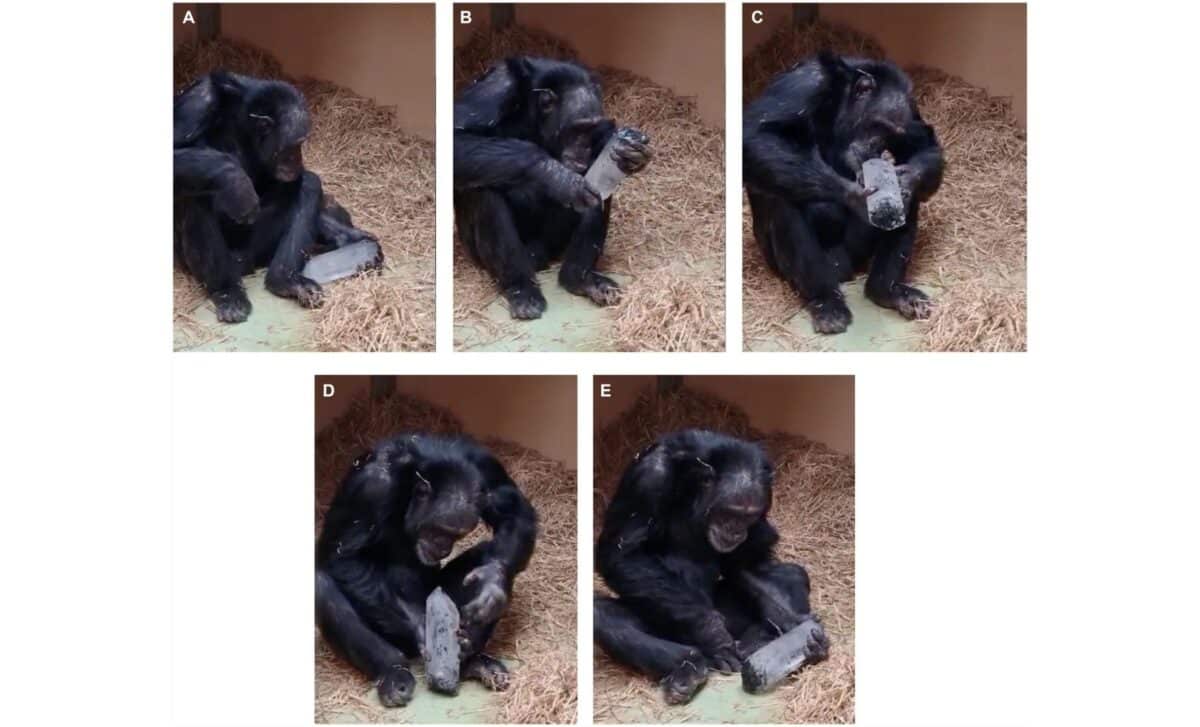
The chimps ignored the rock almost entirely, none devoted more than two minutes to it, while all five members of one group interacted with the crystal repeatedly. It was eventually carried into the dormitory and kept there for nearly two days. When caretakers finally tried to retrieve it, they had to negotiate with the animals using bananas and yogurt.
The second set of experiments embedded smaller crystals within piles of roughly 20 ordinary pebbles. According to the study, the chimpanzees identified and removed the crystals within seconds, consistently leaving the pebbles behind, a result confirmed as statistically significant at p < 0.0001. One chimp, Yvan, retrieved a small quartz crystal from a pile and held it close to his eye for more than 15 minutes, repeating the inspection both outdoors and later inside the dormitory.
A second chimp, Sandy, went further: after collecting a mixed handful of crystals and pebbles, she methodically separated them into two distinct groups, placing transparent quartz, milky calcite, and opaque metallic pyrite together, and setting the rounded pebbles aside.
Transparency and Shape: Two Separate Attractors
Pinpointing exactly which crystal property drove the behavior required some experimental untangling. As the research team noted, when transparent and non-transparent crystals were mixed into the piles, the chimps collected both equally, suggesting that geometric shape alone was sufficient to trigger selection. But when well-formed, flat-faced crystals were mixed with rounded, shapeless transparent ones, the animals again took both, pointing to transparency as an independent draw.
The conclusion reached by García-Ruiz and colleagues is that both properties function as what they call “perceptual attractors”, features that stand out sharply in environments dominated by organic, curved forms. According to the paper, the natural world of savannahs and forests offers almost nothing with straight lines, flat faces, or sharp angles. Trees branch and curve.
Water carves fractal patterns. Animals are rounded. Crystals are, in this context, genuinely anomalous, the only naturally occurring polyhedral objects that early hominins or modern chimpanzees would ever encounter in the wild. That geometric singularity, the researchers argue, would have made them immediately conspicuous to any mind trained to detect pattern and difference.
A Window Into Hominin Cognitive Evolution
The archaeological record for crystal collection by human ancestors is both extensive and puzzling. According to the study, 20 quartz crystals were discovered at China’s Zhoukoudian site alongside Homo erectus remains estimated to be at least 600,000 years old and possibly older than 800,000. Similar finds have emerged in India, Austria, and South Africa across a vast span of time. A 2021 paper cited by the research team documented calcite crystals collected by early modern humans in South Africa’s Kalahari region approximately 105,000 years ago, transported from a distant geological source to a rockshelter, with no evidence of any practical use whatsoever.
García-Ruiz and his colleagues suggest that the chimp experiments may illuminate why. If both humans and our closest living relatives share a spontaneous attraction to crystalline geometry and transparency, that pull could reflect something cognitively deeper than learned behavior, a shared perceptual bias predating the human lineage itself. The paper raises the possibility that encountering crystals may have nudged early hominin minds toward recognizing symmetry, regularity, and Euclidean form in a world that otherwise offered none, potentially contributing to the development of symbolic thought and early artistic abstraction.
The researchers are careful to note that the study’s sample was small and limited to enculturated, sanctuary-raised chimps, meaning the results need confirmation through future work with wild apes before stronger conclusions can be drawn. But the pattern, seen across species and across nearly a million years of archaeological sites, is difficult to dismiss as coincidence.
First Appeared on
Source link






