


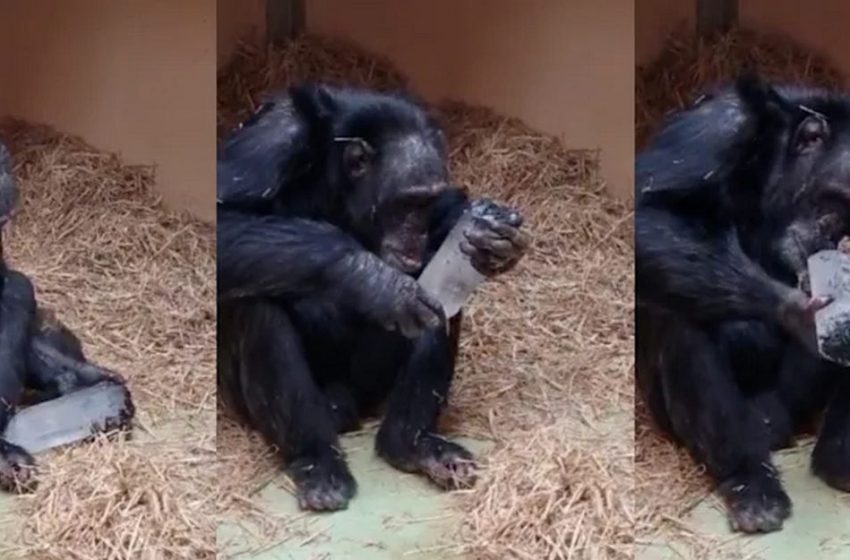
Chimps’ Love for Crystals Could Help Us Understand Our Own Ancestors’ Fascination with These Stones
Scientists have found that chimpanzees are attracted to crystals, seem to value them, want to keep them where they sleep, and can easily distinguish any stone that shines or glitters from others that don’t.
The researchers were hoping to understand whether our own species’ long documented appreciation (bordering on obsession) with crystals, gems, and precious metals, extends even further back down our evolutionary timeline.
The findings must be taken with several grains of sodium chloride crystal, but may open up a fascinating field of study into the origins of value.
Maybe you’ve experienced this: news comes out about a large diamond or ruby selling at auction for the same price as a house, and you or a friend have a brief moment of wondering, “why?”
Similarly, maybe you subscribe, or at least sympathize, with Warren Buffet’s long-held views on gold—namely that it’s nothing but a shiny rock—”a barbarous relic,” as the Oracle of Omaha famously said.
But even so, there’s something about the appeal of shiny rocks that clearly transcends logic, and that’s been true not only for the 5,500 year history of gold’s use as money, but for likely our entire existence.
Crystals have repeatedly been found at archaeological sites alongside Homo remains. Evidence shows hominins have been collecting these stones for as long as 780,000 years. Yet, we know that our ancestors did not use them as weapons, tools, or even jewelry. So why did they collect them at all?
Something about these stones made them desirable, even when they weren’t used for anything, and hoping to understand why, Spanish scientists conducted an experiment with 9 encultured chimps at a primate rescue center.
Encultured means that the animals have had extensive contact with humans, and is the first reason to hold one’s horses regarding scientific conclusions, but the results of the experiment nevertheless left the scientists “amazed.”
“We were pleasantly surprised by how strong and seemingly natural the chimpanzees’ attraction to crystals was,” said lead author Juan Manuel García-Ruiz, a professor in San Sebastian in crystallography. “This suggests that sensitivity to such objects may have deep evolutionary roots.”
Modern humans diverged from chimps between 6 and 7 million years ago, so we share substantial genetic and behavioral similarities. To find out if fascination with crystals is one of them, the researchers provided two groups of chimpanzees (Manuela, Guillermo, Yvan, Yaki, and Toti in group one and Gombe, Lulú, Pascual, and Sandy in group two) with access to crystals.

In the first experiment, a large quartz crystal—called the monolith—was placed on a platform, along with a normal rock of similar size. While initially both objects caught the chimps’ attention, soon the crystal was preferred and the rock disregarded. Once they had removed it from the platform, all chimps inspected the crystal, rotating and tilting it so they could view it from specific angles. Yvan then picked up the crystal and decisively carried it to their hay-lined sleeping huts.
A second experiment showed that the chimps could identify and select smaller quartz crystals—similar in size to those found in hominin site excavations—from a pile of 20 rounded pebbles within seconds.
When pyrite (Fool’s Gold) and calcite crystals, which have different shapes than quartz crystals, were added to the pile, chimps still were able to pick out crystal-type stones.
“The chimpanzees began to study the crystals’ transparency with extreme curiosity, holding them up to eye level and looking through them,” García-Ruiz said. The animals then immediately, like the monolith experiment, took them back to their dormitories.
Chimps repeatedly examined the crystals for hours. Sandy, for example, carried pebbles and crystals in her mouth to a wooden platform where she separated them.
“She separated the 3 crystal types, which themselves differed in transparency, symmetry, and luster, from all the pebbles. This ability to recognize crystals despite their differences amazed us,” García-Ruiz said.
The authors pointed out that chimps don’t usually use their mouths to carry objects, so this could mean they were hiding them, a behavior consistent with treating the crystals as valuable, the team pointed out. It could, however, also mean they were testing to see if they were edible, but maybe not.
A MYSTERIOUS CRYSTAL: Huge Black Diamond Sold for $4.3 Million–and No One Knows Where it Came From or How it Was Formed
Another behavior by the chimps demonstrated the potential that they understood a value proposition in the crystals: that in order to get them back, the researchers had to barter for them, with substantially more pounds of food then the crystal. If indeed they were testing to see if it were edible, the amount of food they demanded in return seems strange.
Philosophically, the food trade experiment mirrors the classical value paradox of gems and precious metals.
One can’t eat a gemstone or gold coin, yet they cost far more than bread. Starving to death, one would trade every gemstone on Earth for a loaf of bread, so why do we assign them so much value? Based on how many bananas and how much yogurt García-Ruiz and his team had to offer, it could be that chimpanzees fall into that same paradox.
An interesting hypothesis as to why the chimps found the crystals interesting is their shape.
SHINY ROCKS TO CATCTH THE EYE: ‘Alien’ Minerals Never Found on Earth Before Reveal Their Traumatic Origin Story
Crystals are the only natural polyhedral objects, meaning the only natural solids with many flat surfaces. When early humans tried to make sense of their environment, their cognitive processes might have been drawn to patterns that were unlike what they knew.
The clouds, trees, mountains, animals, and rivers of the natural world surrounding our ancestors were defined by curvature and ramification, so few items had straight lines and flat surfaces.
The combined observations from the experiments identified that both the transparency and the shape as alluring properties to the chimps. It might have been the same qualities attracting early humans to these rocks.
APISH ASSOCIATIONS: Staggering Finds Show Early Humans Lived Alongside the Very Apes They Evolved from
However, the fact that the chimps had long become accustomed to living with humans should, the researchers note, be considered a limiting factor in interpreting anything conclusively from the studies. Ideally, García-Ruiz said, the experiment should be replicated with wild apes, and preferably not only with Chimps, but also bonobos and gorillas.
Michael Haslam, an archaeologist with Historic Environment Scotland, told the New York Times that the great apes aren’t the only animals that value crystals: some birds have been known to collect them. Bowerbirds, fascinating birds that will decorate their nests with all sorts of objects, have been documented arranging quartz crystals around the perimeter of their nest to attract females.
The gemstones of our marketplaces today are just certain kinds of scarcer crystals that are cut and polished, and there’s every reason to suspect that if the Hope Diamond were placed in front of Sandy, or the male bowerbird, they’d behave exactly the same.
SHARE This Story With Your Friends Who Love Crystals, Or Hate Them…
First Appeared on
Source link






