


Could a nasal swab help detect Alzheimer’s earlier? Duke researchers think so :: WRAL.com
Newly approved Alzheimer’s drugs are offering hope for patients and their families, but they work best when the disease is detected early.
On Wednesday, a new study published by Duke researchers highlights the surprising place that may help doctors spot the disease sooner: the nose.
Dr. Brad Goldstein, a Duke Health physician and professor at the Duke School of Medicine, is leading new efforts to investigate whether a nasal swab could be used to spot early signs of Alzheimer’s.
“I see a range of patients with problems affecting the nose and sinuses,” Goldstein said. “My lab studies smell loss or olfactory problems, and there is a very strong association between smell loss and neurodegenerative diseases like Alzheimer’s disease and Parkinson’s disease.”
Goldstein told WRAL he first began working with the Alzheimer’s Disease Research Center, founded in 2021 in partnership with Duke and UNC, to study the connection further.
“We wrote a grant a few years ago to the NIH, proposing the idea of using the nose as a window into the nervous system to try and learn more about both smell loss and Alzheimer’s disease,” Goldstein said.
He said the idea was to think of the nose as “a window to the brain.”
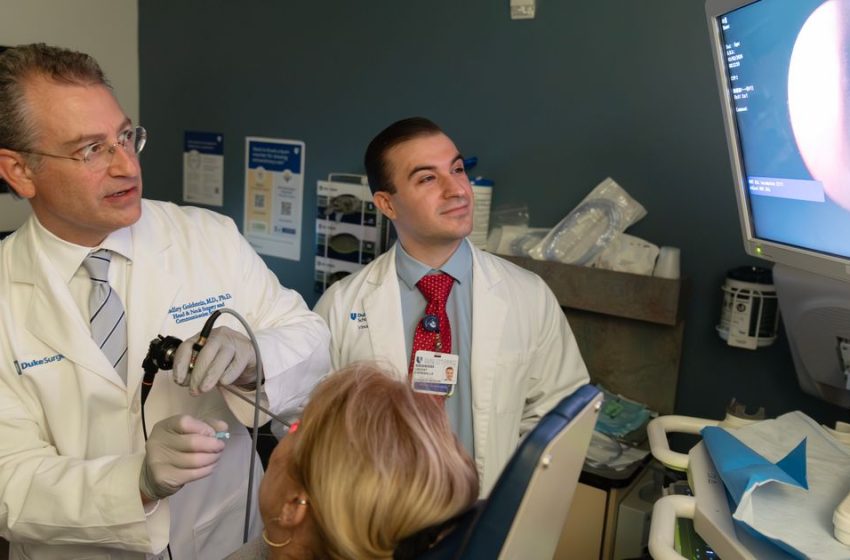
“We had the idea of revisiting the notion of sampling this area in the back of the nose where both neural tissue and immune cells live,” said Goldstein. “We look at the nose with a little endoscope and a light, and take a small brush and swab that area.”
Researchers first numb the nose with a spray, then use a small olfactory brush to collect tissue from the back of the nose.
Alzheimer’s develops slowly as abnormal proteins build up in the brain over many years, eventually leading to memory loss and cognitive decline.
Detecting the disease early has been difficult because many tests only identify the proteins once significant damage has already occurred, and sampling brain tissue in living patients is invasive.
The nasal swab procedure researchers are studying could offer a much simpler and less invasive alternative.
“Right now the standard things are a little more invasive,” Goldstein explained. “A lumbar puncture to sample spinal fluid and measure chemicals and things that are in there. It’s invasive and not without some risks.”
Other tests like amyloid PET scans are less invasive but are expensive, and therefore not widely used as the standard of care. Blood tests that are currently approved for use look for markers that only appear later in the disease’s progression.
“We’re looking at neural and immune tissue. We’re not looking at things that are leaking out into the serum and into the blood,” the researcher noted.
Alzheimer’s is the sixth-leading cause of death in the U.S. Caring for people with Alzheimer’s was estimated to cost the U.S. more than $380 billion in 2025, according to the Alzheimer’s Association.
Goldstein said the findings are early and more research is needed, but stated, “The difference we could potentially make in preventing disease progression for patients and families would be huge.”
Mary Umstead was one of the people drawn to Goldstein’s research. The 60-year-old Durham resident is all too familiar with the burden the disease brings.
Umstead lost her sister, Mariah, at the age of 62 to Alzheimer’s disease.
“She was the most wonderful person,” Umstead said. “She was really warm and kind and genuine, along with being smart and funny.”
Her sister’s earliest symptoms were initially brushed off as ‘getting old,’ Umstead said. Looking back now, she said she realized her sister struggled for years before her diagnosis.
“It started out slowly as we all do as we get older, we can’t think of the name for things, or we confuse the name for things,” Umstead shared.
Behavioral changes then set in with Mariah growing more irritable, a common symptom of the neurodegenerative disease.
Umstead said her sister began working 80-hour weeks as she struggled to keep up with tasks that once came easily.
“We had to always keep an eye on her just to make sure she was safe,” Umstead said. “She was just a very capable person. To watch her lose that capability and to watch her lose herself – heartbreaking.”
Umstead told WRAL she was eager to get involved with the study. She said participating felt like a way to help other families facing the disease.
“If I could give hours or days to anybody with their loved one, I would,” she said.
Umstead continued, “They now have medications that won’t cure the disease, but slow the progress. If you know that earlier, maybe you can save more of who that person is. Save more of who your loved one is and their sense of humor and their snarky self — the parts that you love about your people.”
Umstead said she’ll always remember Mariah as her big sister who “made everyone feel seen,” even the tiniest among us.
“She once saw a hummingbird caught in a spider’s web. She rescued the hummingbird and the hummingbird rested in her hand for a minute before it flew away,” Umstead recalled. “She felt bad for the spider, so she found a fly and gave that to the spider. She didn’t want the spider not to have its dinner.”
When asked what her advice was for other caregivers, Umstead said to remember, “It’s not a sprint, it’s a marathon.”
“Get support, and get help,” she said. “If people offer to help, let them.”
As she cuddled Mariah’s stray-turned-loveable housecat Stormy, Umstead urged us all to cherish the small things.
“They say, ‘Stop and smell the roses,’ but you know, stop and lick the ice cream! Or call your friend. Or do the thing that’s on your bucket list. There’s no need to wait,” she said. “We put off things and we think we have all the time in the world, and that’s just not guaranteed.”
First Appeared on
Source link






