


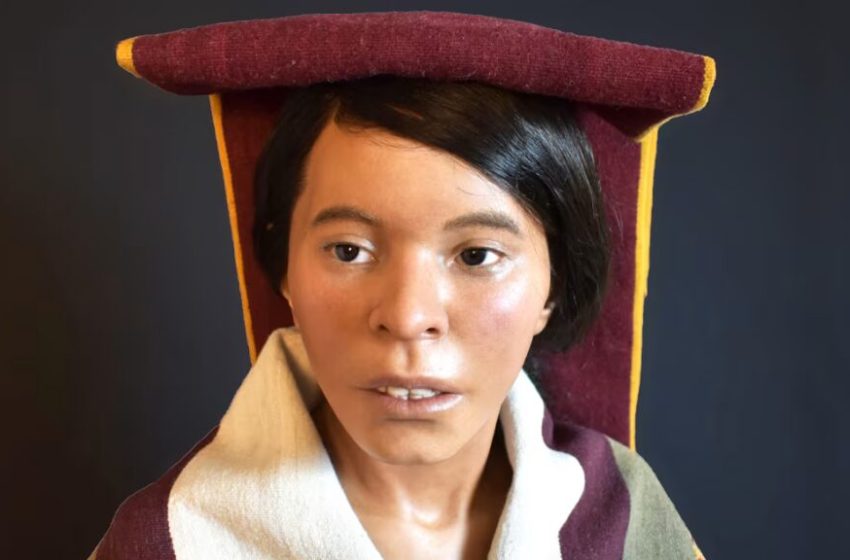
CT Scans Mummified Inca Children Reveal a Violent Secret Hidden for 500 Years
When you slide a 500-year-old frozen child into a high-resolution CT scanner, you expect to see the preservation of the past. What you don’t expect to find are stones where a heart should be and the unmistakable shadow of a club strike to the skull.
Yet that’s exactly what researchers found when they analyzed mummies from high in the Andes, nearly 5,800 meters (19,000 feet) above sea level. The remains of four Inca children sat there for five centuries, the freezing air preserving their bodies so well that their skin, hair, and clothing survived almost untouched.
For decades, historians relied mostly on Spanish colonial accounts to understand who these children were and how they died. Those records described them as flawless offerings to the gods. The new study shows that they weren’t in perfect health and at least one may have been killed somewhere else and prepared before being placed on a mountaintop. Also, instead of simply being left to die, the evidence suggests they suffered deliberate, violent blows to the head.
“Although historical sources describe the children as physically perfect and without flaws, modern scientific analyses reveal a very different reality,” Dagmara Socha, first study author and an archaeologist at the University of Warsaw, told Live Science.
The Grim Reality
Scientists recently used computed tomography (CT) to look inside these famous “ice mummies” without lifting a single thread of their clothing. Led by Dagmara Socha from the University of Warsaw, the team examined four female remains, including the world-famous “Lady of Ampato”—also known as Momia Juanita.
Three of the children were found on Ampato, a dormant 6,288-metre (20,630 ft) stratovolcano in the Andes of southern Peru. Archaeologists believe the human sacrifices may have been done to “calm” a nearby volcano. The fourth child came from a shrine near the Sara Sara volcano, about 160 kilometers (100 miles) away.
These children were part of a ritual known as capacocha, one of the most important ceremonies in the Inca Empire about 500 years ago. During these rituals, selected children or young teenagers were sacrificed and placed high in the mountains to serve as ‘messengers to the gods,’ known as Apus. As the air at such heights is extremely cold and dry, their bodies naturally mummify.
In the past, researchers could only examine the outside of the mummies or rely on written records. Unwrapping or dissecting them would have damaged the remains. This is where CT (computed tomography) scans changed everything.
Bizarre Rituals and CT Scans
The biggest shock was that these children didn’t just succumb to the cold. The scans revealed that all four likely died from severe, intentional blows to the head. We’re talking about blunt-force trauma from wooden clubs or ritual tools. This directly contradicts earlier assumptions that some victims were left to freeze or suffocate. In at least one case, the trauma appears to have been sudden and violent.

The 10-year-old girl showed especially surprising findings. Her abdominal and chest organs had been removed after death. In their place, researchers found stones and pieces of textiles. Her body had also been arranged carefully in a seated position, with knees drawn up to her chin.
This is the first clear evidence that one of these high-altitude Inca mummies was deliberately prepared after death. Scientists suggest this may have been done to correct what were seen as physical imperfections before presenting her to the gods.
“The evidence suggests that these children … continued to function as mediators between the living community and the divine Apus [Andean deities] long after their deaths,” Socha added.
The scans also showed that the children were not in great health. The eight-year-old girl had an enlarged esophagus, possibly linked to Chagas disease — a parasitic infection common in the region. Scarring in her lungs may indicate tuberculosis. These conditions were likely widespread in the Inca population at the time.
We still don’t know everything
Five centuries ago, these girls were sent to the peaks to talk to gods. In practical terms, this meant they were brutally killed and sacrificed. Their story was changed into a more palatable, ceremonial version.
But today, they’re talking to us, through science. They’re rewriting the history of the Inca Empire, proving that the capacocha was even more complex (and more desperate) than the Spanish chronicles ever let on.
However, there is much more to know. For instance, the current study focused on only four mummies. More scans of other high-altitude mummies could help confirm whether organ removal or post-mortem manipulation was common practice or rare.
Plus, in the future, researchers may combine CT imaging with DNA testing, chemical analysis, and isotope studies to learn even more, such as where the children came from, what they ate, and whether they were related.
The study is published in the Journal of Archaeological Science: Reports.
First Appeared on
Source link







