


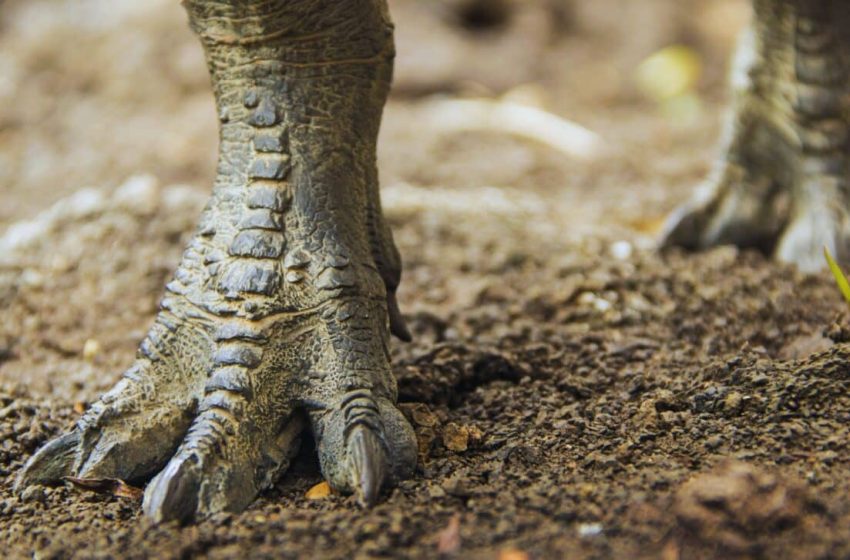
Dinosaurs Were Speed Demons, New Fossil Footprints Prove They Could Sprint Like Athletes!
Newly discovered fossilized footprints in Mongolia reveal that some dinosaurs could run at speeds rivaling top cyclists. This surprising discovery is changing how scientists think about dinosaur movement and confirms long-standing theories that smaller dinosaurs were actually fast sprinters.
Studying footprints gives researchers a unique window into how dinosaurs lived. Unlike bones, which only show us parts of the animal’s body, footprints capture a moment in time, revealing how the animal moved. The tracks found in Mongolia, dating back around 120 million years, have given scientists fresh insight into the speed and agility of one dinosaur, which appears to have sprinted at speeds that could match those of professional cyclists.
A Revolutionary Discovery
The tracks were discovered in Cretaceous sediments in Mongolia, and they belong to two different types of dinosaurs. One set of tracks came from a large theropod, which was moving at a slow pace. However, the other set, found in excellent condition, comes from a medium-sized dinosaur, probably from the Eubrontidae family, that was sprinting at full speed. This dinosaur is believed to have reached speeds of up to 45 kilometers per hour, a remarkable feat for an animal of its size.
“This speed represents the fastest known theropod trackway in the Cretaceous period,” wrote the authors. “Biomechanical modeling consistently indicates that large theropod dinosaurs (particularly those weighing over 1,000 kg) typically employ walking or low-speed running gaits, whereas small and mid-sized theropods are capable of achieving greater running speeds.”
This discovery supports ideas that researchers have had for years. Models and simulations suggested that medium-sized theropods could run fast, and these footprints confirm that the theory was right.
How Scientists Measure Dinosaur Speed
So, how do scientists figure out how fast a dinosaur was running based on its footprints? The process starts with estimating the size of the dinosaur from the impressions of its feet. Then, by measuring the distance between each step, researchers can calculate the dinosaur’s stride length, which is a key factor in determining speed.
The next step involves comparing the stride length to the height of the dinosaur’s hips. A ratio higher than 2.9 indicates that the animal was running, and the theropod from Mongolia scored an impressive 5.25, showing it was sprinting at full speed.
“The running speed of the mid-sized theropod identified in this study aligns with predictions from existing biomechanical models for dinosaurs of comparable size, thereby providing substantial support for biomechanical research and further enhancing our comprehension of the locomotor capabilities of theropod dinosaurs,” explained the paper authors.
This method, explained in a study in Science China Earth Sciences, proves that medium-sized theropods were not only agile but also much faster than we previously thought, adding another layer to our understanding of their abilities.
First Appeared on
Source link






