


Dinosaurs Were Thriving Until The Very End, New Study Finds
The final days of the dinosaurs were far from the slow decline many scientists once imagined. A groundbreaking study published in Science reveals that dinosaurs were flourishing in diverse ecosystems right up until the asteroid impact that ended their reign 66 million years ago. Conducted by researchers from Baylor University, New Mexico State University, the Smithsonian Institution, and international collaborators, the research rewrites one of paleontology’s most debated chapters, the fate of the dinosaurs before the Cretaceous–Paleogene extinction event.
A Final Flourish In New Mexico
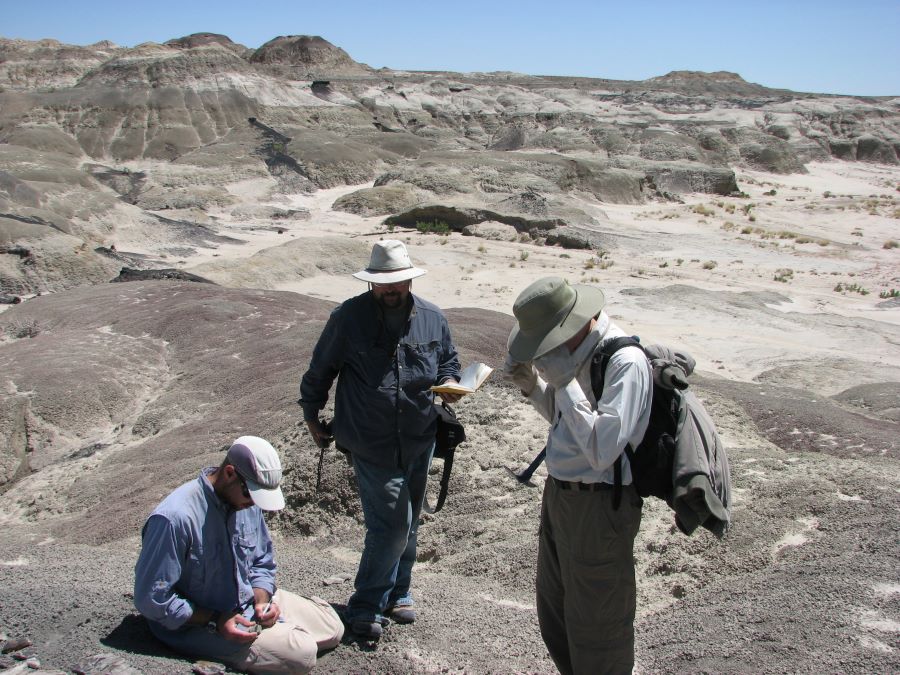
Recent excavations in northwestern New Mexico have uncovered fossils in the Naashoibito Member of the Kirtland Formation, offering a rare snapshot of life just before the asteroid struck. The region’s rock layers date between 66.4 and 66 million years ago, placing them directly at the boundary of the Cretaceous and Paleogene periods. These findings challenge the long-held belief that dinosaurs were already in decline.
“The Naashoibito dinosaurs lived at the same time as the famous Hell Creek species in Montana and the Dakotas,” said Daniel Peppe, Ph.D., associate professor of geosciences at Baylor University. “They were not in decline – these were vibrant, diverse communities.”
The fossils revealed a dynamic environment where titanosaurs, hadrosaurs, and ceratopsians thrived in rich ecosystems that showed no sign of collapse. The region preserved not a dying world but one teeming with biological diversity and ecological complexity. Such evidence indicates that dinosaurs in this part of North America were not merely surviving; they were thriving until the catastrophic event that abruptly ended their dominance.
Dinosaurs Were Not Fading Away
According to the Science study, researchers compared fossil records from New Mexico, Wyoming, and Montana, revealing that dinosaur ecosystems were regionally distinct, forming what scientists call bioprovinces. These divisions were driven more by temperature gradients than by mountains or rivers. Each region supported its own unique species assemblage, adapted to local environmental conditions.
“What our new research shows is that dinosaurs are not on their way out going into the mass extinction,” said Andrew Flynn, Ph.D., assistant professor of geological sciences at New Mexico State University. “They’re doing great, they’re thriving and that the asteroid impact seems to knock them out. This counters a long-held idea that there was this long-term decline in dinosaur diversity leading up to the mass extinction making them more prone to extinction.”
This shift in understanding overturns decades of assumptions. Rather than a fading empire of dinosaurs dwindling toward extinction, it appears that their end was instantaneous and catastrophic, not gradual. The asteroid that struck Earth 66 million years ago did not merely extinguish a weakened lineage; it annihilated a flourishing one.
Life After Impact
The study also sheds light on what followed. After the asteroid impact, mammals began to evolve rapidly, adapting to new ecological roles that opened up in the devastated post-dinosaur world. Interestingly, the biogeographic divisions that once shaped dinosaur ecosystems persisted into the Paleocene epoch, influencing how mammals diversified.
“The surviving mammals still retain the same north and south bio provinces,” Flynn said. “Mammals in the north and the south are very different from each other, which is different than other mass extinctions where it seems to be much more uniform.”
This continuity suggests that while the asteroid impact triggered a mass extinction, it did not entirely erase the underlying ecological frameworks of the planet. The legacy of the dinosaurs’ final ecosystems helped guide how life rebounded after the disaster.
First Appeared on
Source link






