


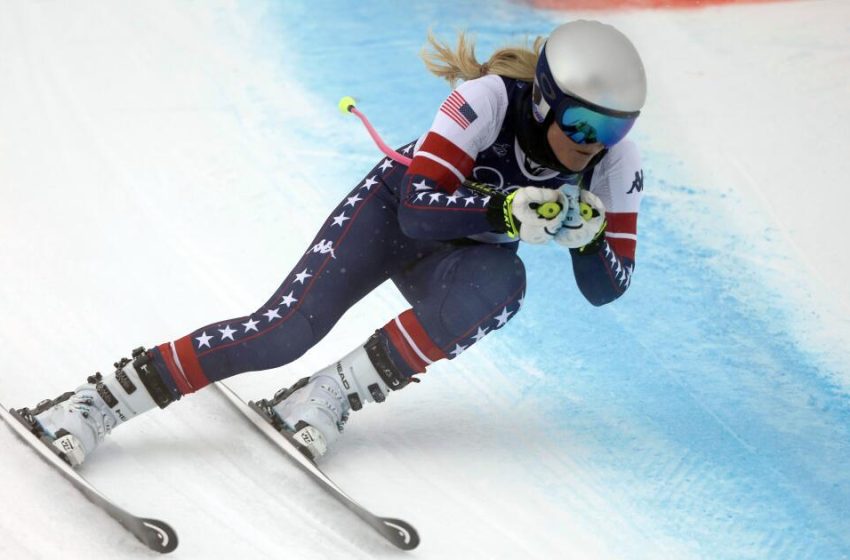
Doctors explain how Lindsey Vonn can ski at Olympics without use of ACL
MILAN — One short week after Lindsey Vonn crashed in Switzerland and tore her left anterior cruciate ligament, she was tearing down the hill in Cortina, Italy, a light knee brace warping the fabric of her racing suit the only sign of anything amiss. When she finished the training run, clocking the third-fastest time for a U.S. woman Friday, she casually fist-bumped a teammate at the finish line.
She made the feat look effortless. Sports medicine experts can say it’s anything but.
“It’s atypical to be able to compete without an ACL, at anything, but especially at a high level like Lindsey Vonn’s going to compete at,” said Clint Soppe, a board certified orthopedic surgeon and sports medicine specialist at Cedars-Sinai Medical Center. “So this is very surprising news to me as well.”
The ACL, which connects the shin bone to the femur, is a main stabilizing force in the knee and protects the lower leg from sliding forward. Straight-line movement doesn’t stress the major knee ligament and some day-to-day tasks such as walking are easily accomplished without an ACL. But what Vonn is doing is far from normal.
“If you add cutting, pivoting, changing directions, in 95% of humans, you need an ACL to do that,” said Kevin Farmer, an orthopedic surgeon and professor at the University of Florida’s department of orthopedics and sports medicine. “She’s obviously fallen into that 5%.”
Farmer calls the rare group “copers.” They overcome the lack of an ACL by strengthening and engaging other muscles. It’s primarily the hamstrings and quadriceps, but everything counts, including the glutes, calves, hips and core.
Vonn will have had just nine days between her injury and the Olympic downhill race when she stands at the start gate Sunday. But the 41-year-old has had her whole career to develop the type of strength and control necessary to carry her through the Games without an ACL.
Lindsey Vonn concentrates ahead of a downhill training run in Cortina d’Ampezzo on Friday.
(Marco Trovati / Associated Press)
And she’s competed despite the injury before.
Vonn skied on a torn right ACL for more than a month until withdrawing just before the 2014 Sochi Olympics. In 2019 she won a bronze medal at the world championships without a lateral collateral ligament and with three tibial fractures in her left knee. She said last week that the same knee feels better than it did during that bronze medal run.
“She’s dealt with knee injuries in this knee before, so she’s been able to develop mechanisms and strategies,” Farmer said. “She probably doesn’t even realize that, but just from years of practicing with a knee that’s not normal, her body has developed mechanisms of firing patterns that allow her knee to have some inherent stability that most people don’t have.”
When athletes suffer major injuries for the first time, pain often prevents them from firing their muscles, said Jason Zaremski, a nonoperative musculoskeletal and sports medicine physician and clinical professor at Florida’s department of physical medicine and rehabilitation. But Vonn, whose injury history is almost as long as her résumé, looked calm during training, coach Aksel Lund Svindal said Saturday.
So even if she’s one ACL short, Vonn’s team knows she has more than enough of the intangibles to get her not only down the mountain but also into medal contention.
“Her mental strength,” Svindal told reporters in Cortina d’Ampezzo. “I think that’s why she has won as much as she has.”
Vonn completed her second run Saturday with the third-fastest time before training was suspended after 21 athletes. She was 37-hundredths of a second behind compatriot Breezy Johnson, who is intimately familiar with what Vonn is attempting.
Johnson, a medal contender who led the second training run at 1 minute 37.91 seconds, attempted to ski in Cortina d’Ampezzo without an ACL in 2022. She had one successful training run but crashed on the second one, sustaining further injuries that forced her to withdraw from the Beijing Olympics.
Johnson, like many, gasped when she saw Vonn’s knee buckle slightly on a jump during training Saturday. She said coming off jumps on this course is especially difficult.
“There are, I think, more athletes that ski without ACLs and with knee damage than maybe talk about it,” Johnson said at a news conference. “… I think that people often are unwilling to talk about it because of judgment from the media and the outside.”
Critics say Vonn is taking a spot from a healthy teammate or that she simply refuses to give up the sport for good. But Vonn has come to terms with the imminent end of her career. She said she came out of retirement with a partially replaced right knee simply wanting an opportunity to put the perfect bow on her ski racing career at a course she especially loves.
The stage is different, but the sentiment is familiar to Zaremski. The doctor has worked with high school athletes who beg for a chance to play a final game after suffering a torn ACL. Through bracing, taping and treatment, sometimes there are temporary fixes for the biggest moments.
“If we’re trying to get a huge event like the Olympics, I would never put anything past her,” Zaremski said of Vonn. “She’s an amazing, once-in-a-generation athlete.”
First Appeared on
Source link






