


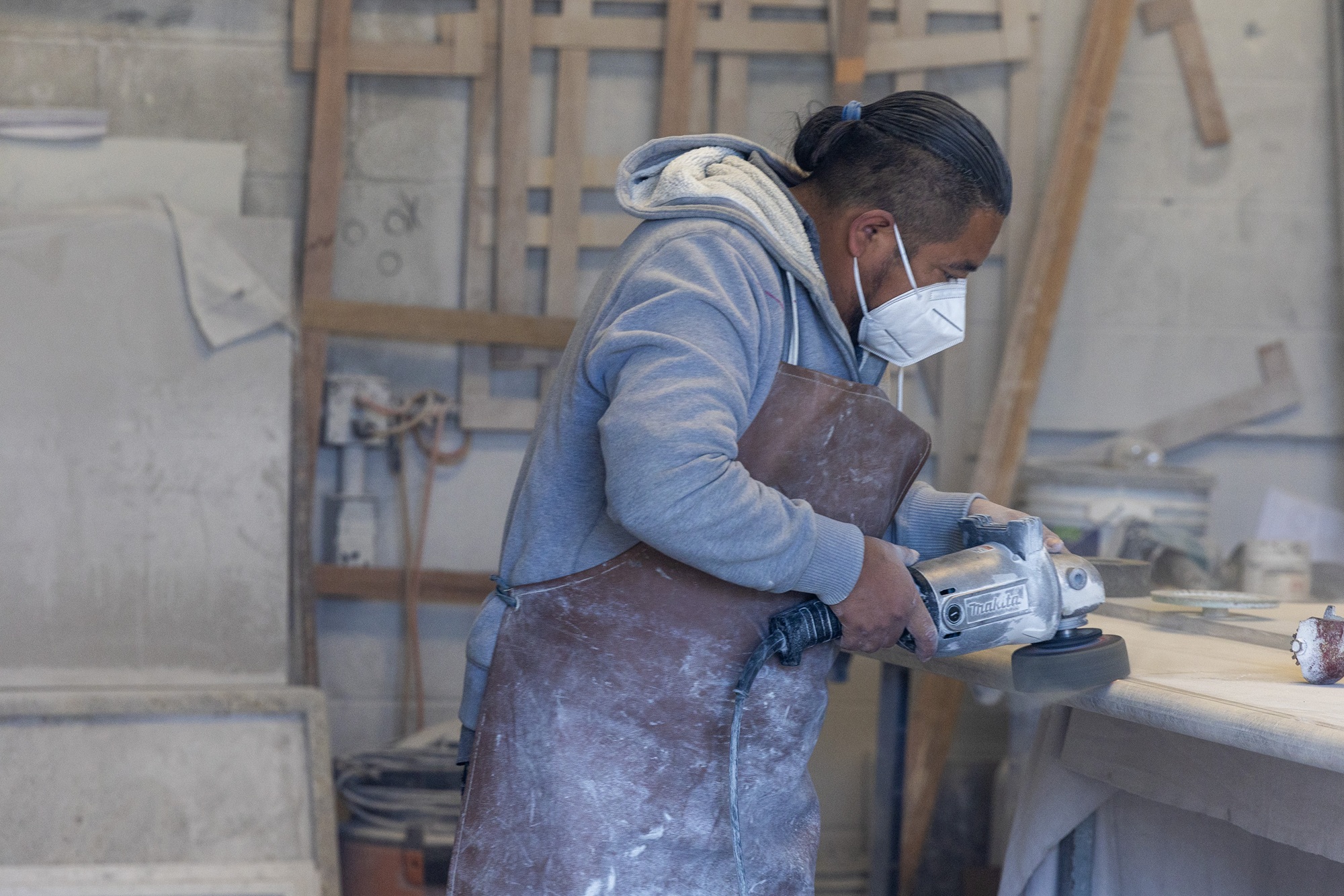
Doctors Petition California to Ban Countertop Material Linked to Deadly Disease
“As long as this dangerous material remains available and is purchased and used in California, it’s inevitable that people will continue to be exposed and die,” Robert Blink, an occupational medicine doctor in San Francisco and former WOEMA president, told KQED. “There’s always resistance to change. But when you’ve got something this dangerous out there that’s literally killing people … we’ve got to stop this from going up. This is not a time for small measures, frankly.”
Engineered stone can contain more than 90% crystalline silica, much more than natural stones such as marble. The factory-made material’s popularity has skyrocketed because it is stain-resistant, produced in attractive colors and designs and is often cheaper than natural stones. But many consumers are unaware of the hazards that artificial stone dust poses to the workers who shape and install their countertops.
Growing scientific evidence has shown that the silica dust released by the material is so toxic that small amounts of exposure are enough to make workers sick. The tiny airborne particles can penetrate filter masks and lodge in the lungs, causing progressive scarring and injury in workers, some as young as their 20s.
Dozens of silicosis cases have also been reported by doctors in Illinois, Utah, Colorado, Massachusetts, as well as other states that are not tracking the disease as systematically as California’s public health authorities. Those figures are widely believed to be underreported. Israel, Spain and other countries have also seen a surge in silicosis tied to engineered stone. Medical experts in the UK are urging authorities to prohibit the use of the material.
James Nevin, an attorney at Brayton Purcell, a firm that represents hundreds of sick workers suing major manufacturers and distributors of artificial stone, said clients are located in 16 other states, including New York, Nevada, Florida, Kentucky and Hawaii.
California currently bans the dry cutting of engineered stone and mandates the use of wet methods — machines that submerge or cover the material’s surface with water to suppress dust. Employers are also required to implement local exhaust ventilation, ensure employees wear powered air-purifying respirators and take other measures.
But Cal/OSHA inspectors have found most of the 120 shops they’ve visited in the last two years were violating the rules, which fabricators and doctors consider too expensive and challenging for many employers to follow. California has about 4,600 countertop fabrication workers.
Major manufacturers, such as Israel-based Caesarstone, did not immediately return requests for comment on the California ban proposal, but publicly opposed a prohibition in Australia. A spokesperson for Cosentino, a company headquartered in Spain, also declined to comment, but told KQED last month that silicosis is preventable when proper safety and health measures are in place to protect workers.
Both companies, which face hundreds of lawsuits by workers claiming silica-related injuries in the U.S. and other countries, have developed crystalline silica-free products for the Australian market but continue to sell high-silica engineered stone in the U.S.
First Appeared on
Source link






