


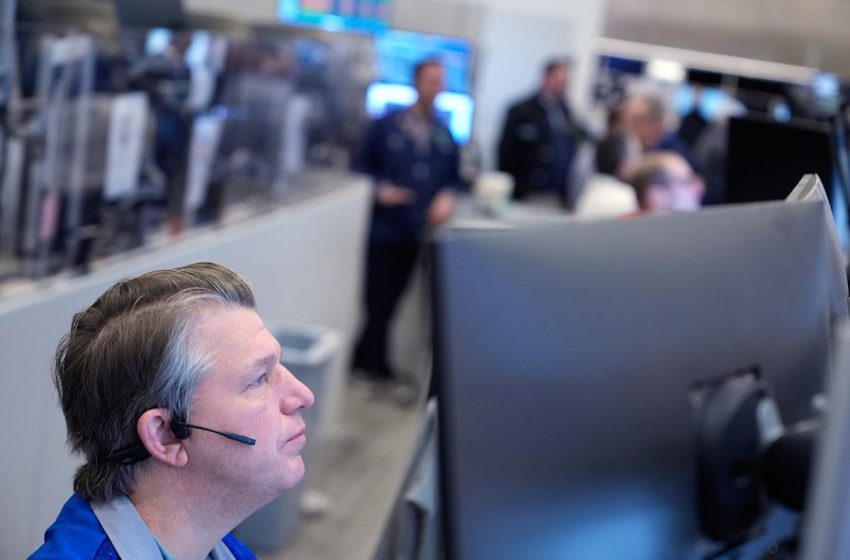
Dow falls more than 800 points, S&P 500 and Nasdaq sink as Iran war jitters return with another oil surge
US stocks fell on Thursday as Wall Street failed to build on a rebound session, with conflict in the Middle East holding focus amid a renewed surge in oil prices.
The Dow Jones Industrial Average (^DJI) led the way down with a drop of over 1.8%, or more than 800 points. The S&P 500 (^GSPC) fell around 0.8%, and the tech-exposed Nasdaq Composite (^IXIC) lost 0.6%.
Focus remains on conflict in the Middle East, as attacks between the US-Israel coalition and Iran have spread across the region. Thursday marks the sixth day of violence, with no immediate signs of abatement.
Trump said on Wednesday that the US was “doing very well on the war front,” while the White House announced that American forces had struck more than 2,000 targets and were moving toward “complete and total control of Iranian airspace.”
As the fourth-largest OPEC oil producer, the impact of Iran’s reduced production capabilities has wide-ranging effects across commodities and stocks, with concerns that surging oil prices might force the Fed to evaluate interest rates in a volatile market.
Looking at oil, prices have begun to rally again. Supply concerns eased after Trump said the US will offer risk insurance and naval escorts for ships transiting the Strait of Hormuz, but damage to infrastructure and tankers in the region has renewed nerves. West Texas Intermediate (CL=F) futures traded near $79 a barrel, while Brent crude (BZ=F) traded above $84.
On the economic calendar, Friday sees a highly anticipated monthly jobs report, offering investors another read on the health of the labor market.
Earnings season, while slowed, continues with Costco (COST) and Marvell Technology (MRVL) releasing results after the close on Thursday.
LIVE 26 updates
-
2 of 3 market warning lights are flashing
Geopolitics has no playbook, so watch this one closely. On Wednesday, I outlined three markets with key levels to gauge if the risk-off theme might accelerate.
First, crude oil. WTI (CL=F) just tagged $82 per barrel and is holding over $80. This changes the macro narrative where inflation fears compound fast. That’s a red warning light.
Second, the dollar. If the US dollar index (DX-Y.NYB) pushes above 100, financial conditions tighten and risk markets usually feel it. It’s still only slightly above 99, so that warning light isn’t quite flashing.
Third, the S&P 500 (^GSPC). America’s benchmark index is teetering on the 6,800 level with only minutes left in the trading day. A close below 6,800 says the shock is sticking and turns that warning light red.
Peering inside the S&P, industrials are the weakest, down the most since April 2025. Even defense names like Raytheon (RTX) and Lockheed Martin (LMT) — the “flight-to-safety trade” from earlier in the week — are getting tagged. Meanwhile, energy (XLE) is having trouble staying green.
-

Gold slide amid broader market sell-off
Gold (GC=F) futures tumbled more than 1% on Thursday amid a broader market sell-off. The safe-haven asset was sold off amid a move higher in the US dollar, making it more expensive for foreign buyers.
Silver (SI=F), platinum (PL=F), and palladium (PA=F) futures also sold off.
A strong greenback also put pressure on stocks and crypto. The 10-year Treasury also sold off as yields rose.
-
It’s not just gasoline. Diesel reacting ‘more aggressively’ to oil price jump amid Iran war.
It’s not just gasoline prices spiking at the pump. Diesel has jumped even more since the outbreak of the Middle East war as oil prices have surged.
The national average for gas touched the highest level this year at $3.25 per gallon on Thursday, up $0.27 from a week ago, according to AAA data.
Diesel jumped by $0.41 over the same period to $4.16 per gallon, its highest level since 2023.
Read more here.
-
Trump replaces Secretary of Homeland Security Kristi Noem
President Trump announced the replacement of Homeland Security Secretary Kristi Noem with Oklahoma Senator Markwayne Mullin.
“I am pleased to announce that the Highly Respected United States Senator from the Great State of Oklahoma, Markwayne Mullin, will become the United States Secretary of Homeland Security (DHS), effective March 31, 2026,” wrote Trump on social media.
Kristi Noem will be moving to serve as Special Envoy for The Shield of the Americas, a new security initiative that will be announced on Saturday.
-

US oil crosses $80 for first time since January 2025 as Iran conflict rages on
Futures on US oil (CL=F) crossed $80 for the first time since January 2025 in midday trading on Thursday, breaking through a key resistance level as the growing conflict in Iran has sent prices surging throughout the week.
West Texas Intermediate crude, the US pricing benchmark, gained more than 7.5% today to trade above $80.20 at around 1:25 p.m. ET. Futures on the international benchmark Brent (BZ=F) have picked up a smaller 4.5% to trade above $85 for the first time since July 2024.
WTI and Brent have now gained more than 20% and more than 17%, respectively, as the Iranian conflict has forced traffic through the key global chokepoint, the Strait of Hormuz, to stand still and increasingly impacted major energy infrastructure, such as Saudi Arabia’s Ras Tanura refinery, which is now offline.
The war has impacted countries throughout the Gulf, from Oman and Bahrain to Lebanon, Saudi Arabia, and the UAE.
Saudi Arabia is attempting to divert its oil flows through its East-West Pipeline that passes through the country to the Red Sea, but the pipeline can only absorb roughly 5 million to 7 million barrels per day against the roughly 20 million bpd that crosses through the Strait of Hormuz on a normal day.
-
BofA: Sticky services inflation ‘warrants caution’ as the Fed considers further rate cuts
When so-called core PCE inflation came in a 3% for December, dovish members of the Fed were quick to attribute the uptick to the White House’s tariff regime — but they’re looking at the wrong variable, according to Bank of America economists Aditya Bhave and Stephen Juneau.
Tariffs have contributed roughly 50 basis points to core PCE inflation, “but that’s only half the Fed’s inflation problem,” the economists wrote in a client note published Thursday morning. More worrying, they wrote, is sticky services inflation that “warrants caution from the Fed.”
If the Fed were to continue easing with deeper rate cuts, the central bank would be taking “the risk that a 30-50bp inflation overshoot gets entrenched,” Bhave and Juneau wrote.
Traders are currently pricing in a 97.3% chance that the Fed will leave the target rate unchanged at 3.5% to 3.75% in its upcoming March meeting, with expectations remaining that the Fed will cut rates by 25 to 50 basis points by the end of the year.
-
Mortgage rates edge back up to 6%, but 5% loans are still in play
Yahoo Finance’s Hal Bundrick reports:
-
Federal Reserve terminates Wells Fargo’s enforcement action after nearly a decade of improvements
The Federal Reserve said it lifted its 2018 enforcement action against Wells Fargo (WFC), following its determination that the bank had met all required conditions.
For nearly a decade, Wells Fargo was required to demonstrate that it had improved its governance and risk management programs and vet that work through two third-party reviews.
The termination of the enforcement action came nine months after the Fed lifted Wells Fargo’s $1.95 trillion asset cap last June, freeing the bank to compete more aggressively against major Wall Street investment players.
Wells Fargo stock was down 3% on Thursday as financial services stocks were beaten down across the board amid a widespread sell-off in stocks.
-

Oil shock, real yields, and the bond market’s warning
Bond yields are jumping with crude oil (CL=F, BZ=F) this week, but the move is looking bigger than a simple inflation scare (due to higher energy prices).
Since the weekend missile strikes on Iran, the US 10-year yield (^TNX) is up 18 basis points (its biggest weekly jump since May), while WTI just hit $79 a barrel — pushing toward its highest levels since mid-2022 and on track for its biggest weekly gain since the March 2022 Russia-Ukraine shock.
The tell is in the bond market math. Bond yields move for two reasons — expected inflation (so-called breakevens) and the inflation-adjusted return (real yields, often inferred from TIPS).
This week, breakevens are only up about 5 basis points, while real yields are up about 12 basis points. Translation: Investors aren’t just pricing inflation — they’re demanding more compensation to own long-term bonds (what’s called the term premium), and they’re dialing back expectations for Fed rate cuts.
And yes, WTI near $80 is a big deal. That level can flip the macro narrative from a short-lived spike to higher-for-longer energy costs — especially if any disruption risk around the Strait of Hormuz starts to look persistent.
-
Software stocks surge as AI disruption fears fade for now
Software stocks bounced back on Thursday as the artificial intelligence fears that had shocked the industry throughout much of February subsided.
The iShares Expanded Tech-Software Sector ETF (IGV) is up 5% over the past five days, outperforming a 1% loss for the S&P 500 (^GSPC) during the same period.
Several of its holdings also saw outsized gains on Thursday as sentiment changed. Last week, Anthropic (ANTH.PVT) announced new AI integrations that connect with several software products, which helped ease concerns.
Salesforce (CRM) stock rose 5% in early trading, while Intuit (INTU) gained 5%, Adobe (ADBE) added around 3%, and CrowdStrike (CRWD) also rose 3%. Online travel service Booking Holdings (BKNG) rose as much as 9%, marking its biggest intraday jump since April of last year.
-
Court rulings push forward tariff refunds, dealing a blow to the Trump administration
The court system is pushing tariff refund claims forward, ordering that the Justice Department can’t delay the issue and that the government must refund all illegally collected tariffs. The rulings come as a blow to the Trump administration, which is all but guaranteed to appeal the issue.
Yahoo Finance’s Washington correspondent Ben Werschkul reports:
-
Oil prices renew rally as conflict expands through Middle East and Strait of Hormuz remains at a standstill
Oil prices surged in a renewed rally Thursday morning, following 24 hours of relatively constrained trading, as the conflict engulfing the Middle East continued to expand.
Futures on Brent crude (BZ=F), the international pricing benchmark, rose by more than 3% to trade above $83.90 after crossing $84 later in the morning. US benchmark West Texas Intermediate crude (CL=F) gained more than 4% to trade above $77.70 after briefly touching $78.
The price pressures are twofold.
As the conflict enters its sixth day, the Strait of Hormuz remains effectively blocked. Iran’s Revolutionary Guard Corps has said the Strait remains open but has increasingly threatened tankers that attempt to cross the critical global energy chokepoint.
President Trump’s announcement that the US would provide insurance and security guarantees to vessels transiting the strait provided some temporary relief to markets, but insurance insiders say there is too much uncertainty to spur any immediate renewal in crossings.
At the same time, the conflict has widened, drawing in Qatar, Bahrain, Saudi Arabia, and the United Arab Emirates. Early Thursday morning, Israel ordered residents to leave southern Beirut in Lebanon as the IDF battles the Iran-backed terrorist group Hezbollah, and Azerbaijan vowed to respond to a drone attack.
-
Nvidia halts H200 production for China-bound chips, stock falls
Nvidia (NVDA) stock fell around 1% in the first half-hour of trading after the Financial Times reported that the firm had halted production of its H200 chip intended for the Chinese market.
The move suggests Nvidia doesn’t expect to sell the H200 chip in China anytime soon, after a protracted back-and-forth with Beijing and Washington over regulatory approval and export controls. While President Trump indicated that Nvidia would be able to sell the graphics processing unit (GPU) in January, Nvidia executives said in the most recent earnings call that they had not yet collected any revenue from the H200.
“While small amounts of H200 products for China-based customers were approved by the US government, we have yet to generate any revenue, and we do not know whether any imports will be allowed into China,” Nvidia CFO Colette Kress said.
According to the Financial Times, Nvidia supplier Taiwan Semiconductor Manufacturing Company (TSM) will reallocate manufacturing capacity from making H200 chips to making next-generation Vera Rubin hardware.
-
US stock market turns into red at the open
The US stock market fell on Thursday morning as Wall Street failed to build on a rebound session, looking toward labor data ahead of Friday’s jobs report to temper ongoing concerns over conflict throughout the Gulf region.
The Dow Jones Industrial Average (^DJI) led the decline, losing roughly 0.7%, while the S&P 500 (^GSPC) and the tech-exposed Nasdaq Composite (^IXIC) lost roughly 0.3% and 0.4%, respectively.
In the oil markets, prices have begun to surge again after flatlining Wednesday. Futures on West Texas Intermediate (CL=F) traded around $76 a barrel, while Brent crude (BZ=F) traded above $83.
Friday’s monthly jobs report will lead headline the economic calendar for the week. In the corporate world, Costco (COST) and Marvell Technology (MRVL) will report results after the close on Thursday.
-

Berkshire’s Abel purchases $15M in stock, vows to use take-home pay to keep buying
Berkshire Hathaway (BRK-B) CEO Greg Abel bought over $15 million of the firm’s stock, according to a regulatory filing, and said he would use all of his take-home pay to keep doing so.
“I already have some shares, but the goal was to continue to demonstrate alignment with them,” Abel told CNBC. “As the CEO, I absolutely, obviously, believe in Berkshire. … I inherited a company that has an incredible foundation.”
Berkshire also restarted share buybacks on Wednesday. Berkshire policy says the company may repurchase stock “whenever the chief executive — after consultation with the chairman of the board Warren Buffett — believes that the repurchase price is below Berkshire’s intrinsic value,” per CNBC.
Abel told the outlet that he consulted with Buffett — from whom he took over at Berkshire in January — about the move.
Berkshire’s Class B shares rose in premarket trading after falling early this week in the wake of the company’s quarterly earnings report. In that report, Berkshire revealed its operating profit fell 30% in the period, which included a 54% decline in its insurance underwriting earnings.
-
Initial jobless claims hold steady, undershooting estimates ahead of Friday jobs report
Data released by the Labor Department showed that 213,000 people filed initial jobless claims in the week ended Feb. 28.
The count of claims, steady from the previous week’s revised level, was below economist expectations of 215,000 initial claims. The labor market signal comes ahead of Friday’s critical February jobs report.
Continuing claims for the week ended Feb. 21 totaled 1.86 million, overshooting consensus estimates of 1.84 million.
Rhode Island, Oklahoma, and Tennessee saw the largest increase in initial claims for the week ended Feb. 21, the Labor Department said.
On Friday, investors will get the week’s standout labor-market reading with the Bureau of Labor Statistics nonfarm payrolls report. Economists are expecting to see 55,000 jobs added in February, roughly in line with January estimates before the month’s adds printed at a blowout 130,000.
On Wednesday, data provider ADP reported 63,000 jobs added to private payrolls, exceeding estimates of 50,000. Layoff announcements also slid in February from the previous month to 48,307 from 108,435, according to a new report released Thursday from the global outplacement firm Challenger, Gray & Christmas.
-
Challenger report: Job cut announcements declined last month
Yahoo Finance’s Emma Ockerman reports:
-
Retirement savers shook off 2025 volatility — and many became millionaires
Yahoo Finance’s Kerry Hannon reports:
-

Wall Street: AI’s ‘creative destruction’ coming for entire firms
It’s not just employees that have to worry about AI stealing their jobs, or creating labor uncertainty; it’s also entire companies. Some economists say the fears of an AI job apocalypse are overblown but the stock market thinks otherwise.
Bloomberg News reports:
-
Trade Desk stock rises following OpenAI report
Trade Desk (TTD) stock jumped 19% before the bell on Thursday after reports emerged from The Information that OpenAI has had early talks to partner with the platform, which offers automated services for advertisers to place ads on a large scale.
The Information reports:
First Appeared on
Source link






