


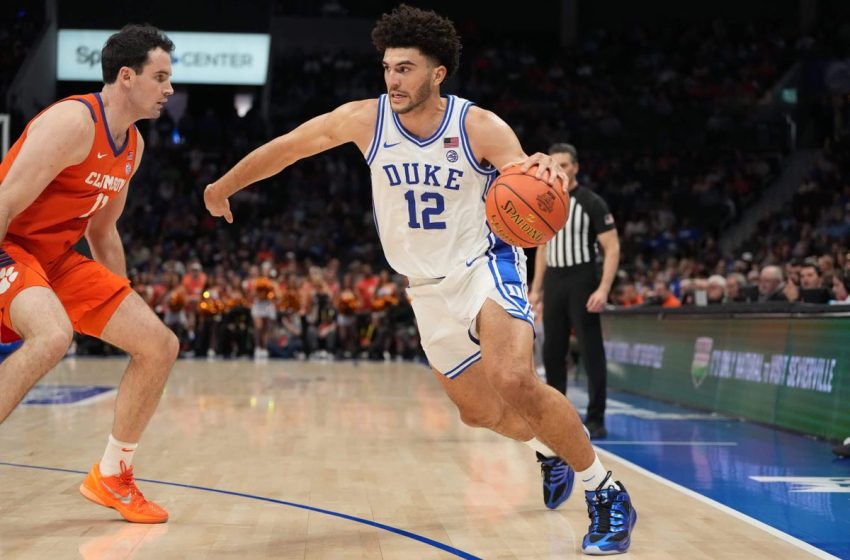
Duke, Arizona, Michigan and Florida earn No. 1 seeds in men’s NCAA Tournament
Duke, Michigan, Arizona and defending national champion Florida are the No. 1 seeds in the 2026 men’s basketball NCAA Tournament, with Duke claiming the No. 1 overall seed in the 68-team bracket and topping the East Region.
It’ll be Michigan in the Midwest, with Chicago as the site of the regional semifinals and finals, Arizona in the West (San Jose, Calif.) and Florida in the South (Houston). The East Regional semifinals and finals will be played in Washington, D.C. And the Gators may have to deal with a disadvantage if they can reach the Elite Eight — the No. 2 seed in the South is Houston, which would be playing at home if it can advance that far.
First
Round
Second
Round
Sweet 16
Elite
Eight
Final
Four
Final
Four
Elite
Eight
Sweet 16
Second
Round
First
Round
The biggest question of Sunday’s 68-team bracket unveiling on CBS was answered when the Midwest Region was revealed and 31-1 Miami (Ohio) popped up as a No. 11 seed. The RedHawks, upset by Massachusetts in the MAC tournament for their only loss of the season, got an at-large bid but will have to beat SMU in a First Four game in Dayton, Ohio, to reach the round of 64.
Those two got in over the first two teams out of the field, Oklahoma and Auburn from the SEC. Selection committee chair Keith Gill said on the broadcast that SMU got the nod in part because its recent slide of five losses in six games came without third-leading scorer B.J. Edwards (12.7 points per game) because of an ankle injury. He’s expected back for the NCAA Tournament.
Florida was the only mild question mark among the No. 1 seeds before the NCAA selection committee unveiled the bracket Sunday on CBS. The Gators lost 91-74 to Vanderbilt in Saturday’s SEC tournament finals, giving Connecticut and Houston a theoretical chance if they could collect enormous wins in their conference tournament finals.
Houston lost to Arizona, UConn lost to St. John’s, and Florida will be a top seed as it chases history.
If Todd Golden’s team can follow up last year’s national championship with another at the Final Four in Indianapolis, that will give the program consecutive titles twice in its history, after Billy Donovan’s teams won it in 2006 and 2007. UCLA is the only other program to have multiple repeat championships, in 1964-65 and from 1967-73 under John Wooden.
Michigan, like Florida, comes into the tournament looking to rebound from a loss, the Wolverines falling 80-72 to Purdue in Sunday’s Big Ten tournament title game. The Blue Devils, Wolverines and Wildcats all have looked like the most dominant team at various points this season.
Duke beat Michigan on a neutral floor and Florida at home, and Arizona beat Florida on a neutral floor in the season opener. Those are the only meetings among the No. 1 seeds this season.
Duke oversees the most loaded region, per the committee’s seeding of the teams. It will be joined by No. 2 seed UConn, No. 3 seed Michigan State and No. 4 seed Kansas. Arizona has No. 2 seed Purdue, No. 3 seed Gonzaga and No. 4 seed Arkansas. Gill said Purdue jumped to a No. 2 seed, dropping Michigan State to a No. 3 seed, because of the Boilermakers’ win over Michigan.
In the Midwest, Michigan is followed by No. 2 seed Iowa State, No. 3 seed Virginia and No. 4 seed Alabama. In the South, after Florida and Houston, it’s No. 3 seed Illinois and No. 4 seed Nebraska. If the Cornhuskers can beat No. 14 seed Troy on Thursday in Oklahoma City, they will make history with the first NCAA Tournament win in program history.
Eight conferences earned multiple bids, including the Mid-American Conference with two because Miami (Ohio) got the at-large bid and Akron won the conference tournament for the automatic bid. The SEC again led the way this year with 10 bids, followed by the Big Ten with nine, the ACC and Big 12 with eight apiece, the West Coast Conference with three and the Atlantic 10 with two.
First Appeared on
Source link






