


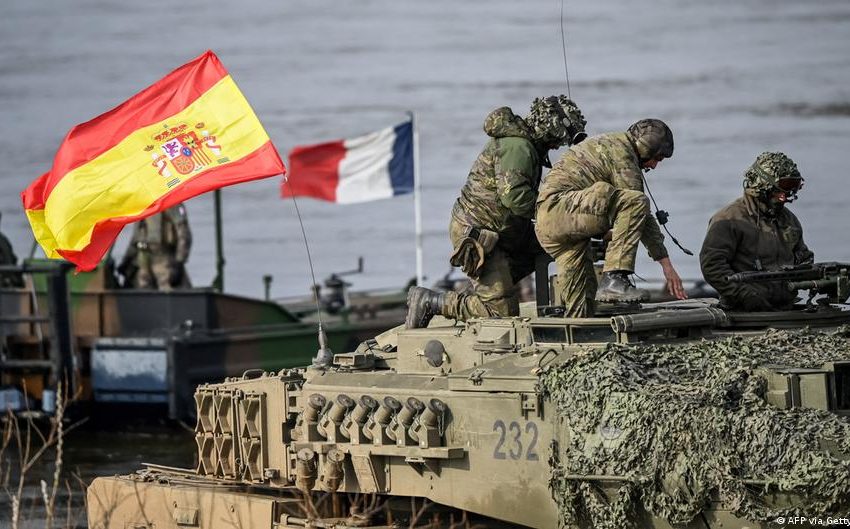
Europe looks to shore up own defenses amid US uncertainty
Europe’s collective defense still relies on the NATO trans-Atlantic alliance, the EU’s top diplomat told the Munich Security Conference on Sunday.
But there is an urgent need, Kaja Kallas said, for Europe to take the lead in its own defense.
Kallas, the European Commission’s high representative for foreign affairs and security policy, channeled the Avengers superhero franchise with her address, titled “Europeans Assemble! Reclaiming Agency in a Rougher World.”
She singled out Russia as Europe’s biggest threat, saying its “endgame” was not the Donbas region of Ukraine but a wider assault on the region.
“Russia already seeks to cripple economies through cyberattacks, disrupt satellites, sabotage undersea cables, fracture alliances with disinformation, coerce countries by weaponizing oil and gas,” said Kallas. “And of course there is also the nuclear threat.”
Europe’s shield, she said would be a new security strategy, pursuit of a larger bloc with the addition of new member states and new trade agreements beyond its borders like those with India, Mercosur and an upcoming deal with Australia. These partnerships also include security agreements.
“We are getting there, dusting off our capes, pulling on our boots, revving up our engines,” she said.
Stoltenberg: Europe has increased defense spending
Speaking on Sunday, MSC head Wolfgang Ischinger stressed the need to plan for European defense, in particular to “ramp up defense production and to create a more cohesive and globally competitive European defense market.”
Woven throughout speeches and soundbites from European leaders at the three-day event was an insistence they had started to deliver that, responding to demands from the Trump administration to pull their weight in NATO.
“The European Union is mobilizing up to €800 billion […] investing in the capabilities we need — from air and missile defense to drone and military mobility,” said European Commission President Ursula von der Leyen on Saturday. “We are delivering.”
Former NATO chief-turned-Norwegian finance minister Jens Stoltenberg said the US ultimatum had led to European allies and Canada spending “significantly” more on capability.
“When you listen to the US or the Trump administration, the criticism is not primarily against NATO, it’s against NATO allies not paying for NATO. And I think that’s a valid point, and Europeans are delivering,” Stoltenberg told DW.
EU members spent an estimated €381 billion ($452 billion) on defense in 2025 — up from €251 billion in 2021, prior to Russia’s invasion of Ukraine.
For Kallas, though, it’s not merely that NATO members need to meet Donald Trump’s demand for 5% of GDP spending on defense, but ensuring it’s spent wisely. She said European nations needed to cast their procurement nets wider to maximize return on investment.
“We have too many standards, we have too many different capabilities, and in order to bring down the costs, also bring down the procurement times, we really need to work together,” said Kallas. “It’s not only how much we spend, but actually how to spend it more wisely.”
Estonian Foreign Minister Margus Tsahkna said pooling Ukraine’s defense capabilities — now tested for four years in its conflict with Russia — was an opportunity for Europe to advance its own security.
“We need to understand in Europe that it’s not about a different national interest, about the defense industry,” Tsahkna told DW.
“There is no competition between each other. We actually need more support, more new innovation, and Ukraine is our opportunity.”
Europe considers defense future without US
In late January, NATO Secretary-General Mark Rutte told lawmakers at the European Parliament that those who thought Europe could defend itself without the United States should “keep dreaming.”
And US Secretary of State Marco Rubio, in a speech focused on preserving Western culture and defense in line with Trump’s values, said Saturday it wasn’t Washington’s “goal” to see the end of the trans-Atlantic alliance. Other US lawmakers mingling with the politicians, policymakers and security experts in Munich also tried to ease fears of a Trump-led withdrawal from the continent.
“Let us show [Europe] that we are trustworthy,” Delaware Senator Chris Coons — a Democrat — told DW. “That we are the reliable partners that you’ve come to count on for decades, and find ways that we can share the burden of our shared defense and security needs and find a positive path forward.”
But this weekend made it clear that Europe is prioritizing non-US partnerships — European Commission President Ursula von der Leyen explicitly singled out what she called Europe’s “closest partners” Norway, Iceland, the UK and Canada for new security collaborations, with the US a notable omission.
While talking up collective defense, European leaders were quick to emphasize the role of NATO for the continent’s overall security, particularly for its nuclear deterrent.
Leaders also scuttled talk of a unified European army as a kind of backup to NATO.
“NATO is actually the frame which is working, it’s not a theoretical thing, these are the plans and commitments protocols, so we cannot start creating something different,” said Tsahkna.
“If we become stronger in conventional capabilities, in cyber, in crisis management — if we take better care of Europe and other continents and thereby also relieve the United States — then I feel safe under the American nuclear umbrella, because the Americans also need us,” said Marie-Agnes Strack-Zimmermann, head of the European Parliament’s defense committee.
Washington’s message was that “the US needs a stronger Europe,” said Tsahkna. “Actually, we need a stronger Europe. And I think that this Munich conference showed that Europe is waking up.”
Edited by: M. Kuebler
First Appeared on
Source link






