


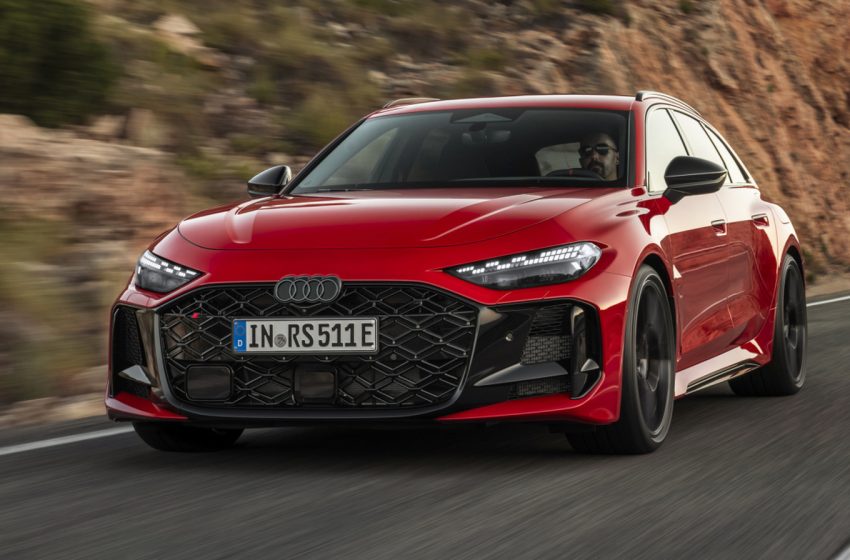
Even The New Audi RS5 Itself Looks Shocked By How Powerful Its PHEV V6 Is
I’m sure you’ve already seen the leaked images of the new Audi RS5 (wasn’t our fault!) so I’m going to dive right into it. This is the new Audi RS5, revealed for now only in European-spec form, though what we get in the U.S. will be essentially the same — aside from the fact that we probably won’t get the RS4-replacing RS5 Avant, instead being stuck with “just” the RS5 sedan, a liftback that replaces what used to be called RS5 Sportback.
These two new RS5s are the first Audi Sport cars to use a plug-in-hybrid powertrain, and it sounds like a doozy, combining the old cars’ twin-turbo V6 with an electric motor for a total of 630 horsepower. That’s even more than the RS6’s V8. It also has an electric range of over 50 miles, an advanced suspension setup, and the industry’s first electromechanical torque vectoring system at the rear. Audi promises its exhaust “underscores every throttle input with rich, full-bodied sound,” too.
It’s way wider
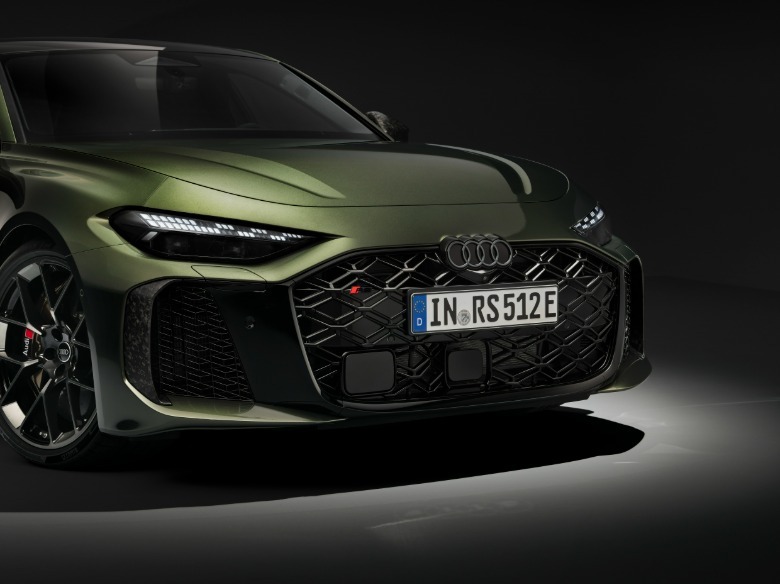
Even the RS5 itself looks shocked by the performance and tech it has. Audi’s definitely taken its singleframe grille to a new extreme here, giving the RS5 a prominent honeycomb pattern and large air curtains at either end. Aside from messy sensor integration — a common Audi problem these days — I actually really like the front end. Sure, it’s very mouthy, but I think it works. The RS5s in Audi’s press photos have black or carbon bumper inserts, but I want to see what it looks like in body color or silver, if either will be an option. Audi does say a black appearance package is standard, which is a shame.
 Audi
Audi
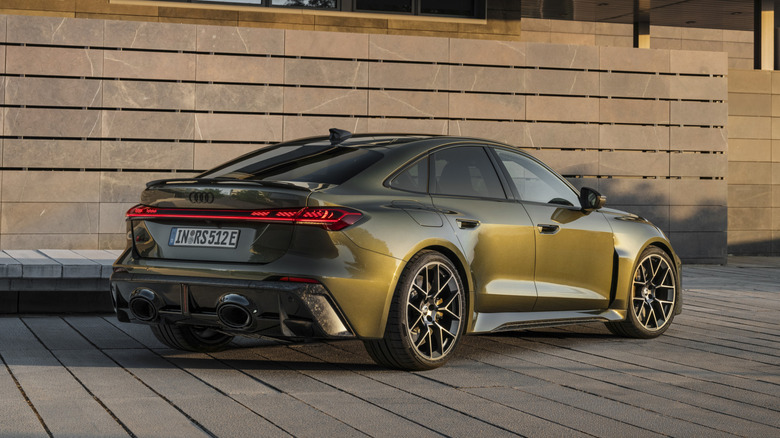
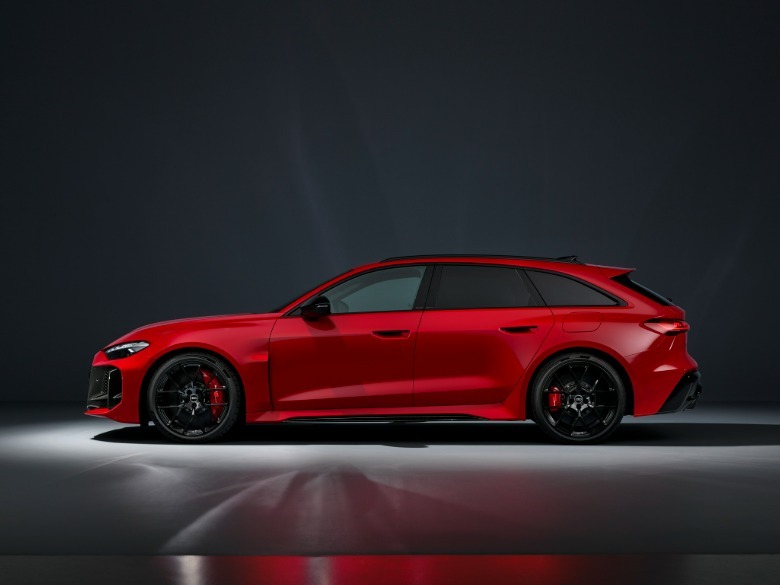
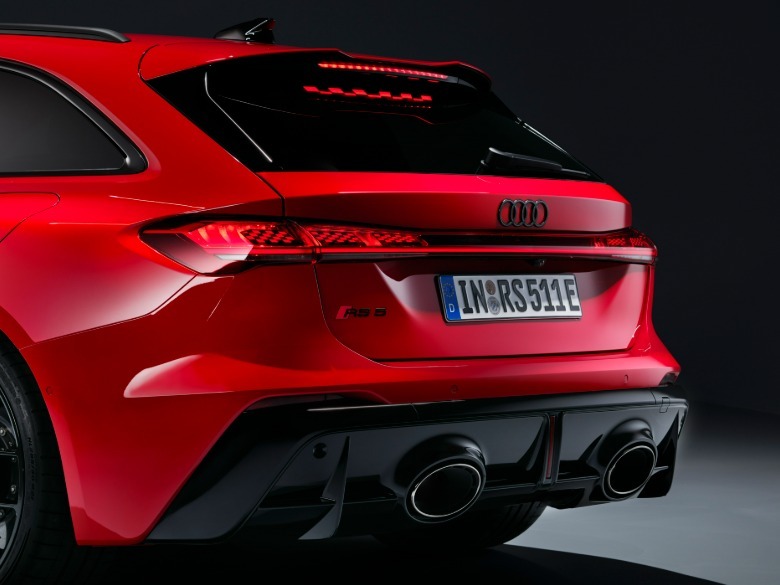
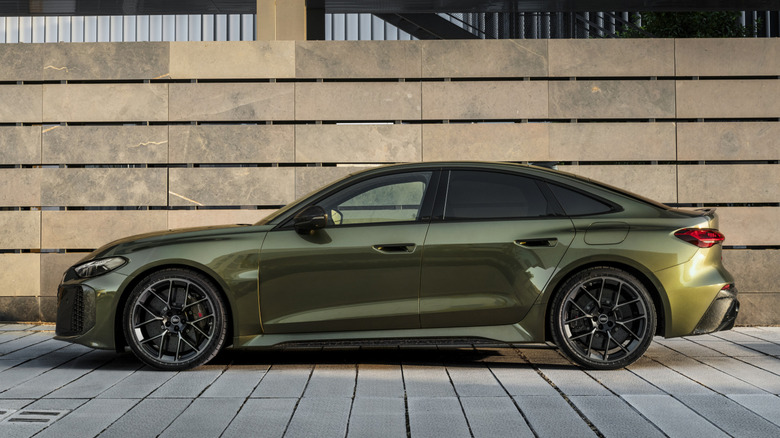
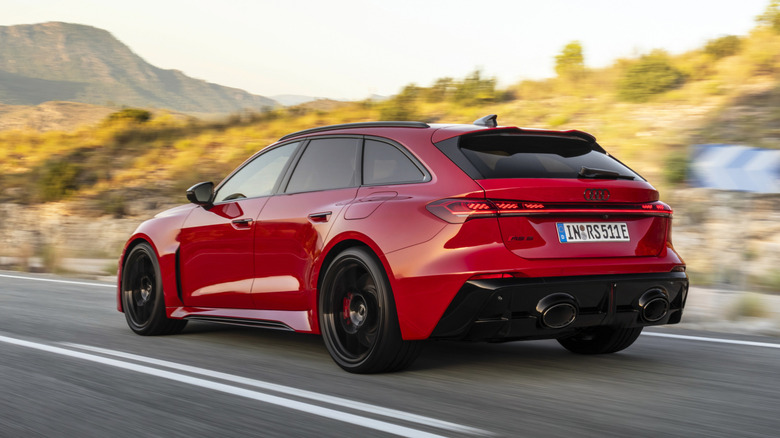
Audi widened each fender by more than an inch and a half, and it has some of the best boxy flares we’ve seen from an Audi production car maybe ever, plus real air vents behind the front wheels similar to the RS3’s. Unlike on a BMW M3, the RS5’s rear doors are new to better flow onto the wider haunch, and it just looks awesome from every angle. The rear diffuser is quite absurd, with a technical design and a pair of giant oval exhaust tips. There’s a little spoiler on the trunklid of the sedan, while the Avant has a slightly more pronounced spoiler on the tailgate. Sure, it sucks that we probably won’t get the wagon, but I think the RS5 liftback looks really damn good.
 Audi
Audi
20-inch wheels with 285/35 tires are standard, but you can option 21-inch forged wheels that come in an almost bronze color. There are nine color options to choose from, including “fascinating effect colors such as Merlin pearl effect, Goodwood green and Panther black crystal effect.” Surely Audi’s Exclusive division will be able to do whatever custom spec you want, too. Two of my favorite details are the checkered flag motifs in the headlights and taillights, and the checkered flag CHMSL that reflects down onto the Avant’s rear glass.
630 horsepower is a lot of horsepower
Okay okay, I know you want to hear more about the powertrain. Under the hood is an improved version of the same twin-turbo 2.9-liter V6 used in the old RS4 and RS5, making 503 horsepower (an increase of 59 hp) and 443 pound-feet of torque on its own. Inside of the torque-convertor 8-speed automatic transmission is an electric motor producing 175 hp and 339 lb-ft that also replaces the 12-volt starter motor, juiced up by a 25.9-kWh battery pack mounted above the rear axle under the trunk floor. Total system output is 630 horsepower and 608 lb-ft, going to all four wheels through Quattro all-wheel drive, of course.
Audi says the RS5 will accelerate from 0 to 62 mph in 3.6 seconds, a couple tenths off the RS6, on to a top speed of up to 177 mph. A boost button on the steering wheel activates full power for ten seconds, and it works even if the car is in electric mode, instantly turning on the engine and opening the exhaust valves. There’s as much as 54 miles of electric-only range in the city in the European cycle, and the battery can be charged at up to 11 kW, enough to go to 100% in two and a half hours. In the sportiest drive modes, the car keeps the battery at 90% to ensure maximum power is always available. There’s a new thermal management system for the battery that uses pumps, fans, and heat exchangers to keep it at 68 degrees Fahrenheit for consistent performance.
An invisible maestro
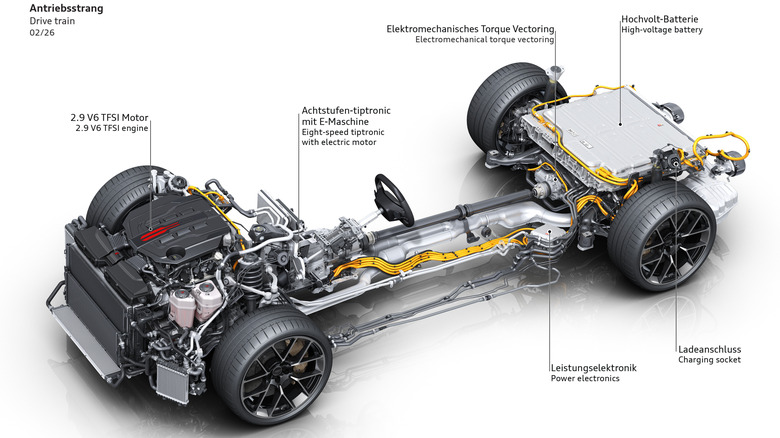
There’s a limited-slip center differential that can variable distribute torque from 70/30 to 15/85 between the front and rear axles, and it has a preload, which makes sure the axles are coupled even when no torque is being applied. This reduces understeer and increases steering responsiveness, especially when mid-corner when you’re off the throttle and weight is shifting, and also helps torque get transferred to the wheels faster.
 Audi
Audi
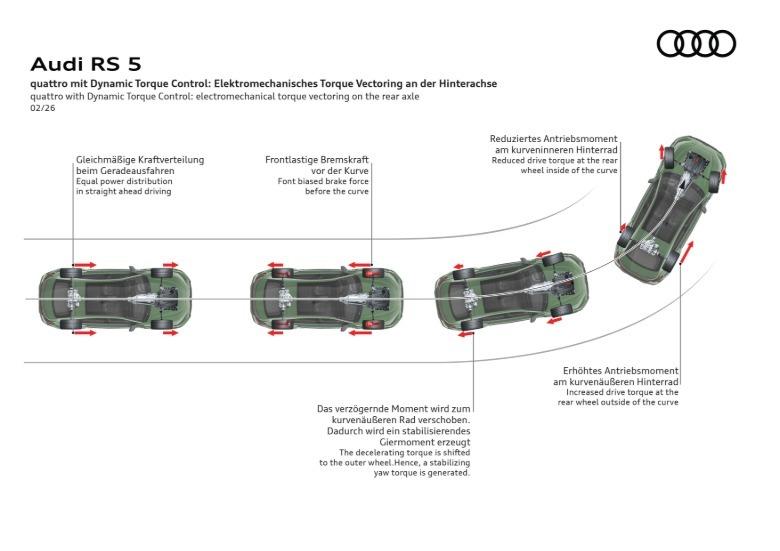
Being introduced on the RS5 is Audi’s Dynamic Torque Control, the rear-axle electromechanical torque vectoring system that it says “is the invisible maestro conducting an orchestra of driving fun and safety like never before.” As Audi explains it, better than I could:
This functionality is enabled by a central driving dynamics controller and the high-performance torque vectoring system. A water-cooled permanent-magnet electric motor with an output of 11 hp and 30 lb-ft serves as a high-voltage actuator, overdrive gears, and a conventional differential with low lock percentage are the key components. Combined, they can rapidly and precisely distribute torque between the rear wheels. It takes just 15 milliseconds – around a tenth of the blink of an eye – for the electro mechanical torque vectoring to deploy torque differences of up to 2.000 newton meters and react to any driving situation.
The overdrive gears use the actuator’s torque to transfer this difference to the wheels via the driveshafts. Unlike purely mechanical systems, electro mechanical torque vectoring can transfer torque in either direction. It operates accurately and reliably, both on and off throttle as well as under braking – irrespective of which way the forces are pushing. The result: both under forceful acceleration and sudden braking, the system’s full potential is always available.
Electro mechanical torque vectoring in the rear transaxle ensures a perfect balance between agility, stability, and traction. In a straight line, the system initially splits torque evenly between both wheels. When necessary, it shifts it to the wheel with better traction – guaranteeing the Audi RS5 maximum acceleration. When entering a corner, the torque differential has a stabilizing effect for high directional stability. At corner exit, torque is shifted to the outer wheel where it helps rotate the vehicle and realize its acceleration potential. Because the torque vectoring can be tuned differently for different cornering phases and different drive select modes, drivers can experience a broad range of driving characteristics in their RS5.
The driving dynamics controller (HCP1) makes this possible. It continuously analyzes many different input values: the driver’s inputs – such as steering angle, throttle position, and brake pressure – are all taken into account. As is data about the vehicles current state – such as longitudinal and transverse G forces, yaw rate, slip angle, speed, and the surface’s estimated friction coefficient. All computations happen in one place. At a frequency of 200 Hz – meaning every five milliseconds – the driving dynamics controller calculates the target differential torque for the given driving situation. This is then applied by the electro mechanical torque vectoring with the utmost dynamics and precision.
If you need a tl;dr, that all means the RS5 will have better traction, steering precision, power delivery and stability. It should make the car even more fun, too. There’s also an RS Torque Rear mode designed for closed-course drifting, with a special data recorder to go along with it.
Tested to extremes
The RS5’s suspension is a five-link setup front and rear with new twin-valve shock absorbers that have separately controlled compression and rebound. It’s been tuned on a hydro pulse system to make sure it can handle even the most extreme road surfaces and situations. The front axle has new joints, links and rubber bushings, while the rear axle is a clean sheet design necessitated by the DTC system that has elastic deformations to make sure the tires are always making contact with the road.
Audi says the steering ratio is more direct than the S5’s and reacts better to small inputs, promising that the car feels quick on its feet despite the sedan weighing 5,192 pounds. Steel brakes are standard, with a brake-by-wire system that primarily uses regenerative braking until more braking force is needed. Larger carbon-ceramic brakes are option, using carbon discs in the rear as well to bring the car to a stop from 62 mph in 100 feet. You’ll be able to adjust the amount of regeneration in three different stages, too.
Available in Europe this summer
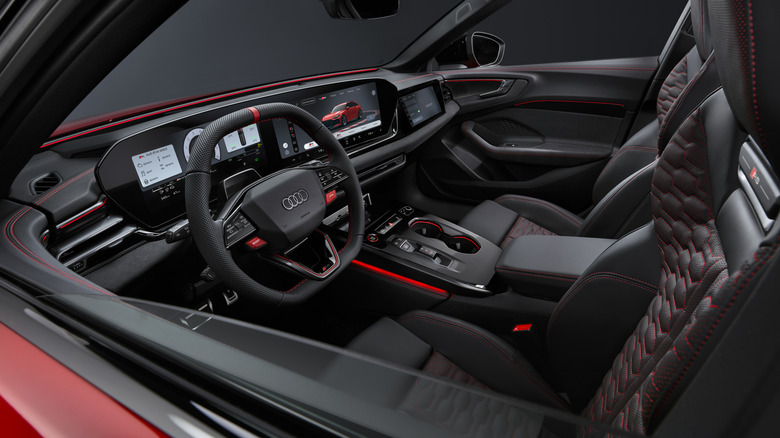
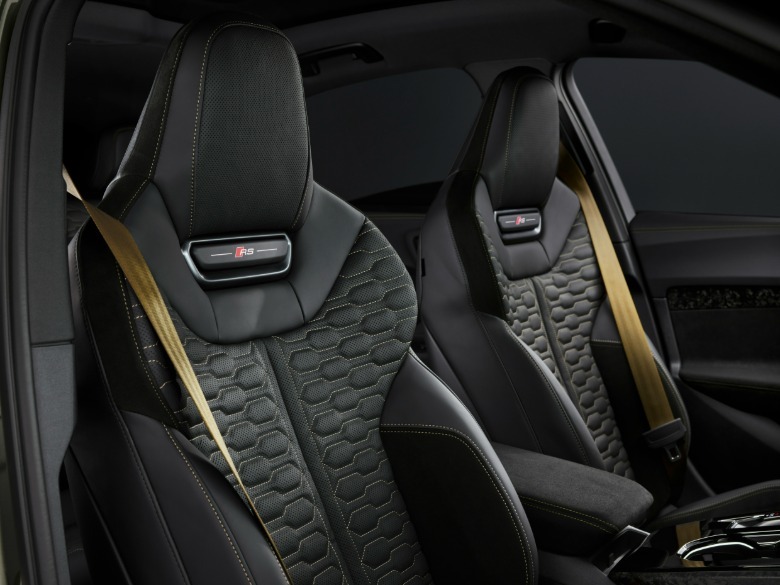
Ah, I haven’t mentioned the interior yet. There’s not as much exciting stuff to talk about in here. You get an 11.9-inch virtual cockpit and 14.5-inch touchscreen placed in the same surround, and the 10.9-inch passenger screen is standard. There are RS-specific designs for the gauge cluster and infotainment with a lot of performance pages, and the optional head-up display can show things like a launch control guide or shift indicator. The sport seats look very supportive, and I’m into the new steering wheel, which has a flat top and flat bottom and actual control knobs. You can pick from five different interior design packages with contrasting stitcing, seat belts and other colored accents, including a gold one that looks great.
 Audi
Audi
An Audi Sport package (shown on the sedan in these photos) adds different front and rear bumper designs, the option of Bedford Green metallic paint, bronze brake calipers, diamond-cut wheels, Serpentine Green and brass interior accents, and a higher top speed. With the Audi Sport package you can add a Carbon Camouflage package that adds lots of forged carbon trim.
 Audi
Audi
Both versions of the RS5 will be available to order in Europe this quarter before deliveries start in the summer. In Germany, the sedan will cost €106,200, the equivalent of around $125,000, while the Avant will be about €1,650 more expensive. It’s not clear whether those prices include the VAT, but even if they do, that’s a fairly big jump over the outgoing RS4 and RS5. I’d expect the starting price in the U.S. to be just around $90,000-100,000, about ten or twenty grand more than the old car. We’ll know more U.S.-specific details later this year.
First Appeared on
Source link






