



Experiments Ring the ‘Death Knell’ for Sterile Neutrinos
Neutrinos have about as little influence as a particle can have. They have essentially no heft, no electric charge, and no “color” charge. As a result, the neutrino has no connection with most of nature’s forces; it can slip through whole planets and stars without striking a single atom.
But neutrinos have proven more than capable of bending the life path of a scientist.
In the late 1990s, when physicists unexpectedly discovered that neutrinos have mass, Thierry Lasserre abandoned cosmology to go all in on the particles. “It was so exciting I just couldn’t resist,” said Lasserre, now a physicist at the Max Planck Institute for Nuclear Physics in Heidelberg, Germany. And Mark Ross-Lonergan was planning to be a meteorologist until a chance encounter with particle physics in 2010 inspired him to switch fields. Lassere and Ross-Lonergan, along with thousands of others, have devoted their careers to investigating this tiny and almost perfectly inert speck.
For more than a decade, their investigations seemed to be closing in on a breakthrough. Experiments reported strange acts of neutrinos appearing and disappearing. These results, along with neutrinos’ mysterious mass, all pointed to a single potential explanation: A particular “sterile” type of neutrino, of a particular mass, seemed to lurk undiscovered behind the scenes.
Researchers spent years running increasingly sophisticated experiments to pin down the interloper. However, in the face of an increasing number of null results, most notably in studies published in late 2025, most physicists now agree that this sterile neutrino doesn’t exist. “This is, in my opinion, the death knell for sterile neutrinos,” said Ross-Lonergan, a physicist at Columbia University and co-author of one of the latest studies.
These developments have only deepened the mysteries of neutrinos. Their apparent ability to appear in some experiments and vanish from others remains unexplained. And the fact that they have mass essentially requires them to be in contact with some undiscovered aspect of reality. For physicists, the particle’s influence continues unabated.
“It’s on us to learn how to get creative,” said Matheus Hostert, a physicist at the University of Iowa. “This is a very exciting time for the field, especially for theorists like myself who get to ask hard questions about all this data.”
Disappearing Act
Everything physicists know about neutrinos, they’ve learned through experiments that didn’t quite add up. “The whole field is built on a backbone of anomalies,” Ross-Lonergan said.
Wolfgang Pauli first inferred the presence of the neutrino in 1930 from a study of radioactive decays. In these decays, an atom of one element transforms into another while releasing its remaining energy in the form of an electron. But in certain decays, the electron doesn’t have enough zip. Pauli argued that some additional, invisible particle must be smuggling the leftover energy into the world. This particle, which he called “little neutral one,” would have no electric charge and no mass. It would interact with the atoms of our world only through the weak force, which makes radioactive decay possible by turning certain subatomic particles into others.
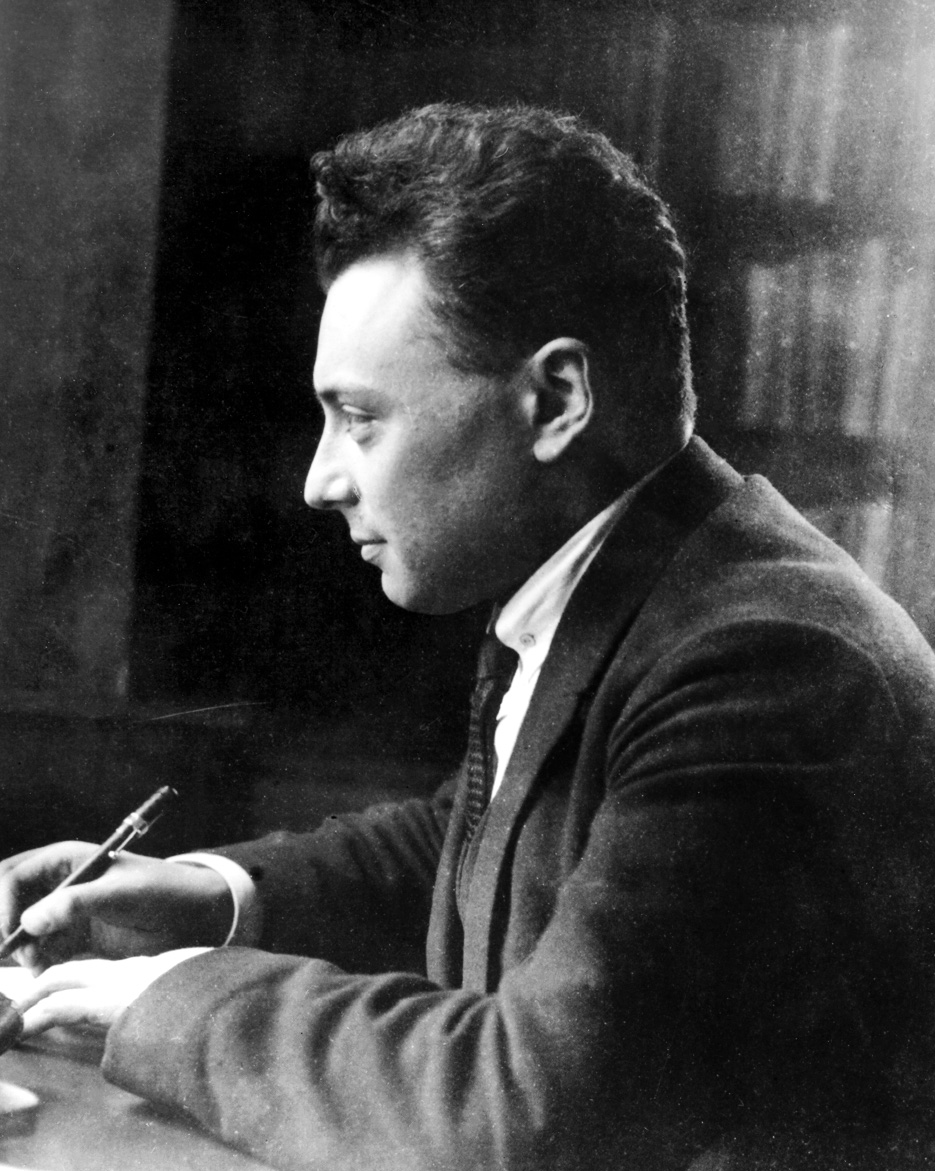
Wolfgang Pauli first intuited the presence of the neutrino from the missing energy in radioactive decays.
The weak force is so weak, however, that a neutrino could travel through light-years of lead without altering a single atom. Pauli bet a case of champagne that no one would ever detect one. But some 20 years later, ingenious experimentalists caught unmistakable signs of neutrinos at the Savannah River Site nuclear power plant in South Carolina.
Soon after, physicists started brainstorming about what they could learn from these nigh-invisible heralds of weak force transformations. They turned their focus from artificial nuclear reactors to a natural one — the sun.
In the late 1960s, Raymond Davis Jr. oversaw the installation of a 100,000-gallon tank of dry-cleaning fluid in a mine nearly a mile underground, where he planned to study solar neutrinos. John Bahcall, the co-leader of the experiment, calculated the number of neutrinos the experiment should see. But the tank picked up just one-third of the number of neutrinos that Bahcall had predicted it should. Either the sun was underperforming expectations, or neutrinos were going missing.
The anomaly took 30 years to resolve. But when the resolution came, via the Super-Kamiokande experiment in Japan and the Sudbury Neutrino Observatory (SNO) in Canada, it delivered a bombshell.
First Appeared on
Source link






