


‘Extremely rare’ fossilized anus discovered after 300-million-years
It’s a tail as old as time.
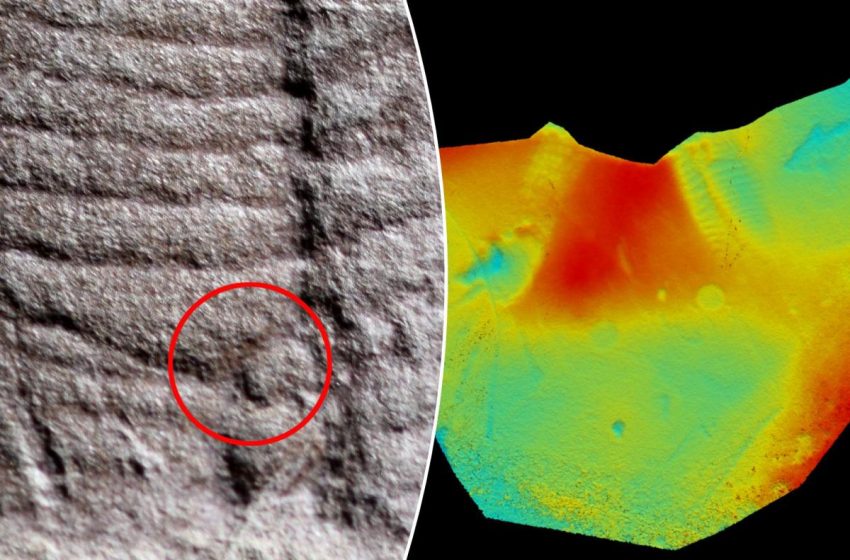
Scientists may have discovered the world’s oldest butthole after unearthing the nearly 300-million-year-old impression of a reptile’s backend in Germany, per an upcoming study in the journal Current Biology.
“Such soft-tissue structures are extremely rare in the fossil record – and the further back we look in Earth’s history, the more exceptional they become,” said Lorenzo Marchetti, a paleontologist at the German Natural History Museum in Berlin, in a statement.
He and his team described the fossil, which was found in the Thuringian Forest in Central Germany. According to their analysis, it was remarkably well-preserved, complete with belly scales and, most notably, a cloaca, a multi-purpose vent-like opening used for pooping, peeing, mating and laying eggs.
The backdoor imprint reportedly dates back between 298 to 299 million years ago to the early Permian period, making it the oldest poopchute fossil of its kind. The record had been previously held by a 120-million-year-old butthole that belonged to a dinosaur known as a Psittacosaurus.
It was also the oldest known impression of the reptile skin period.
Researchers said the buttprint’s owner only measured around 3.5 inches in length, but nonetheless left a mark as this was the first time said trace fossil had been described.
The researchers dubbed it Cabarzichnus pulchrus, noting that the animal’s size and nearby footprints indicate that the critter was likely a bolosaurian, an early species of reptile.
The creature reportedly lived during a seminal time in cold-blooded evolution, when reptiles were beginning to rapidly diversify, Science Alert reported.
In fact, the buttprint helped them get to the bottom of this reptilian evolution caper.
Researchers noted that C. pulchrus‘ cloaca — dubbed the Swiss Army knife of backend openings — had a shape and orientation that more closely resembled resembled turtles, lizards and snakes and not dinosaurs and crocodiles.
The creature’s body also sported rows of polygon-shaped skin scales that were comprised of keratin like the dermal coverings of modern reptiles.
Marchetti said that these impressions “are far more than simple footprints.
Furthermore, they “preserve anatomical details” that would otherwise be completely lost and shed light on the “early development of reptiles and their skin structures.”
First Appeared on
Source link






