


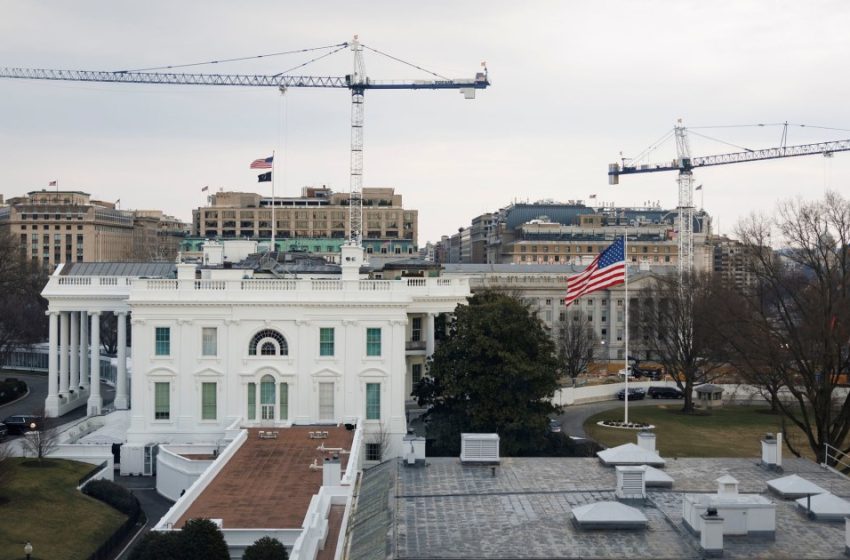
Federal judge temporarily blocks construction of Trump’s White House ballroom
A federal judge in Washington has issued an order temporarily blocking the construction of President Donald Trump’s expansive new White House ballroom and any further demolition of the East Wing.
Subscribe to read this story ad-free
Get unlimited access to ad-free articles and exclusive content.

“I have concluded that the National Trust is likely to succeed on the merits because no statute comes close to giving the President the authority he claims to have,” wrote U.S. District Judge Richard J. Leon, an appointee of President George W. Bush.
The ruling blocks the administration “from taking any action in furtherance of the physical development of the proposed ballroom at the former site of the East Wing of the White House, including but not limited to any further demolition, site preparation work, landscape alteration, excavation, foundation work, or other construction or related work, other than actions strictly necessary to ensure the safety and security of the White House and its grounds.”
Leon paused his order from taking effect for 14 days to allow time for an appeal. The Justice Department filed a notice of appeal roughly 90 minutes after he issued his ruling.
Leon issued the preliminary injunction after having agreed with the plaintiffs that Trump exceeded his authority with the project.
Leon wrote that the president of the United States is the “steward of the White House for future generations of First Families.”
“He is not, however, the owner!”
Leon wrote that “unless and until Congress blesses this project through statutory authorization, construction has to stop!”
Congress, he wrote, “is the collective voice of the American people in our system of government,” and “the Constitution itself vests authority over federal property, including the White House, in Congress.”
The administration, Leon noted, had argued that the project should not be halted and that “any delay to construction would imperil national security and expose the White House to damage.”
“Please! While I take seriously the Government’s concerns regarding the safety and security of the White House grounds and the President himself, the existence of a ‘large hole’ beside the White House is, of course, a problem of the President’s own making!”
Carol Quillen, president and CEO of the National Trust for Historic Preservation, said the ruling was “a win for the American people on a project that forever impacts one of the most beloved and iconic places in our nation.”
Trump spent several minutes talking about the ruling in the Oval Office at a signing event early Tuesday evening.
“He’s saying I need congressional approval. He’s so wrong,” Trump said of the judge. “This is being financed privately.”
The president also suggested that the judge’s direction allowing construction “to ensure the safety and security of the White House and its grounds” means the whole thing can be built, before getting into details about security features in the structure, including ballistic proof glass, drone and “bio-defense” measures, “bomb shelters that we’re building, we have a hospital and very major medical facilities that we’re building.”
“That’s called I’m allowed to continue building,” Trump said.
Shortly after the ruling was released, Trump complained on Truth Social about the plaintiff in the case, the National Trust for Historic Preservation, calling it “a Radical Left Group of Lunatics.”
He wrote that the $400 million project “is under budget, ahead of schedule, being built at no cost to the Taxpayer, and will be the finest Building of its kind anywhere in the World.”
The ballroom has been a central passion project for Trump during his second term. He has been heavily involved in the planning and has repeatedly shown off models of the site to reporters and made repeated references to it when he speaks about other topics, including the war with Iran.
He has said the project is necessary to allow the White House to host foreign leaders and large indoor events, rather than use makeshift tents on the South Lawn.
He has raised an estimated $400 million in private money for the project, including from Comcast Corp., the parent company of NBCUniversal.
The National Planning Commission, which is led by Trump appointees, is expected to vote on the project Thursday. The vote was delayed following largely negative public feedback to the ballroom, including that it was “appalling” and “hideous.”
Some architects have also criticized the size of the 90,000-square-foot addition, which is nearly twice the size of the executive residence. David Scott Parker, a member of the preservation group that brought the suit, told The Associated Press in an interview this month that “everything here feels inflated.”
Leon had blocked the National Trust’s earlier bid to block the ballroom’s construction, saying that version of the suit was based on a “ragtag group of theories” that didn’t “bring the necessary cause of action to test the statutory authority” of the president to pursue the project with private funding and outside of Congress’ approval.
The group then filed an amended suit, focusing on a claim that Trump had exceeded his authority.
Leon agreed but said the “good news” for the fate of the project is it is “not too late for Congress to authorize the continued construction of the ballroom project. The President may at any time go to Congress to obtain express authority to construct a ballroom and to do so with private funds.”
That way, Leon wrote, Congress will retain “its authority over the nation’s property and its oversight over the Government’s spending” and the National Trust’s interests “in a constitutional and lawful process will be vindicated. And the American people will benefit from the branches of Government exercising their constitutionally prescribed roles. Not a bad outcome, that!”
Leon, who was appointed in 2002, is well-known for his use of exclamation marks.
He used 18 of them in the ballroom ruling — more than the 14 that appeared in his opinion in February finding that the Trump administration had “trampled” on Sen. Mark Kelly’s First Amendment rights when the Defense Department targeted Kelly, D-Ariz., over a social media video, but less than the 26 he used in an opinion last year blocking Trump’s executive order targeting the law firm WilmerHale.
First Appeared on
Source link






