


‘Finally Serious’ – US Joins ‘Great-Power Game’ in Central Asia, Ditching Decades of ‘Neglect’
WASHINGTON DC – The Trump administration is undertaking a strategic recalibration in Central Asia, aiming to challenge the growing dominance of Russia and China.
On the eve of today’s rare White House summit with the presidents of five key Central Asian nations, US officials signaled a rapid change in approach, determined to prove that Washington can still compete in the region’s great-power game.
JOIN US ON TELEGRAM
Follow our coverage of the war on the @Kyivpost_official.
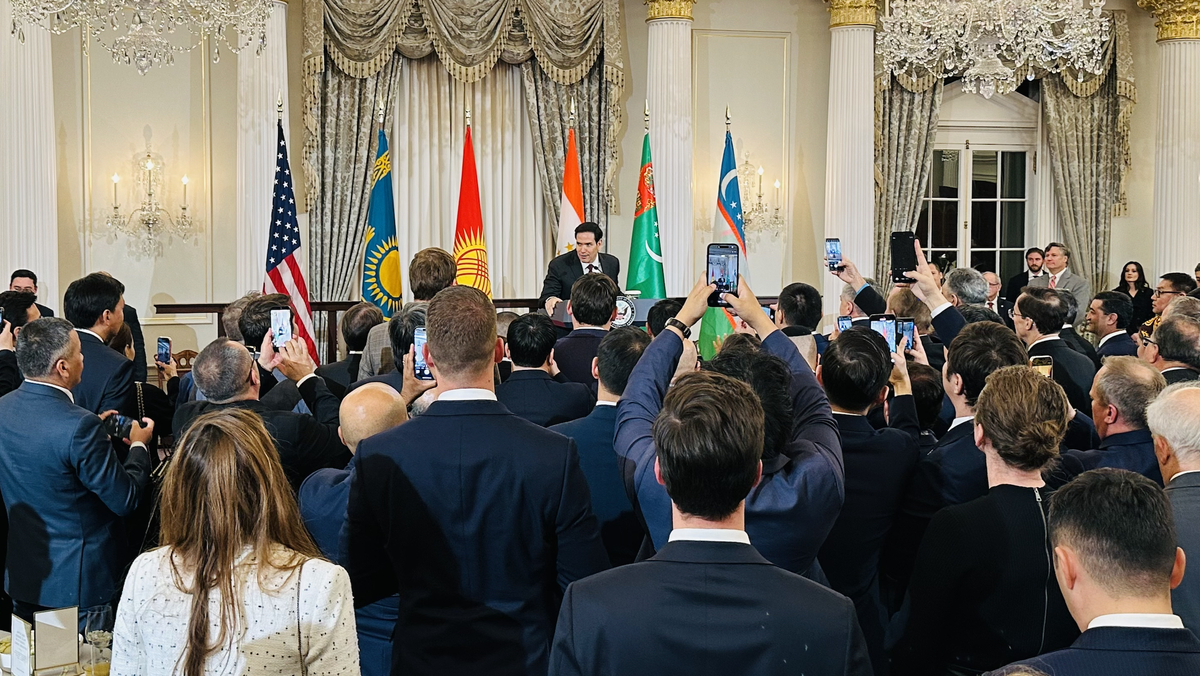
The opening gambit came Wednesday night at a State Department reception. Senators Jim Risch (R-ID) and Steve Daines (R-MT) unveiled bipartisan legislation to scrap the Jackson-Vanik amendment, a decades-old trade restriction and what critics have long called an “absurd relic.”
Dismantling this amendment, which analysts deemed the start of the effort, sends an unambiguous message: Washington is finally serious about Central Asia.
Strategic counter to Moscow and Beijing
This legislative effort is a plainly strategic counter to the expanding influence of Moscow and Beijing.
With Russia’s stability increasingly volatile and China aggressively advancing its Belt and Road Initiative and debt diplomacy, Washington is scrambling to offer a credible alternative to nations like Kazakhstan, Uzbekistan, and Tajikistan – countries Senator Risch described as “great nations caught between powerful neighbors.”
The Jackson-Vanik amendment, originally passed in 1974 to pressure the Soviet Union over Jewish emigration, has outlived the USSR by more than three decades. Its continued application to Central Asia has been a long-standing irritant for governments seeking closer ties with the West.
Other Topics of Interest
Germany’s Far-Right AfD Party Accused of Harboring Russian “Sleeper Cell”
A lawmaker for the ruling CDU party pointed out that AfD politicians in the Bundestag have asked parliamentary questions about sensitive military and security matters in recent months.
Edward Lemon, president of the Oxus Society for Central Asian Affairs, offered a blunt assessment that has become the driving logic for repeal. “The US is shooting itself in the foot by keeping these Soviet-era restrictions in place,” he told Kyiv Post on Wednesday.
“They’ve been lifted for Russia and China – nations actively undermining US interests – but not for countries that actually want to work with America,” he added.
Lemon called the repeal “low-hanging fruit” for a White House eager to strike deals on critical minerals and boost investment along the Middle Corridor – the vital transport route linking China and Europe via the Caspian Sea.
The corridor is now viewed as a crucial hedge against both Russian transit control and Chinese dominance.
Confession of neglect and a high-level recalibration
At the State Department reception, the mood was a blend of optimism and self-criticism. Deputy Secretary of State Christopher Landau praised Trump for “recognizing areas of the world that haven’t had the attention they deserve,” while Secretary of State Marco Rubio was even more candid, admitting that US engagement with Central Asia had suffered from “a little bit of neglect.”
“We spend so much time managing crises that we sometimes overlook emerging opportunities,” Rubio said, framing the new diplomatic offensive as both practical and overdue. The US, he added, “seeks markets, while the C5 seek responsible, diversified development.”
Trump’s Special Envoy Sergio Gor emphasized that Central Asian capitals “now have a direct line to the White House,” crediting Senator Daines for “forcing the issue” of regional engagement onto the administration’s top priorities.
The charm offensive
Wednesday’s reception served as the warm-up. Today, the presidents of Kazakhstan, Kyrgyzstan, Tajikistan, Turkmenistan, and Uzbekistan join Trump for a multilateral meeting in the Oval Office, followed by a state dinner – a rare display of diplomatic theater aimed at turning high-level optics into tangible action.
Rubio, addressing the assembled foreign ministers, underscored the administration’s new level of engagement. “You are looking to take the resources that God has blessed your nations with and turn them into responsible development that allows you to diversify your economies,” he said.
He then announced: “I personally intend to visit in the coming year – all five countries – so we’ve got to work on that and make that happen together.”
Landau called the opportunities in Central Asia “amazing,” emphasizing “many ways to partner there.” Both he and Gor had just returned from Kazakhstan and Uzbekistan, where they helped prepare agreements to be announced during today’s White House summit.
The Trump administration’s renewed interest is also deeply pragmatic. Rich in minerals and energy, the five overwhelmingly Muslim nations of Central Asia remain economically tethered to Russia and commercially intertwined with China.
Washington’s challenge is to prove it can offer an alternative – one based on trade, investment, and strategic cooperation rather than coercion.
Ultimately, this diplomatic surge is about credibility. The repeal of the Jackson-Vanik amendment would serve as concrete evidence that the US can match words with deeds in a region long neglected but newly vital to its strategic calculus.
Washington insists it is ready to engage Central Asia “like never before,” as one US diplomat put it. Whether the repeal becomes proof of that promise – or just another unfulfilled pledge – remains to be seen.
First Appeared on
Source link






