


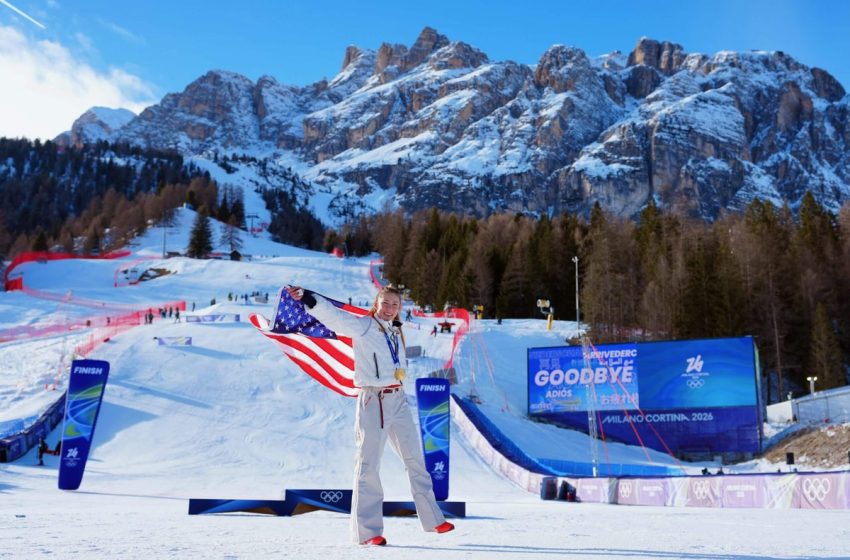
For Mikaela Shiffrin, at last, another beautiful day at the Olympics
CORTINA D’AMPEZZO, Italy — When it was over, when Mikaela Shiffrin had finally exorcised four years and nearly two weeks’ worth of Olympic ghosts, she could barely move.
There was no grabbing of the helmet in disbelief. No overjoyed arm pumps. No whooping up a crowd that seemed to be waiting for her to do … something.
Shiffrin just stared up at them. Then came the crouch. She sat on the back of her skis, letting them slowly skitter across the snow as she hugged her knees. Only, after she had let it all sink in, breathed for the first time all afternoon, maybe even for the first time in four-plus years, did the time arrive for the celebration.
And, finally, it was time to celebrate, to let the arms rise to the crowd, and then a nice, powerful right-hand lead to the sky.
She jumped up and down on the medal stand, pumping her fist again at the red-white-and-blue throng with the flags. She danced in the middle of her team’s dance circle. She went up on the shoulders of some Team USA guys.
But back to the stillness, the quiet moment right after the race.
Why?
Well, she said, there’s always a moment of disbelief, especially after an eight-year wait. Does the scoreboard really have a green light next to her name? If it doesn’t, jumping for joy could get really awkward. So maybe take a beat.
But there was a lot more than that to those few seconds. Before the second run, she’d tried to take a nap at the top of hill, like she often does. Everyone else is getting fired up for one of the biggest races of their lives, and the best to ever do it is catnapping.
The sleep wasn’t coming, though. She started to cry a little as her thoughts drifted to her father, who died in 2020 after an accident at the family home in Colorado. Jeff and Eileen Shiffrin raced in college. They taught their children to love the sport and let them take it from there.
And then she started thinking that she really could do this thing that had gotten so hard, that carried so much pressure, and so many expectations, and fairly or unfairly, was going to shape the way a lot of people were going to think about her.
It sounded like this:
“I actually can show up today and, and honestly say in the start gate that I have all the tools that are necessary to do my best skiing and to earn that moment,” she said.
And then she did, and all the people who helped get her there were flashing through her mind. Her father, but also her brother and his wife, and her coaches and psychologist and her mother.
“I just wanted to take that moment and communicate in my heart and in my mind with the people who have been there, and thank them.”
Let’s be clear about one thing. Mikaela Shiffrin was going to be fine whether she won that slalom race at the Olympia delle Tofane slope on Wednesday, or if she skied into the woods. She’s won more than anyone in the sport — 108 World Cup victories, now three Olympic gold medals, and a silver. More than half of those World Cup wins have come in slalom, where she’s all but untouchable when she’s on her game. The guy who is second on the win list, the Swedish great Ingemar Stenmark, has said Shiffrin is better than he was.
Her legacy is as secure as it gets.
But she knows better than anyone that the Olympics play an outsized role in defining a career, especially for an American. That’s what she signed up for.
Shiffrin seemed to refuse to believe it at first, crouching to her skis after crossing the finish line. (Ezra Shaw / Getty Images)
This win, nearly 3,000 days after she’d last won a medal at the Olympics, after eight years of answering questions about how she could have finished fourth in slalom in Pyeongchang, South Korea, when she lands on the podium in three of every four slalom races, was a big deal.
Being great at the Olympics, especially for someone who is great so often everywhere else, and is expected to be great when it feels like the whole world is watching, is as hard as it gets. She’d accepted that the day might not go her way, that she’d face four more years of questions about why she could not win at the Olympics anymore.
She didn’t always think it would be that way. When she won Olympic gold in Sochi, Russia, in 2014 at 18 years old, she figured it was just another race.
“It’s just skiing,” she thought. No big deal.
That’s how Jeff Shiffrin taught her to think. After Shiffrin won the gold medal in Sochi, he heard a story about how his daughter had stayed to help clean up a room after a lunch that had been organized for her and some executives with the U.S. ski federation.
She was 18 at the time of that lunch, a gold medalist. There were adults with her that wandered off while she cleared the table of the plates and put them in the garbage and wouldn’t listen when she was told she could just be on her way.
Jeff Shiffrin let the story sink in. Then, as his daughter danced with a gold medal around her neck, he waved his arm at the room, and said hearing a story like that about his kid, meant more to him than watching her win a gold medal, because skiing is just skiing and races are just races.
But then the noise got louder, and being great at the Olympics became a lot harder. That’s what happens. It’s why when she crashed three times in six races in Beijing, she said she felt like “a joke.”
Of course, Mikaela Shiffrin is no joke.
For years, and especially the past few weeks, the trick has been trying to get back to something that felt even remotely similar to what she had felt in Sochi 12 years before. That hasn’t been easy. It took years of work to put the 2022 Beijing Games in its own box, to explain it to herself in skiing terms.
A strange mountain. A foreign land. COVID regulations and restrictions. No control. Her close friend and physio, Regan Dewhirst, was sick and isolated for a chunk of the Games.
As Cortina approached, she needed to keep it big and small, to understand it as an opportunity but also remember that it was “just skiing” and she’s really good at skiing.
“I came to this Games so excited and grateful,” she said.
Then last week she raced the slalom in the team combined, her worst slalom run of the season on the kind of soft, slushy track she hadn’t trained on this season, and in the gray light that can mess with her. Breezy Johnson had given her the lead. Her run, 15th out of 18 skiers, sent them from first to fourth. Bring on the noise.
It was a stark reminder that there is always more work to do. No matter how many wins she has, even this season, when she has won seven of eight World Cup slalom races, and everyone thinks it’s a given that she is going to win another simply by clicking into her binding, this thing she does is seriously hard, especially at the Olympics.
And so back to the training hill they went, fixing what had gone wrong because of some alchemic combination of conditions and bad Olympic juju.
She also went down a rabbit hole of questioning her grit and her heart and her chosen path in life, her toughness and her tenacity. The Olympics will do that, even to the best of the best.
Maybe Federica Brignone, the 35-year-old Italian great who won the super-G and the giant slalom nine months after a horrendous knee injury that included a tear of her anterior cruciate ligament, said it best the other day. She had skied just two races ahead of the Olympics. She won because she expected nothing. She just tried to ski, to make turns.
And that’s where Shiffrin somehow ended up Wednesday morning, on the most sunsplashed, azure day in the Dolomites.
“What was beautiful was that I actually felt that it just felt like ski racing,” she said. “It felt like another day on the mountain between the start and the finish, and even the rest of the day.”
She didn’t look at the flags with the Olympic rings. She desensitized herself to the noise. It’s possible, she said, that she’d just gotten tired of thinking about the bigness of it all. She was, she said, “just ready to ski.”
And did she ever ski. An opening run on the limit, with one slight bobble, that gave her a mammoth lead of 82 hundredths of a second.
Camille Rast, who took the silver, said she knew after that the gold medal was Shiffrin’s. Only then, Shiffrin skied like it wasn’t, growing her margin to 1.5 seconds by the end of the second, basically flawless run.
Then the silence. Then the dancing. And always thoughts drifting back to her father.
She hears people who have lost a loved one talk about feeling their presence with them. That’s not how she has experienced it, and sometimes, it really pisses her off. Why do they get to feel that and she can’t?
“Why can’t it just be easier?” she said.
Of course it can’t be. And neither can the Olympics. That’s the hand she’s been dealt.
On Wednesday, she played that hand as well as anyone could play it.
It was just skiing. And as she said, it was beautiful.
First Appeared on
Source link






