


Four amazing dinosaur discoveries that stunned researchers in 2025
In 2025, scientists have named several new dinosaur species and are learning new facts about the remarkable lives of dinosaurs.
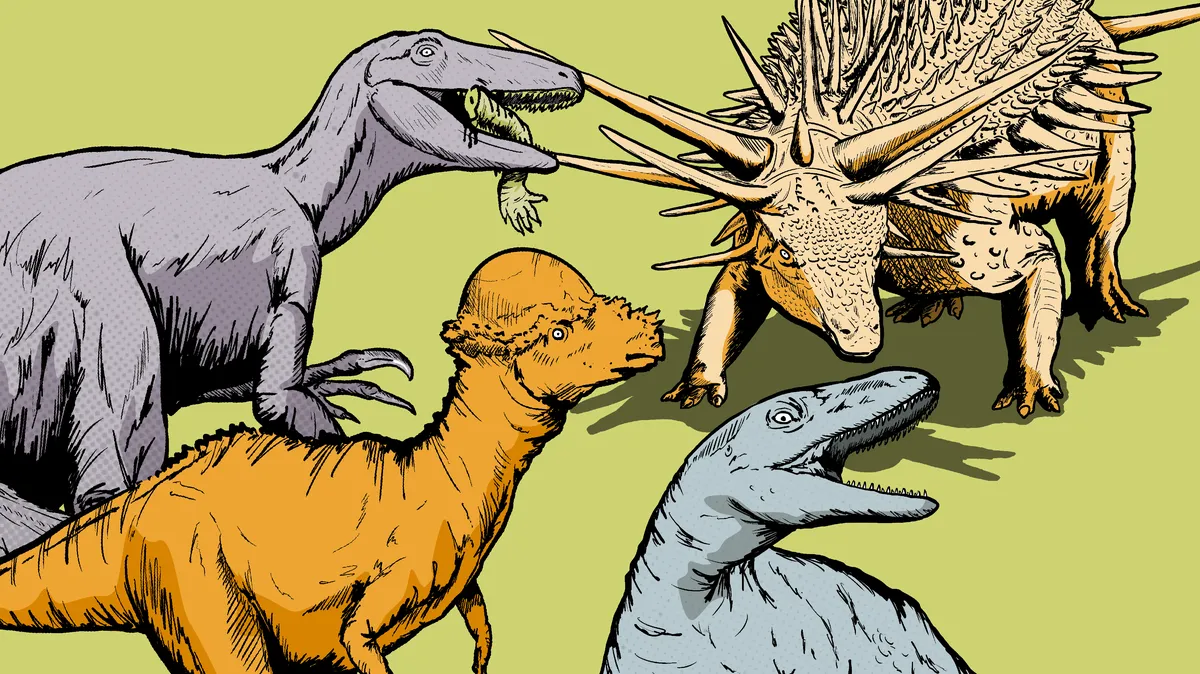
Paleontologists have found a ‘Dragon price’ dinosaur — which may be a missing link in the Tyrannosaurus family tree — and a dinosaur with its skeletal remains covered with remarkably long spiky bones that reach several feet. These are just some of the new discoveries found by researchers this year.
Here are a few of this year’s most unexpected and fascinating discoveries, ranging from the social lives of dinosaurs to still-undiscovered giants.
This ‘Prince’ shakes up the T. rex family tree
In June 2025, researchers announced the discovery of the Khankhuuluu mongoliensis dinosaur, meaning “Dragon Prince of Mongolia”. Those 86 million-year-old bones appear to be connected to a dinosaur closely linked to the direct ancestor of all tyrannosaurs, if not the direct ancestral species itself, according to research published in the journal Nature.
This dinosaur may have sat in a Mongolian museum’s collection long before it was discovered to be an unknown tyrannosaur species.
It wasn’t until May 2023 that paleontologist Jared Voris, a Ph.D. candidate at the University of Calgary, examined remains believed to be those of an early cousin of the tyrannosaur, with the most well-known dinosaur being the Tyrannosaurus rex. However, the more Voris studied, the more it became clear that the bones were an important missing link in the family tree of tyrannosaurs, according to Science.
Unable to view our graphics? Click here to see them.
According to the study, the Khankhuuluu helps fill a gap in the origin story of tyrannosaurs. Research co-author Darla Zelenitsky, a paleontologist at University of Calgary said, “Khankhuuluu is essentially the missing link between smaller, earlier forms and these large apex predators that we’ve come to know and love, like T. rex,” Science reported.
This prickly dinosaur amazed researchers
In August 2025, the new discovery, announced in an article published by the journal Nature, contained vertebrae, dorsal ribs and weird spikes which were fused directly on to the dinosaur’s bone.
The longest spikes on the Spicomellus afer are an incredible 34 inches long, extending along a bone collar that sits around its neck, according to the study.
These creatures existed during the Cretaceous Period, which is when dinosaurs were still present on Earth between 145 and 66 million years ago.
This dinosaur still had dinner in its mouth!
In September 2025, this new megaraptor dinosaur was discovered in 2019 in central Patagonia, according to a study published in the journal Nature.
The megaraptor, named Joaquinraptor casali, was about 19 years old when it died, according to researchers at the Patagonian Institute of Geology and Paleontology, noting the raptor reportedly had been munching on a nearly 8-inch crocodile arm at the time of its death.
The fact that much of Joaquinraptor’s skull was preserved sheds light on the dinosaur’s diet.
New dome-headed dinosaur unearthed in Montana
In October 2025, this newly discovered dinosaur was found in the northern reaches of Montana. Known as the Brontotholus harmoni, a part of the pachycephalosauridae family, that are described for having incredibly thick dome-shaped skulls, according to a study published in the Zoological Journal of the Linnean Society.
The fossils were originally found in Montana in 1985 and in Canada in 1989, one of the study’s authors, Dr. D. Cary Woodruff, a paleontologist at the Phillip and Patricia Frost Museum of Science in Miami, Florida, told USA TODAY.
“This taxon is the first pachycephalosaurid from the Two Medicine Formation and the massive frontoparietal dome indicates that it was the third largest North American pachycephalosaurid,” the authors reported in their study.
CONTRIBUTING Michelle Del Rey/USA TODAY
SOURCE Nature, Zoological Journal of the Linnean Society, BBC, SciNews, Natural History Museum London, Popular Science, Science Daily, Reuters and USA TODAY research
First Appeared on
Source link






