


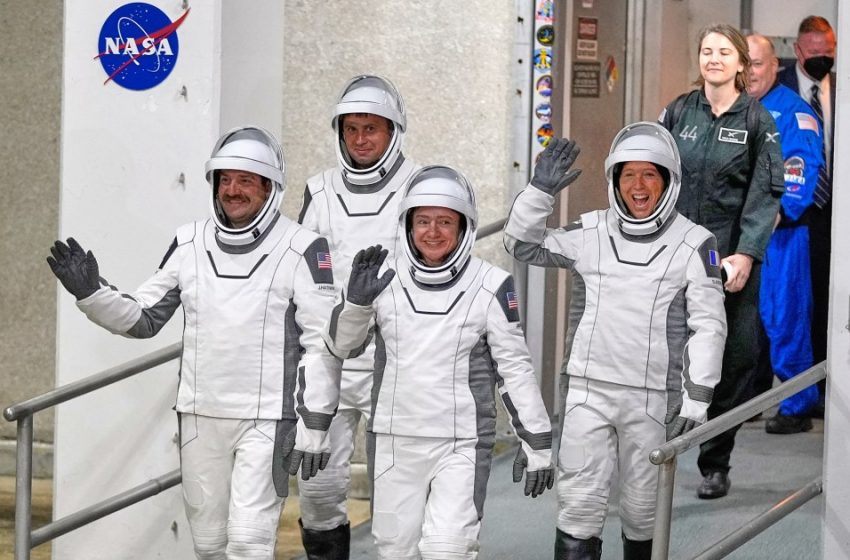
Four astronauts arrive at space station after prior crew’s early departure
Four new crew members, including two from the United States, received a warm welcome after arriving at the International Space Station on Saturday.
The spacecraft carrying NASA astronauts Jessica Meir and Jack Hathaway, European Space Agency astronaut Sophie Adenot, and Russian cosmonaut Andrey Fedyaev docked at 3:16 p.m. ET.
“They all arrived safe and sound, and we have been waiting for this moment for a very long time,” said Sergey Kud-Sverchkov, who was already on-board as part of the Russian Federation’s Roscosmos crew.
The spacecraft, named Dragon, launched into orbit early Friday morning with the propulsion of a SpaceX rocket.
“We are so excited to be here and to get to work,” Meir said after greeting the small crew on board the space station. “We did it. We’re here. We love you.”
Adenot, speaking later, said she enjoyed the trip.
“That was quite a ride, but very fun,” she said. “The first time we looked at the Earth was, wow, mind-blowing. The Earth is so beautiful from up there, and literally, we see no lines, no borders.”
They arrived at an unusually quiet orbiting lab.
The four were originally going to overlap in space with the outgoing crew, a mission known as Crew-11. But that group had to return to Earth early because of a medical issue. (NASA did not disclose the identity of the affected astronaut or the nature of the incident for privacy reasons.)
The Crew-11 astronauts departed on Jan. 14, leaving a sole NASA astronaut, Chris Williams, onboard the International Space Station, along with two Russian cosmonauts, Kud-Sverchkov and Sergey Mikayev.
The four new arrivals, together known as Crew-12, will bring the space station up to its standard occupancy of seven people.
“You just float in and it’s just such a cool experience,” Hathaway said after greeting those on board. “It’s been a great trip with my great Crew-12 friends.”
The crew lifted off atop a SpaceX Falcon 9 rocket at 5:15 a.m. ET Friday from Cape Canaveral Space Force Station in Florida.
High winds earlier this week along the flight path caused NASA to push the launch back two days. The agency routinely monitors weather conditions along the rocket’s path, in case an emergency on ascent requires the Dragon capsule carrying the astronauts to separate from the rocket and land along the East Coast.
A recent Falcon 9 mishap, during an uncrewed SpaceX mission to deploy a batch of the company’s Starlink satellites, also led NASA officials to review findings from the company before giving the go for launch.
The Feb. 2 incident prompted SpaceX to briefly pause launches while it and the Federal Aviation Administration investigated the problem. Several days later, the FAA cleared SpaceX to resume operations, and a subsequent launch successfully deployed Starlink satellites, with the rocket performing as expected.
In the time the space station has been understaffed, no major issues have cropped up, NASA officials said in a news briefing earlier this week. As such, there was no urgent need to rush the new crew’s arrival.
“We’re looking forward to some extra helping hands, but we’ll launch when we’re ready,” Dina Contella, deputy manager of NASA’s International Space Station Program at the Johnson Space Center, said Monday.
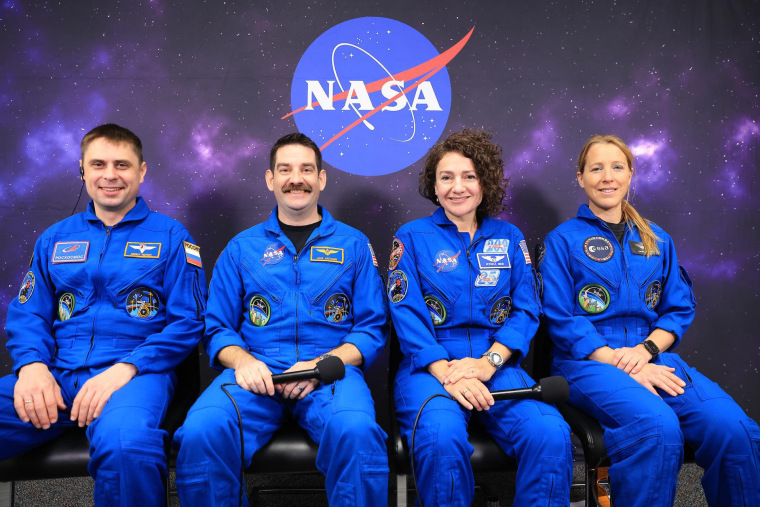
The four new space station crew members are slated to remain at the orbiting outpost for around eight months. During that time, they will conduct science experiments, including research on food production in space, how microgravity affects blood flow in the body, medical investigations on pneumonia-causing bacteria and other studies that NASA says will “advance research and technology for future moon and Mars missions and benefit humanity back on Earth.”
The Crew-12 mission is the first for Hathaway and Adenot. It’s the second spaceflight for Fedyaev. Meir previously spent 205 days on the space station, starting in July 2019. During that time, she and fellow NASA astronaut Christina Koch, assigned to NASA’s Artemis II flight around the moon that is scheduled for a possible March launch, made history by performing the agency’s first all-female spacewalks.
On Saturday, Meir expressed wonder at the cooperation that has made the space station a beacon for humankind.
“It is a promise kept decades in the making, of five nations, sustained by trust and partnership, empowered by science, innovation and curiosity,” she said before entering the space station. “As we look back at Earth from these windows, we are reminded that cooperation is not just possible, it is essential. Up here, there are no borders and hope is universal.”
First Appeared on
Source link






