


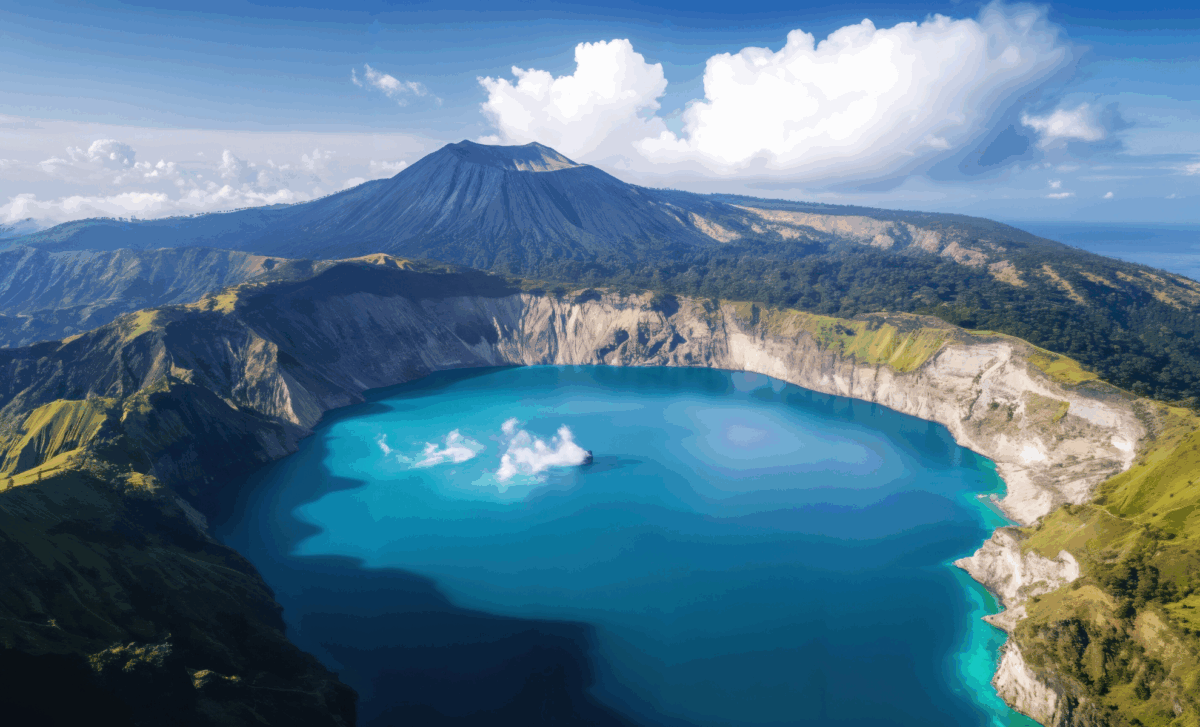
Four Million Years After Impact, Life Emerged In The Heart Of A Finnish Crater
When an asteroid slammed into what is now Lake Lappajärvi in Finland some 78 million years ago, it unleashed unimaginable heat and destruction. But from that chaos, a new world quietly emerged. Within just a few million years, microscopic life had found its way back into the crater’s fractured rocks. A recent study published in Nature Communications reveals how this once-sterile scar became an unlikely cradle for life.
From Fire To Fertility: The Crater That Became A Microbial Refuge
In the heart of Finland, Lake Lappajärvi tells a story of both violent impact and slow regeneration. Formed by a 23-kilometer-wide asteroid strike, this lake’s bedrock still carries the marks of an ancient collision that melted stone at over 2,000°C (3,632°F). When the shockwaves subsided, the real transformation began — in silence, over millions of years.
A research team led by Jacob Gustafsson and Henrik Drake of Linnaeus University in Sweden dove deep into the region’s geological memory, analyzing rock cores buried beneath the lake. Their findings, published in Nature Communications, reveal traces of microbial activity just 4 million years after the impact — a blink of an eye in geological time. Using advanced isotopic analyses of calcite and pyrite crystals, the researchers detected the telltale fingerprints of microbial metabolism.
“We see the products of the microbial process,” Drake said, describing how ancient microbes likely converted sulfate into sulfide in the crater’s mineral-rich waters.
The delicate chemistry preserved in those crystals paints a vivid picture of a world reborn.
“It’s amazing what we can find out in tiny crystals,” Gustafsson added, emphasizing how even microscopic mineral inclusions can reveal entire biological histories.
This evidence not only redefines how quickly life can recolonize devastated terrain, but also strengthens the idea that impact craters elsewhere — like on Mars — might once have been havens for microbial life.
The Slow Cooldown: Four Million Years Of Heat And Hope
Understanding how this crater cooled after its fiery birth offers clues to its potential as a microbial incubator. While similar craters such as Germany’s Ries and Canada’s Haughton cooled within hundreds of thousands of years, Lappajärvi took far longer to release its heat. “Four million years is a very long time,” said Teemu Öhman, an impact geologist with the Lake-Lappajärvi UNESCO Global Geopark, noting how the site’s geological makeup made it unique.
“If you compare Lappajärvi with Ries or Haughton, which are the same size, they cooled way, way, way faster.”
That slow cooling likely created a sustained window for microbial life to thrive. Beneath the lake’s surface lies a thick layer of granites and gneisses that once liquefied in the impact’s heat. These materials, rich in heat-retaining minerals, kept groundwater temperatures hovering around 50°C (122°F) for millions of years — ideal for thermophilic microbes. The researchers believe the crater’s limited layer of sedimentary rock played a key role in this.
“Sedimentary rocks often don’t fully melt during impact because of their inherent water and carbon dioxide content,” Drake explained, suggesting this moisture could have helped stabilize post-impact hydrothermal systems.
By the time temperatures dropped to around 30°C (86°F), methane-producing microbes had begun to take over, marking a second phase of biological succession. The crater’s story thus unfolds not as a tale of destruction, but as a testament to resilience — an ecosystem built from ash and stone, one isotope at a time.
Echoes From The Depths: Why It Matters Beyond Earth
The significance of this discovery extends well beyond a Finnish lake. If microbial life could return to an asteroid impact site on Earth within a few million years, similar processes might have unfolded elsewhere in the solar system. Mars, with its abundant craters and signs of ancient hydrothermal activity, becomes an even more intriguing candidate for past life.
The Lake Lappajärvi study underscores a profound idea: life is not merely a survivor of catastrophe, but often a direct consequence of it. Each fractured crystal, each isotopic anomaly, tells a story of renewal after destruction — a narrative written in the deep time of our planet’s geology.
First Appeared on
Source link






