


Funding TSA won’t fix long airport lines overnight
Washington
Funding to pay Transportation Security Administration officers may be on its way soon, but despite this, frontline workers and hours-long lines of travelers at US airports may not return to normal right away.
For weeks, the partial government shutdown seemed to have no end in sight as few proposals were passed back and forth. Many workers didn’t come to work or quit their jobs altogether.
Then, on Thursday evening, President Donald Trump directed his newly installed Department of Homeland Security chief to swiftly pay TSA agents. Hours later, the Senate unanimously moved to fund most of the DHS, including TSA, but not Immigration and Customs Enforcement and part of Customs and Border Protection.
It’s unclear which effort might take effect first to get paychecks to the workers. CNN has reached out to the White House, DHS and TSA about how quickly Trump’s order can be carried out. And House Republican leaders do not yet have a plan for passing the Senate bill.
Even in a best case scenerio, it may take days, if not weeks, for airport security checkpoints to return to full staffing levels, union leaders said.
Roughly 61,000 TSA employees are working without pay during the shutdown, which began February 14. The workers will likely miss their second full paycheck as soon as today after not receiving their first full paycheck in mid-March and only getting a partial paycheck at the end of February.
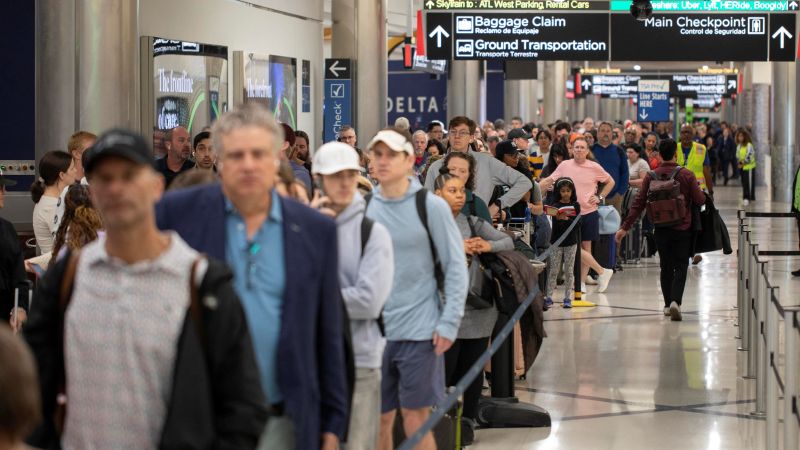
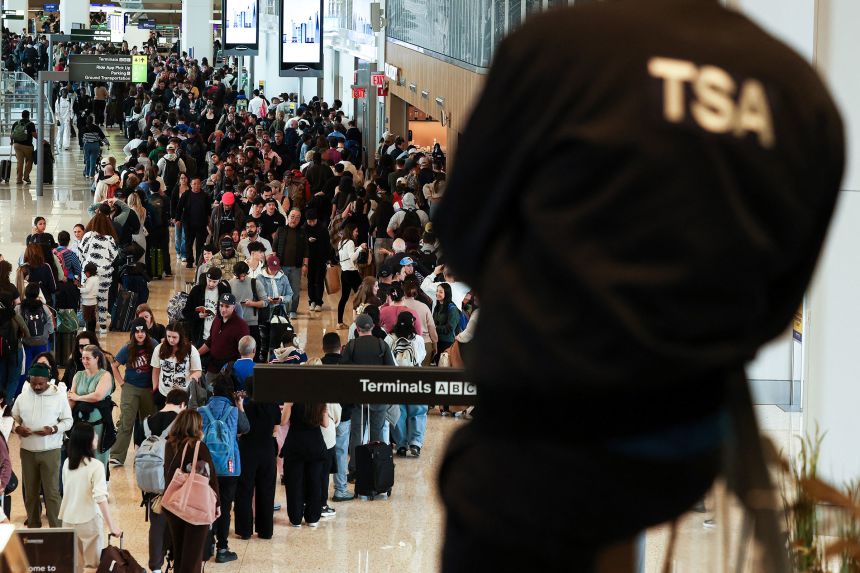
Travelers have had to contend with hours-long waits to get through security at multiple airports nationwide recently as financially-strapped TSA workers call out in higher numbers.
TSA officers had to wait 14 to 30 days to receive their back pay during the most recent government shutdown in the fall, Johnny Jones, secretary-treasurer of the American Federation of Government Employees’ TSA Council 100, said.
“Folks are going to need money,” Jones told CNN Thursday before Trump and the Senate took action. “People are not going to be able to come to work until they get a deposit. They can’t pay for child care … You don’t have any gas.”
On Friday, TSA will reach over $1 billion in missing paychecks because of the shutdown, testified Ha Nguyen McNeill at a House hearing on Wednesday.
She said many TSA workers have “missed bill payments, received eviction notices, had their cars repossessed and utilities shut off, lost their child care, defaulted on loans, damaged their credit line and drained their retirement savings.”
“Some are sleeping in their cars, selling their blood and plasma and taking on second jobs to make ends meet, all while being expected to perform at the highest level when in uniform to protect the traveling public,” McNeill said.
TSA officers and union leaders have also told CNN of employees’ financial hardships during the funding lapse, making it difficult for some to come to work.
The long security checkpoint lines won’t disappear immediately, Aaron Barker, president of AFGE Local 554, which covers airports in Georgia, said at a news conference on Tuesday.
“Until that paycheck hits that account, you can expect the same,” Barker said.
Federal employees are guaranteed to receive back pay once the shutdown ends, according to a 2019 law.
Prior to this shutdown, the transportation security officers’ call out rate was 4%. Now, some airports are seeing 40-50% of workers not show up each day, according to McNeill.
“They simply cannot afford to report to work,” McNeill said.
She also noted there’s been an over 500% increase in the frequency of assaults on officers.
TSA reported nearly 500 workers quit during the lapse in funding.
“As the shutdown drags on, we fear we will continue to lose talented and experienced employees to other jobs that can provide a steady paycheck,” McNeill said.
Most TSA positions start at about $40,000, based in locations like Ithaca, New York; Alexandria, Louisiana; or Dothan, Alabama. In Chicago, the jobs start at $45,000. Positions listed for officers in more remote places like Nome, Alaska, can start around $75,000.
The salaries were increased in 2024 to make the compensation match other workers in the federal government, which the department says increased retention.
Throughout the shutdown, many aviation officials have called on Congress to fund DHS or find a way to pay TSA workers.
Last year, when federal workers endured the longest shutdown in American history, several pieces of legislation were brought to the table to pay workers.
The Shutdown Fairness Act and the Keep America Flying Act would pay certain federal workers in the event of a funding lapse, including TSA employees.
Another bill, the Aviation Funding Stability Act of 2025, which could cover air traffic controller salaries during a shutdown, does not have a provision for TSA.
None of the bills appear to be moving forward since last fall, despite aggressive pushes from both sides of the aisle to pay workers.
Sheldon Jacobson, a founder professor in engineering at the University of Illinois who analyzes data to improve aviation security said paying these critical workers during shutdowns should be a bipartisan agreement.
“Everybody agrees that air travel is important,” Jacobson said. “The TSA, air traffic control, they’re critical. Then why are we not paying them?”
The president and lawmakers should support legislation that ensures all government workers get paid even during shutdowns, said Max Stier, CEO of the Partnership for Public Service, a nonpartisan group that focuses on improving the federal government.
“They should solve this for all times,” Stier said, noting that presidents and lawmakers still get paid during funding lapses. “It should be that federal employees get paid, even if Congress and the president don’t do their job.”
First Appeared on
Source link






