


Germany and the Gulf region: Energy and arms deals
The fact that the key Gulf states — Saudi Arabia, Qatar, and the United Arab Emirates (UAE) — are currently held in high regard by the German government is evident from the steady stream of ministerial visits to their capitals. Only recently, Environment Minister Carsten Schneider of the center-left Social Democratic Party (SPD) traveled to Saudi Arabia; shortly thereafter, Economy Minister Katherina Reiche of the center-right Christian Democratic Union (CDU) arrived and explained why: “When partnerships that one has relied on for decades begin to become a little fragile, we must look for new partners.” Partners, for example, in energy and armaments projects.
Reiche signed a memorandum of understanding with the Saudi Arabian energy minister and posted the news on X.
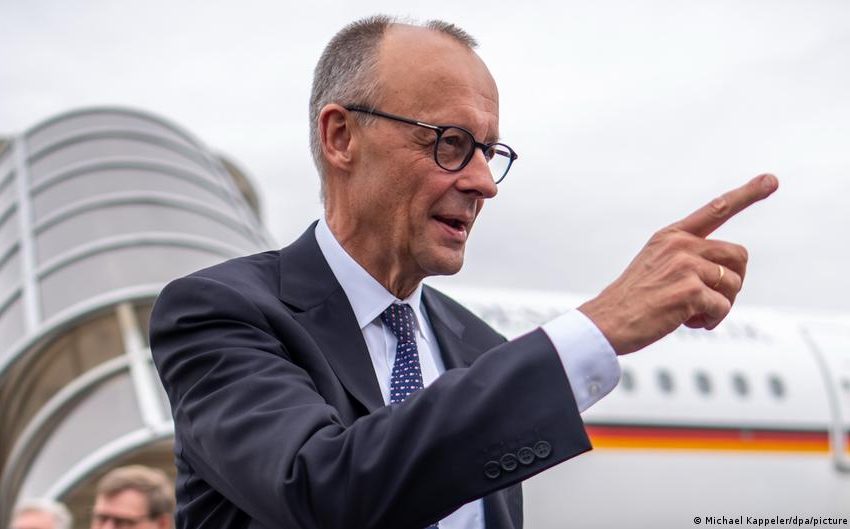
This week, Chancellor Friedrich Merz will visit Saudi Arabia, then Qatar, and finally the Emirates — all within less than 72 hours. His aim is to deepen economic ties and secure reliable agreements at a time when Europe, and Germany in particular, can no longer be certain how much it can depend on the United States.
First India, now the Gulf, next China
In the Chancellery, talk is therefore of “new strategic partnerships” — with India, which Merz already visited at the start of the year; with China, which he is scheduled to visit at the end of February; and, in between these two appointments, the Gulf region.
The magic word for German relations in the Gulf is, time and again: energy. For decades, the Gulf states supplied oil to resource‑poor Germany, and since Russia’s war of aggression against Ukraine, gas has become ever more crucial. The EU has sharply reduced its reliance on Russian gas; today, liquefied natural gas (LNG) accounts for about 10% of Germany’s overall supply, with 30% of that in 2024 coming from the US. A share which, in the view of the German government, could well be reduced — if, for instance, Saudi Arabia and Qatar were to deliver more.
Liquefied gas for Germany, weapons for the Gulf states
DW Chief Correspondent Michaela Küfner will accompany Merz on his trip to the Gulf. Speaking on the subject of gas, she observed: “At present, Washington is Europe’s most important LNG supplier. If Europe does not want to slip seamlessly from dependence on Russia into dependence on the US, it needs the classic energy‑exporting countries of the Middle East. That will probably also mean handling its own arms exports more generously in the future.” These are projects the government chose not to discuss in detail before the visit.
It is already known that Saudi Arabia and Qatar have expressed interest in the Airbus A400M military transport aircraft. At the same time, many energy projects have stalled in recent years because Qatar sought long‑term supply contracts, while Germany favored shorter‑term agreements. According to the government, it is now prepared to show greater flexibility toward the Gulf states on this point.
Merz will be accompanied to the Gulf by a large business delegation. Yet in Berlin, many journalists are eager to know whether he will also address the sensitive human rights situation in all three states. Government spokesman Stefan Kornelius commented late last week: “We have seen that in Saudi Arabia there has been a reform course with social and cultural opening. This has also enabled improvements in women’s rights. Nevertheless, much remains to be done, and further progress is needed.”
Dispute over Trump’s ‘Board of Peace’
Of course, the tensions surrounding the mass protests in Iran also play a role. Will the US actively intervene on the side of the opposition to overthrow the Islamic Republic? And what role does the war in the Gaza Strip, as well as US policy on this issue, play? Most recently, Israel’s anger made headlines over the fact that Trump’s new “Board of Peace” — intended to help resolve the Gaza conflict — will also include Qatar.
Germany, however, places little value on this council, not least because it was openly conceived as a counter‑model to the United Nations in New York.
At this point, government spokesman Kornelius struck a more cautious note: “The composition of this body is subject to criteria that we cannot control or assess in depth. We are aware of Israel’s position. But we also know that Israel has an interest in reaching an understanding with Qatar. These are relations and circumstances that develop between states, and that Germany does not have to comment on now.” This example underscores how sensitive the region remains for Germany, and how closely every word of the Chancellor will be scrutinized — despite the emphasis on economic cooperation.
This article was originally written in German.
While you’re here: Every Tuesday, DW editors round up what is happening in German politics and society. You can sign up here for the weekly email newsletter, Berlin Briefing.
First Appeared on
Source link






