


Getting Kicked In The Balls, or Childbirth? Science Finally Has An Answer
Few debates survive more stubbornly in locker rooms than the question of which hurts more: a kick to the testicles or giving birth. The science reveals something more interesting than a simple ranking: two completely different biological systems, each shaped by evolution to produce exactly the level of pain they do.
The viral claim that testicular injury registers “9,000 del units of pain” is not supported by any scientific measurement. The del scale does not exist in clinical use, and no universal pain scale covers both experiences. Pain is subjective, contextual, and shaped by far more than raw nerve signals.
Why the Testicles Are So Sensitive by Design
Healthline reports that the genitals are densely packed with nerve endings, far more concentrated than in most other body regions. The testicles have no protection from large muscles, fat, or bone. Their only covering is a layer of fibrous tissue called the tunica albuginea, which can handle moderate pressure but has clear limits.
“The reason, from an evolutionary standpoint, why it hurts so much to get hit in the testicles is that they are the key to producing sperm,” said Dr. Nathan Starke, a urologist at Houston Methodist Hospital, speaking to Inverse. The pain also involves two distinct types of nerve fibers. One carries fast signals, producing the immediate sharp sensation. The other carries slow signals, which transmit more gradually and produce the deep, nauseating throb that follows. “Slow pain is designed to really hurt you so you remember it,” Starke said.
The stomach cramping that accompanies a testicular impact has a precise anatomical origin. During fetal development, the testes form near the kidneys before descending into the scrotum around the seventh month of gestation, pulling their nerve supply with them. When struck, pain signals travel upward along those original pathways, producing referred pain felt deep in the abdomen.
The Evolutionary Trap Behind Difficult Childbirth
Human childbirth is significantly harder than in other primates, and scientists have been arguing about why for nearly a century.
The most widely cited explanation is the obstetrical dilemma. The theory holds that the human pelvis faces two competing pressures: it must be narrow enough to support efficient bipedal walking, but wide enough to pass a large-brained infant. “This trade-off explains why we have such helpless infants, but also very painful and long births,” said Nicole Webb, a paleoanthropologist at the University of Tübingen and the University of Zurich, in comments to Discover Magazine.

Not everyone accepts this framing. Holly Dunsworth, a bioanthropologist at the University of Rhode Island, has argued the obstetrical dilemma lacks sufficient evidence. “People tend to get swept away by good stories,” she told Discover. Research has found no evidence that wide hips impair walking in modern humans, and some analyses suggest wider pelvises may actually be more mechanically efficient.
Dunsworth and colleagues proposed an alternative called the EGG hypothesis, for Energetics, Gestation and Growth. Their argument is that birth timing is constrained not by skeletal geometry but by the mother’s metabolic limits. Humans can sustain roughly 2 to 2.5 times their resting metabolic rate before physiological strain becomes unsustainable, and fetal energy demands approach that ceiling late in the third trimester, triggering labor before the body’s limits are breached.
A Third Factor: The Pelvic Floor’s Competing Job
Research published in Proceedings of the National Academy of Sciences from engineers at the University of Texas at Austin and the University of Vienna used finite element analysis, a structural modeling technique borrowed from civil engineering, to examine how the pelvic floor responds to the competing demands of childbirth and organ support.
Their findings showed that a larger pelvic canal would ease delivery, but the floor supporting it would become too slack to hold organs in place. “Although this dimension has made childbirth more difficult, we have evolved to a point where the pelvic floor and canal can balance supporting internal organs while also facilitating childbirth and making it as easy as possible,” said Krishna Kumar, an assistant professor who led the research.
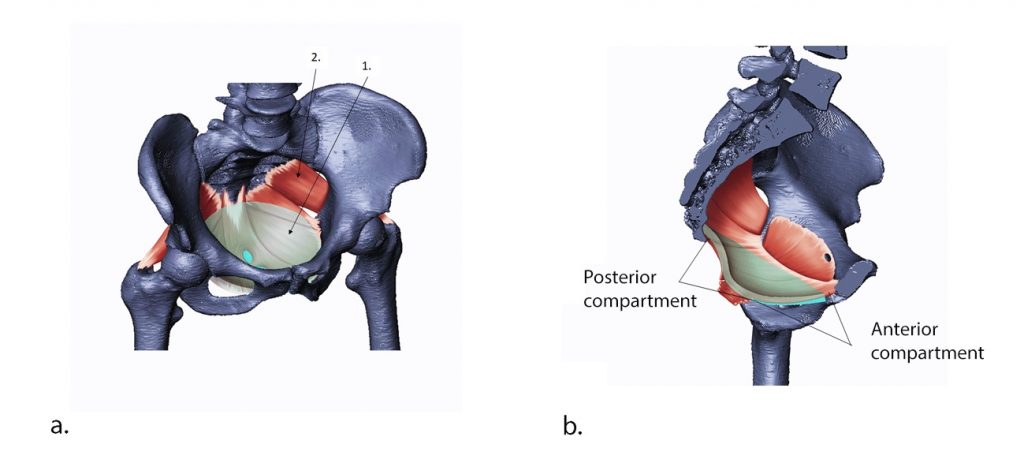
Nicole Grunstra, an affiliated researcher at the University of Vienna, found that a thicker pelvic floor creates its own problem: “Being unable to push the baby through a resistant pelvic floor would equally complicate childbirth, despite the extra space available in the birth canal.” Pelvic floor thickness, she concluded, represents another evolutionary compromise with no clean fix.
And the Winner Is…
No one, and that is precisely the point. The deeper problem is that pain is subjective: what registers as torture for one person is a tickle for another. Science can map the nerve fibers, model the pelvis, and trace the referred ache to its embryological origin, but it cannot hand down a verdict on lived experience.
Testes owners may point at mothers of four and conclude childbirth cannot be that bad if someone signed up for it again. The rebuttal is fairly decisive: ball-busting is an actual kink. Repeat customers exist on both sides of this argument, which makes the case for universal suffering hard to sustain.
The answer guaranteed to disappoint everyone is a “tie“. One experience is a brief, acute shock the body is wired to make memorable. The other is a prolonged physiological event shaped by millions of years of competing biological constraints. Neither wins. At least everyone can agree on one thing: be grateful it is not kidney stones.
First Appeared on
Source link






