


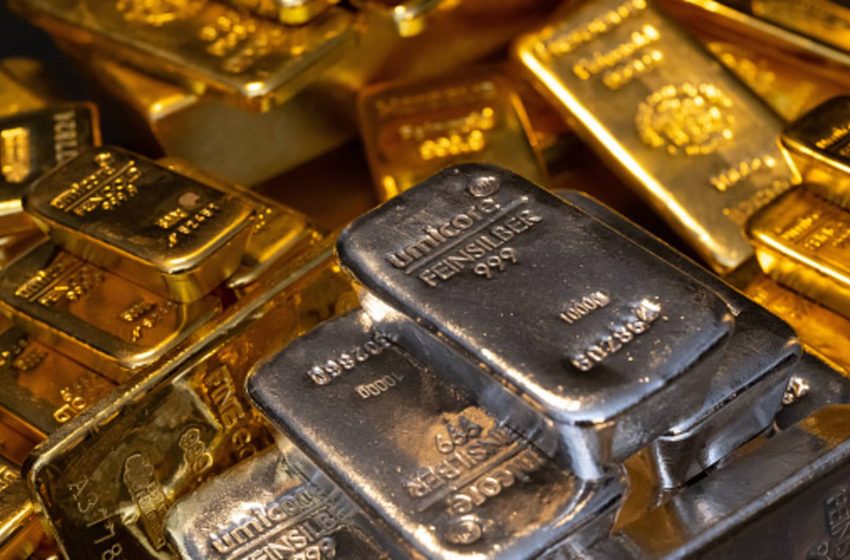
Gold and silver prices after historic sell-off: What’s next
As precious metals continue to seesaw after Friday’s historic sell-off, investment banks are doubling down on gold — but urging caution on going all-in on silver. At 2:11 a.m. ET on Thursday, spot gold shed 0.7% to settle at $4,926.9 an ounce, reversing the rebound from Tuesday and Wednesday’s session which saw the yellow metal’s price add 6% and 2% respectively. Silver was also down with New York spot silver down 10% to $79.6 per ounce, after rising by 6% on Wednesday and 7.6% in the Tuesday trading session. It comes after a while ride. Metals across the board staged a sharp sell-off on Friday, leaving gold down 9%. Silver lost almost 30% in the biggest one-day blow since 1980 for silver futures. The sell-off which many investors attributed to the nomination of Kevin Warsh as the next Federal Reserve Chair, continued into this week – before a broad pivot out of tech and software stocks on Monday saw capital being poured back into typically stable assets, including gold, and both metals rose. XAU= XAG= 5D line Gold and silver spot price Gold and silver’s bull runs began early in 2025, with their perceived safe-haven status bolstering their value amid rising geopolitical tensions and speculation that gold could replace the dollar as the world’s reserve currency amid a softening of the greenback. Later, concerns about the Federal Reserve’s independence from the White House helped power the rally. Silver prices were also boosted by the metal’s industrial uses and a flash of retail investor interest in the metal and related exchange-traded funds. Read more Gold and silver extend rebound but concerns over volatility linger We’ve been here before: What gold’s past bull runs tell us about where it could go next Is silver a meme trade? How the metal became ‘GameStop in 2026’ Gold is still in a bull market Many market watchers still see upside ahead for gold. UBS strategists said they viewed the sell-off as “normal volatility within a continuing structural uptrend, rather than the end of the bull market.” In a Monday evening note, they said they judged it remains in the “mid to late stage of its bull market — moving from a steady upward trajectory to new highs, but now experiencing intermittent drawdowns of 5–8%.” They noted that factors that typically signal the end of a gold bull market — “persistently high real interest rates, a structurally stronger US dollar, improved geopolitical stability, and restored central bank credibility” — had yet to materialize. UBS forecasts that gold will hit $6,200 by next month, before falling to $5,900 by the end of the year. The investment bank is maintaining its long position on the metal. “The recent spike in price volatility also creates opportunities for income-seeking investors to monetize this environment,” its strategists said. In a Tuesday note, analysts at Goldman Sachs also remained bullish, despite the sell-off. “We continue to see significant upside risk to our gold forecast of $5,400/toz by Dec 2026,” they said. Goldman’s forecast is underpinned by central banks continuing to bolster their gold stores, and private investors stepping up gold ETF purchases as the Fed cuts interest rates. Bank of America also remains bullish on gold, predicting it could hit $6,000 an once in the coming months. In a Tuesday note, BofA’s team said they had been bullish on gold since it was trading below $2,000 an ounce in 2023 but cautioned they were “somewhat concerned about the speed of recent price gains and the rise in volatility accompanying them.” “We also follow a few scenarios closely that could increase headwinds to the yellow metal,” they added. They also noted “uncertainty” on what U.S. President Donald Trump’s White House will do after the mid-term elections in November, and “whether the administration will be able to implement policies as easily going forward.” Silver investors urged to exercise caution In another UBS note from the weekend, in the midst of the sell-off, they said prices would need to fall even further “to make the metal attractive to us.” “In our view, an asset exhibiting 60-120% volatility requires an expected return of 30-60% to go long, which is not yet the case,” they said. “Lower prices are therefore needed to make the metal attractive to us … we think investors should carefully consider the return required for an asset that has recently exhibited [such high] volatility.” Silver had a stellar 2025, outperforming gold with an annual gain of 150%. But the recent sell-off saw the metal tumble more than 30% from the record high it hit just days earlier. UBS forecasts that spot silver will return to the $100 threshold by next month, before falling back to the $85 level by the end of the year. While silver is regarded as a safe-haven asset, it is, unlike gold, a critical component in consumer goods, including computers, solar panels, medical devices and cars. The UBS team said this complicates the picture, because a rising silver price reduces industrial demand for the metal. “With more than 50% of demand linked to industrial applications, we believe current prices … are likely to result in reduced industrial demand over time, as end-users seek to optimize silver usage and lower input costs,” they said. Likewise, Goldman Sachs analysts Lina Thomas and Daan Struyven were warier of silver than gold, because of supply constraints in the critical London market. “The persistent London liquidity squeeze adds an additional layer of extreme price behavior on top of the same call‑structure‑driven volatility seen in gold,” they said, adding: “We continue to advise volatility-averse clients to remain cautious.” BofA’s strategists appeared somewhat positive on the outlook for silver, but also noted potential headwinds — such as a fall in solar panel consumption. “More concretely on silver, prices had deviated from ‘fair value,’ which we estimate is somewhere around $60-70/oz, so we are not entirely surprised about the correction,” they said. “Yet, we still forecast a deficit, so the metal should ultimately find support.”
First Appeared on
Source link






