


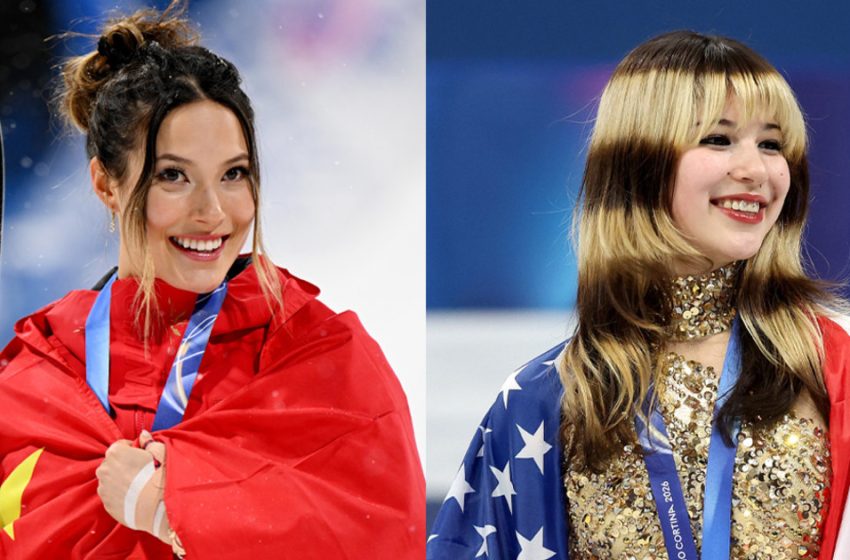
Gold medal greats Alysa Liu and Eileen Gu face uncomfortable comparisons at Olympics
U.S. figure skater Alysa Liu and Beijing-backed freestyle skier Eileen Gu woke up Friday morning to find themselves in a side-by-side contrast they never asked for, pitted against each other in a geopolitical battle they never sought.
Hours after Liu’s stirring performance in the free skate on Thursday in Italy won her America’s first Olympic women’s figure skating gold in 24 years, the Oakland native was suddenly thrust into association with another native Californian, Gu, the skier who is competing on behalf of China.
Congressman Michael Baumgartner, R-Wash., didn’t even need to use words to convey comparisons that blasted out of many conservative circles on Thursday night and Friday.
The “good Asian, bad Asian” narrative disappointed — but didn’t surprise — Cal State Fullerton sociology professor Christina Chin.
“We have two totally different sports. But yet there’s a tendency that if there’s two of them, then we must compare, we must make a racial comparison,” said Chin, who has published works on Asian Americans in sports.
“There’s this ‘who’s a good Asian, who’s a bad Asian’ question that’s come down to these two athletes, who had many factors that went into their decision of who they were going to compete for.”
Gu has been one of her sport’s most divisive figures for two Olympic cycles. The daughter of a Chinese immigrant mother, Gu was born and raised in Northern California but chose to compete under the PRC flag.
The Beijing-supported athlete won two golds and a silver in the last Winter Games and has captured two more silvers in Italy.
The Wall Street Journal reported last week that Gu and Los Angeles native Beverly Zhu, a figure skater, have been paid $14 million over the last three years to compete for China.
The latter, competing under her Chinese name Zhu Yi, finished 26th in the 2022 Olympics.
U.S. Rep. Andy Ogles, R-Tenn., earlier this week posted a picture of Gu with an Olympic medal and remarked: “There must be consequences for those who betray the United States and support our adversaries.”
Gu’s critics found more fuel Thursday night following the heroics of Liu, the daughter of a Chinese dissident father who fled China due to his role in the pro-democracy protests and ensuing massacre in Tiananmen Square in 1989.
Alysa and Arthur Liu have been targets of Beijing harassment and spying, the father has said.
Alysa Liu’s path to glory, which included a retirement from the sport at 16, felt like a “dream” with the clock and calendar still turned back to golden Thursday.
“I mean, I’m still in yesterday, to be honest,” Liu told “TODAY.” “I’m still (mentally) there and I still feel the hype of the arena, and it was a dream.”
Gu is far from the first American to have played for another country or taken money from a problematic regime. But she seems to have taken an outsized amount of heat for apparently picking green over red, white and blue.
The phrase “Be an Alysa Liu” caught fire across social media on Friday among those who criticize Gu’s athletic allegiance to China. One post alone, doing a side-by-side of Gu and Liu with the message, “In a world full of choices … Be Alysa Liu,” had garnered more than 1.4 million views.
“The standards are definitely different for Asian American athletes,” Chin said. “There are constant questions about how they’re seen, how they’re racialized in a way that’s very different than compared to white athletes.”
Gu has another shot at a medal on Saturday, competing in women’s halfpipe skiing.
When asked about Gu earlier this week, Vice President JD Vance told Fox News that he supports Americans: “I’m going to root for American athletes and I think part of that is people who identify themselves as Americans. That’s who I am rooting for.”
Gu on Thursday defended herself and said she feels “like a bit of a punching bag for a certain strand of American politics.”
“So many athletes compete for a different country,” Gu said. “People only have a problem with me doing it because they kind of lump China into this monolithic entity, and they just hate China. So it’s not really about what they think it’s about.”
First Appeared on
Source link






