



Gruesome reality of Elon Musk’s Mars plan as expert reveals horrifying toll on human body
From changing size, to crushed immune systems and childbirth complications, humanity colonizing Mars could come with a host of problems for the human body.
Elon Musk believes Mars settlement is possible by 2050, but there are considerable challenges and questions that still need to be answered before a permanent presence on the planet can be seriously considered, Rice University professor Scott Solomon believes.
In his upcoming book, Becoming Martian: How Living in Space Will Change Our Bodies and Minds, Solomon argues that one of the most important unanswered questions is whether or not humans can reproduce outside of Earth.
It is unknown whether a child could be born in space or on another planet, where gravity is weaker or non-existent and radiation levels are far higher than on our pale, blue dot.
In Becoming Martian, Solomon explains that there have been no confirmed cases of people having sex in space, and there has been little research on what the development of a fetus and giving birth in a low-gravity environment might look like.
The evolutionary impact of living on Mars for generations is also unknown, though Solomon believes it is likely that humans would become smaller and might be unable to return to Earth.
In an interview with the Daily Mail, the professor said: ‘We’re at a moment right now when history is happening in terms of people actually pushing the envelope of going deeper into space.
‘I think what readers might find interesting is learning a bit more about what would happen if those efforts are successful. That’s the story that I try to tell here – let’s imagine what happens next.’
Rice University professor Scott Solomon said the idea of building a city on Mars assumes that humans could reproduce on the planet, which is not a given. A Mars colony proposal by Musk’s company, SpaceX, is pictured

Solomon said the pace of cultural and evolutionary distinction on Mars would depend on how easy it is to travel between there and Earth. A rendering of a Martian astronaut and base are pictured
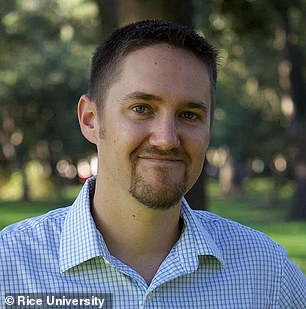
Rice University professor Scott Solomon reveals the many potential problems humanity will face when trying to colonize Mars in his upcoming book
While conducting the research for his book, Solomon spoke with dozens of experts at NASA, SpaceX and other agencies or companies focused on space exploration.
During that process, he said one of the biggest surprises was ‘how little we know about reproduction in space.’
‘The idea of building a settlement, a city, on another planet or somewhere in space, kind of assumes that people can go there and have children and raise a family,’ the professor said.
‘Could we have children on Mars? I think that’s still an open question,’ Solomon added.
‘And if the answer is no, or if the answer is yes, but there are issues, we need to know that, I think, before we should start moving forward with plans to actually create settlements beyond Earth.’
Gravity on Mars is about one-third as strong as it is on our planet. There has been extensive research done on astronauts who have spent time in space, which shows that bone density decreases in low-gravity environments.
That means a Martian woman would have more fragile bones, which could be a serious problem when giving birth.
‘We know childbirth is already risky, and so we could imagine a scenario where women who are born on Mars are at even greater risk of complications during childbirth,’ Solomon said.
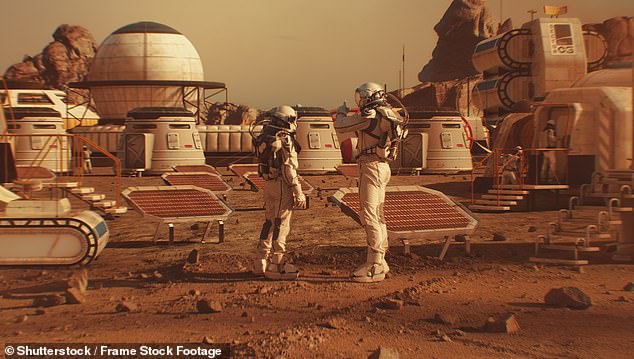
Gravity on Mars is about one-third that of Earth, which could lead to lower bone density for people born there. A rendering of a Martian base is pictured

The cover of Solomon’s book, Becoming Martian, is pictured. The book discusses whether humans could reproduce on Mars, what evolution on the planet might look like and more
The professor also noted that the Red Planet’s low-gravity environment may create evolutionary pressure that favors people with denser bones, ‘so that they can basically afford to lose bone density as they age.’
Solomon then explained that in his view, it is likely that Martians would become smaller than Earthlings due to other evolutionary pressures on the Red Planet.
‘We know that on islands on Earth, animals often get smaller or get larger, and that’s known as the island rule, which I described in the book,’ he said.
‘It’s possible that we could see either larger or smaller Martians. I argued that smaller might be more likely for a number of reasons, one of which is the smaller you are, the fewer resources you need to consume.
‘And especially in the early days of a settlement on Mars, those resources might really be quite limited, and there might be an advantage to needing less of them.’
Solomon went on to explain that if, despite the challenges, humanity is able to establish a colony on the Red Planet, our smaller, denser-boned Martian cousins may not be able to visit Earth.
Our planet’s complex microbial ecosystem could pose serious risks to a person born and raised on Mars.
‘One of the biggest challenges might be our immune systems,’ Solomon said. ‘Here on Earth, we are exposed to a huge number of microorganisms.
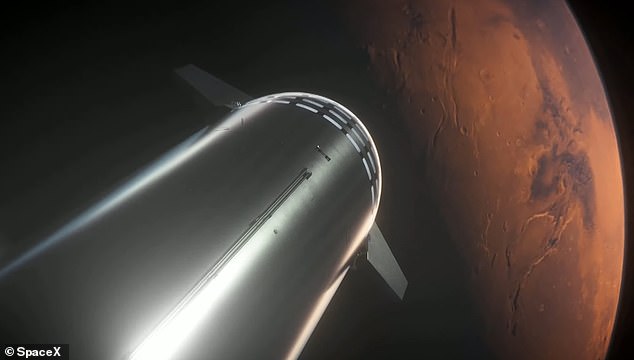
Elon Musk’s Starship design for expeditions to Mars is pictured

Elon Musk believes Mars settlement is possible by 2050, but Solomon argues there are many important questions that need to be answered before seriously considering colonization. Musk is pictured arriving at Mar-A-Lago with Shivon Zilis, a venture capitalist, in Palm Beach, Florida, on Sunday for the wedding of Dan Scavino, White House deputy chief of staff, and Erin Elmore, the State Department’s Art in Embassies director
‘If we go to Mars, we will take only a very tiny fraction of all of those microbes with us… A child born on Mars would be only exposed to that tiny fraction of microbes that make it all the way to Mars.
‘So if they came back to Earth, a lot of the microorganisms that we interact with on a regular basis that aren’t harmful to us because our immune system is used to them – they could be really dangerous to a person from Mars.’
In his book, Solomon points out that risk is reminiscent of when European explorers first arrived in the Americas, bringing with them diseases that native people had never been exposed to, which decimated their populations.
Beyond the scientific questions of reproduction, evolution and immunity, Solomon’s book also examines what the relationship between civilizations on Earth and Mars might look like.
The professor said that Martian culture might evolve similarly to the way immigrants on Earth hold on to certain parts of their heritage, but eventually begin to identify more with the place where they grew up after a few generations.
‘The first people that go to Mars will almost certainly still feel very connected with Earth,’ Solomon said. ‘But with each generation born on Mars, I think they will increasingly identify as being Martian, even though they’ll have this Earth heritage.’
Solomon added that the pace of that cultural distinction, as well as the pace of diverging evolution, would depend on how easy it would be for people to go back and forth between planets.
If Earthlings frequently have children with Martians, then the DNA of people on each planet would remain more similar for longer.

Solomon believes that after multiple generations of living on Mars, humans would become smaller and might not be able to return to Earth. The Red Planet is pictured

Solomon said if given the opportunity, he would love to visit Mars, but he would want to come back to Earth. A rendering of a Martian landscape is pictured
But Solomon said: ‘If I’m right that it will be hard to [travel between planets] because of the risk of getting sick, for example, then you might start to see them (Martians) become quite distinct culturally, politically, as well as biologically.’
Another factor that would contribute to distinct civilizations on each planet is the time it would take to communicate, Solomon said.
It takes up to 20 minutes for an email, photo or video to be beamed from one planet to the other. Instant texting, phone or video calls, would therefore be impossible in the way we are used to on Earth.
Many people are skeptical about space exploration and colonization, believing it is more important to focus on Earth and trying to fix the myriad problems on our home planet.
Solomon generally agreed with that sentiment, but said it is possible to try to fix the problems on Earth while looking to the stars at the same time.
‘It’s absolutely important for us to dedicate a lot of attention and resources to solving our problems on Earth,’ he said.
‘But I think that we should be able to do that while also learning about what it’s like in space and whether we might someday be able to live there.’
Despite the challenges and risks of Martian exploration and settlement, Solomon told the Daily Mail he would ‘love to go visit.’

Astronaut Scott Kelly (right) wrote the foreword for the book Becoming Martian: How Living in Space Will Change Our Bodies and Minds. He was the subject NASA’s year-long Twins Study that compared identical twins. Scott was in space while his identical twin Mark (left) was on Earth
‘I love to travel. I love adventures. I’m a scientist, I’m a curious person. I would love the opportunity to go and explore,’ the professor said before adding a caveat.
‘But I would want to come back home.’
Becoming Martian: How Living in Space Will Change Our Bodies and Minds by Scott Solomon will be available from February 17 published by The MIT Press
First Appeared on
Source link






