


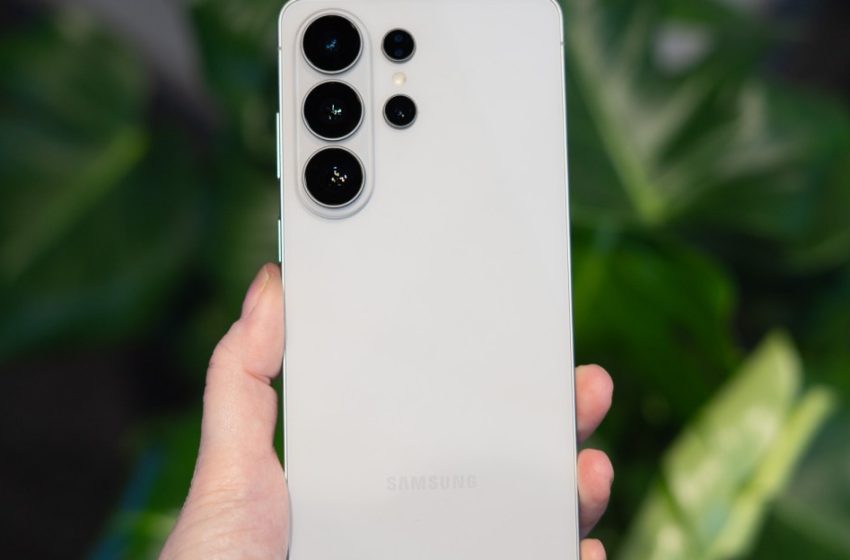
Hands on: I’m super impressed with the Galaxy S26 Ultra’s new Privacy Display
Maybe it’s a reflection of just how slow hardware innovation has been, but the Galaxy S26 Ultra’s new Privacy Display, which limits the screen’s viewing angle to keep any would-be peepers away, left me totally impressed.
It’s not a brand-new technology — we’ve seen it before in laptops — and it was leaked thoroughly before Samsung’s announcement. But seeing it work on the S26 Ultra for the first time was cooler than I expected, especially given that hardware thrills are hard to get these days.
It’s not just one of those special screen protectors; you can turn it on or off. There are two sets of pixels in the display: one that projects the image straight ahead toward the viewer and one that projects light off to the sides, so you can see the screen from an angle. By turning off that second set of pixels, the screen looks basically normal to the person holding the phone, while looking very dim from an angle. Someone directly behind you with a good view over your shoulder might still see a bit of what’s onscreen, but the effect is stronger just off to the sides.
There’s also a setting to make the effect even greater if you want to be really sure nobody can peek at what you’re seeing. I flipped the feature on and off while looking at the screen from an angle; it seemed to reduce the image’s contrast, making text very difficult to read.
1/3
What’s really cool is that in true Samsung fashion, you can customize this a hundred different ways. You can obscure only notifications as they pop up at the top of the screen, or have it automatically turn on when you enter a PIN or use a specific app. It can also tie into routines, so you could have it turn off when you arrive home and turn back on when you leave. The effect works the same way whether you’re holding the phone horizontally or vertically, too.
Otherwise, the S26 Ultra is mostly a software update. The phone is slightly slimmer and lighter than its predecessor: 7.9mm thick down from 8.2mm, and 214 grams down from 218 grams. Part of that weight difference is due to a switch back to aluminum from titanium as Samsung follows Apple’s lead. It’s still a big phone, but it looks and feels more like an S26 Plus Plus than something entirely different.
Samsung has finished the job it started a couple of generations ago, bringing the Ultra aesthetics in line with the regular S26 and S26 Plus. All hints of the boxy Note look are gone. The Ultra has the same curvature around the corners as the other two models. And once again, there are no magnets built into the back of the device — those are supplied in the case instead.
There is one more meaningful hardware update to the camera: Both the main 200-megapixel and 50-megapixel 5x zoom come with slightly brighter lenses, from f/1.7 to f/1.4 on the main and f/3.4 to f/2.9 on the telephoto. Every bit of extra light the lens can deliver to the sensor helps, especially for low-light photography, so this is a welcome update.
But of course, there’s AI. It’s not quite as bad as I’d feared — Samsung added natural language generative photo edits in the gallery app, much like Google offers in Google Photos. You can give it multimodal prompts, too, inputting another image as a source and asking AI to blend the two in a specific way so it looks like you’re holding your dog or wearing a different shirt. It’s a whole lot easier to turn your photos into their own special brand of AI slop.
The S26 series will also be some of the first phones to offer an agentic Google Gemini assistant. This is limited to only a few apps to start, focusing on ridesharing and grocery shopping. I caught a demo of the Uber integration on the S26, and while it was very much on rails, it all appeared to work as it should have. You can let the AI work in the background while you do something else on your phone or you can watch its progress and interrupt if you see something go awry. It’s still an early preview, but it’s a pretty serious step toward the agentic AI future we’ve all been promised.

The S26 series gets some Pixel-like features, including Now Nudge, which provides Magic Cue-type contextual prompts right in the keyboard. If a friend asks you if you’re free on a certain day, it’ll provide a shortcut to view your calendar or a direct link to an event you have scheduled for that day. Samsung is also getting scam detection for phone calls and AI call screening for unknown phone numbers. Even Samsung’s Bixby got an update this year. You can ask it things about your phone, like how to adjust the screen a certain way, with natural language and it should give you improved help in finding what you’re looking for within the menus.
All versions of the S26 Ultra sold worldwide will come with a Snapdragon 8 Elite Gen 5 chipset for Galaxy, tuned specifically for Samsung. The price stays the same this year: $1299 for 256GB of storage and 12GB of RAM. Given the RAM shortages, tariffs, and inflation, that’s about the best news we can hope for.
Photography by Allison Johnson / The Verge
First Appeared on
Source link






