


Here’s How Scientists Are Looking for Them
Astronomers are on the cusp of a groundbreaking discovery that could reshape our understanding of cosmic bodies beyond our solar system. A new search for “exotrojans”, objects that could orbit at the Lagrange points of distant pulsar systems, has captivated the scientific community, though conclusive evidence remains elusive.
The Search for Exotrojans: A New Frontier in Space Exploration
Exotrojans are hypothetical celestial objects that orbit at the Lagrange points of distant stars. The concept of a Trojan is familiar to astronomers, as it refers to asteroids that share an orbit with a planet. In our own solar system, Jupiter is home to thousands of Trojans, asteroids that cluster at points 60 degrees ahead of and behind the planet in its orbit. Scientists have long speculated that similar objects might exist around stars outside our solar system. These objects, dubbed “exotrojans,” could offer insight into the gravitational dynamics of distant star systems, much like their counterparts do in our own backyard.
The hunt for exotrojans has been challenging, especially in the case of pulsar systems. Unlike typical stars, pulsars are rapidly rotating neutron stars that emit intense radiation and magnetic fields. These extreme conditions make it harder to detect smaller objects that might be orbiting at the Lagrange points. Despite the obstacles, astronomers are not deterred and are turning to innovative techniques to detect these elusive objects.
Black Widow Pulsars: Extreme Environments for Exotrojans
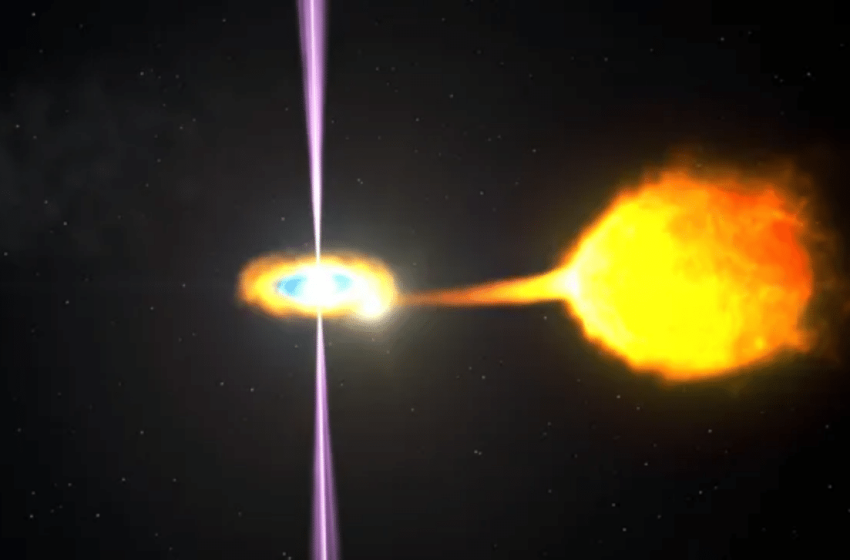
The recent study, led by Jackson Taylor of West Virginia University and his team, focuses on pulsar binary systems, specifically, black widow pulsars. These systems consist of a rapidly spinning pulsar paired with a much smaller companion star, which is often only 1% the size of the Sun. The pulsar’s immense gravitational pull slowly strips away material from its companion, eventually destroying it over time. This process, which leads to the “black widow” nickname, presents a unique environment to search for exotic objects such as Trojans.
While the black widow pulsars may seem inhospitable to planets, the reality is quite the opposite. The low mass of the companion star actually makes it more likely that a stable orbit could exist for smaller objects, such as an exotrojan. This could provide the perfect opportunity to study co-orbital dynamics in these extreme environments. However, detecting such objects is far from easy. Traditional methods of exoplanet detection, such as tracking the gravitational pull a planet exerts on its star, are rendered ineffective by the extreme conditions of pulsar systems.
New Techniques for Detecting Exotrojans
To overcome these challenges, the team employed two innovative detection techniques. The first method involved comparing optical light curves with radio data from the pulsar system PSR J1641+8049. Optical light peaks occur when the heated side of the companion star faces Earth, while radio pulses are emitted by the pulsar and track the orbital center of mass of the entire system. If there were a mismatch between the two, it would suggest that a third body, such as a Trojan, was influencing the system’s gravitational dynamics.
The second technique relied on a dataset from the NANOGrav project, which tracks radio pulse timing over a period of 15 years. Known as Time of Arrival (TOA) measurements, these data points can reveal subtle oscillations in the system’s center of mass, which could indicate the presence of a third object. If an exotrojan were orbiting in a stable Lagrange point, it would cause the system to wobble, resulting in detectable changes in the radio pulse timing.
band as an example, with the remaining model curves shown in A. Y. Kirichenko et al. (2024). Every band except
was used in calculating To,s. The vertical dashed line marks the TSC as predicted by radio timing. The uncertainty on the TOA-predicted TSC is far smaller than the
-axis scale of the figure. The vertical cyan band encloses the 68% confidence interval of the TSC as calculated from the optical light curve.
No Conclusive Evidence Yet, But Hope Remains
Despite the promising methodologies, the researchers did not find conclusive evidence of any exotrojans in their sample. Two systems showed what the authors believe were false positive signals, likely caused by noise or limitations in the data. In the remaining seven systems, no objects larger than the size of Earth were detected, although one system did show hints of an object up to eight times the mass of Jupiter.
While these findings may seem disappointing, they do not signal the end of the search. The researchers emphasize that the search for exotrojans is still in its early stages. Given the complexity of pulsar systems and the limitations of current technology, it’s possible that smaller, more elusive objects are present but remain undetected. With further data from upcoming projects like NANOGrav’s 20-year dataset, astronomers remain hopeful that the elusive exotrojan will soon be found.
First Appeared on
Source link






