


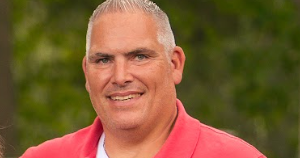
His chest felt like his son was lying on it. His doctor recommended a procedure that’s “crazy even to heart surgeons.”
When Paul DeGeorge felt pressure on his chest in the middle of the night, he thought his 4-year-old son was lying on top of him. DeGeorge had fallen asleep on the couch after coming home late from his job as a police officer, and it wouldn’t be unusual for the boy to snuggle up next to his dad.
But when DeGeorge opened his eyes, his son wasn’t there. The “crushing weight” remained.
“That was like, ‘Oh my God, something’s up here,'” the 49-year-old DeGeorge said.
He wasn’t sure what could be wrong. He was healthy and active. He did jiujitsu and coached his kids’ sports. He was on his feet all day at work as an officer with the Special Operations Division for New Jersey Transit, the state’s public transportation provider. He had no family history of heart disease. To be safe, he drove himself to the emergency room at Atlantic Health Morristown Medical Center, where doctors “ran a whole battery of tests.” For days, he had no answers.
“I was terrified. You don’t know what they’re going to find, what’s going on,” DeGeorge said.
Dani King / Atlantic Health
Then a cardiologist realized that something was wrong with DeGeorge’s aortic valve. The aortic valve controls blood flow. Typically, it has three flaps that open and close with every heartbeat. DeGeorge had just two, a condition called bicuspid aortic valve. It develops in the womb and can cause issues with blood flow or put the aorta at risk for tearing.
Dr. Benjamin van Boxtel, the surgical director at the hospital’s Atlantic Aortic Center, said that most bicuspid aortic valve patients don’t start to feel symptoms for decades. They may notice some shortness of breath or fatigue. Crushing pressure like what DeGeorge was experiencing is a major warning sign.
“When someone comes in and they have chest tightness and chest pressure, that’s an end-stage symptom,” van Boxtel said.
“Musical chairs of the heart”
DeGeorge would need major open-heart surgery. There are several options available to treat a bicuspid aortic valve, van Boxtel said. Most commonly, patients receive an aortic valve replacement, where the damaged bicuspid valve is replaced with either a mechanical valve or a bioprosthetic valve made from cow tissue.
The mechanical valve would require DeGeorge, then 48, to make “massive lifestyle changes,” including taking blood thinners for the rest of his life and giving up contact sports, van Boxtel said. As for the bovine valve, van Boxtel said he “didn’t see it lasting more than 15 years,” meaning DeGeorge would likely need another open-heart surgery.
There was a third option: a complicated surgery called a Ross procedure. In this surgery, a patient’s pulmonary valve is harvested from their heart. The pulmonary valve has less wear and tear on it than the aortic valve, so it is usually in better health. Over time, it can heal itself and accommodate new levels of activity, making it a good substitute for the aortic valve.
The bicuspid aortic valve is then removed and replaced with the patient’s pulmonary valve. Finally, a cadaver pulmonary valve replaces the original pulmonary valve.
The procedure is like “musical chairs of the heart” and “is crazy even to heart surgeons,” van Boxtel said. But he wanted to let DeGeorge “feel like a healthy 40-year-old guy again.”
DeGeorge was intimidated but decided the Ross procedure was his best option. He could live normally and wouldn’t need further open-heart operations. If anything ever went wrong with the replacement pulmonary valve, it could be treated through the groin with a catheter in a less invasive procedure.
A complex but successful surgery
A week and a half later, DeGeorge, his wife and his cousin arrived at the hospital. DeGeorge was nervous about the upcoming procedure, but said he was happy to be able to fix the defective valve and move on with his life.
“I’d be lying if I told you I slept much the night before,” he added.
The procedure took about six hours, van Boxtel said. DeGeorge had some antibodies in his blood that meant the surgical team had to carefully monitor medications, temperature changes and other variables during the procedure. Even with the extra precautions, everything went smoothly, van Boxtel said.
“Sometimes you’ve got to know when to go quickly and when to slow down, and we were really able to thread that needle with Paul,” van Boxtel said.
“This story could be very different”
Just hours after the operation was complete, DeGeorge was able to sit up in bed. He had little pain. Within a few days, he was up and walking. Van Boxtel said this isn’t unusual, since Ross procedures are typically performed on younger patients who can recover more easily.
Eighteen months after his operation, DeGeorge said he is feeling better than ever. He was recently honored at a New York Jets game, and is back on full duty at work. He has resumed coaching and jiujitsu. Most importantly, he is able to keep up with his kids.
Atlantic Health 
“I feel fantastic now,” DeGeorge said. “I couldn’t feel better.”
DeGeorge will have follow-up care for the rest of his life. For the first year after a Ross procedure, patients need to carefully monitor their blood pressure as the pulmonary valve adjusts. DeGeorge will also see a cardiologist regularly and have routine scans to monitor his heart. Otherwise, things will be relatively calm for the father of two.
“I’m happy being back to work. I’m happy to feel good, I’m happy to be with my kids,” DeGeorge said. “I was very fortunate. This story could be very different. I couldn’t be happier to be where I am now.”
First Appeared on
Source link






