


How a pacemaker for the brain could help Parkinson’s patients
Keith Krehbiel has broken more ribs than he can count — from bike crashes to falls during pickleball matches. Another time, he climbed up the stairwell in his home and blacked out just as he reached the top.
“Falling is a common symptom of people with Parkinson’s,” he said.
Krehbiel is among the estimated 1.1 million Americans with Parkinson’s disease, a movement disorder of the nervous system that worsens over time. Another 10 million people worldwide are estimated to have the disease.
Symptoms often start slowly, many times beginning with a tremor that is barely noticeable in one hand or a foot or one’s jaw. But over time, the disorder causes stiffness, a slowing of movement, and balancing issues along with a slew of autoimmune issues.
Krehbiel, a longtime business and political science professor at Stanford University, has dealt with the disease for nearly three decades — diagnosed in 1997 with early onset Parkinson’s at the age of 42.
“I was running and noticed my left arm didn’t move nearly as much as my right arm,” he said. “About that time, I was doing something in the kitchen and my pinkie started shaking, and I didn’t know what that was about either.”
When he was diagnosed, he didn’t think it was that big of a deal. He continued running, biking, and bowling to maintain his lifestyle. “It wasn’t crushing,” he said, “because I was ignorant. I didn’t know anything about Parkinson’s.”
With the help of medication, he figured out a way “to live with it.” Based on one study of people with early onset Parkinson’s, Krehbiel calculated he would live to about 55, maybe 60.
“My goal was to last long enough, so I could see my daughters graduate from high school,” he said.
He shattered that goal. But as the years went by, his symptoms intensified, as did his falls, the slowing of his nervous system and the side effects of medications. He felt he lived in a brain fog and was nauseous all the time. Movements that were once easy became laborious.
“Your breathing slows, your heart rate slows,” he said, describing the combination of living with Parkinson’s and medication side effects. “Everything slows down. I stand up I get dizzy. I have to train myself to expect that.”
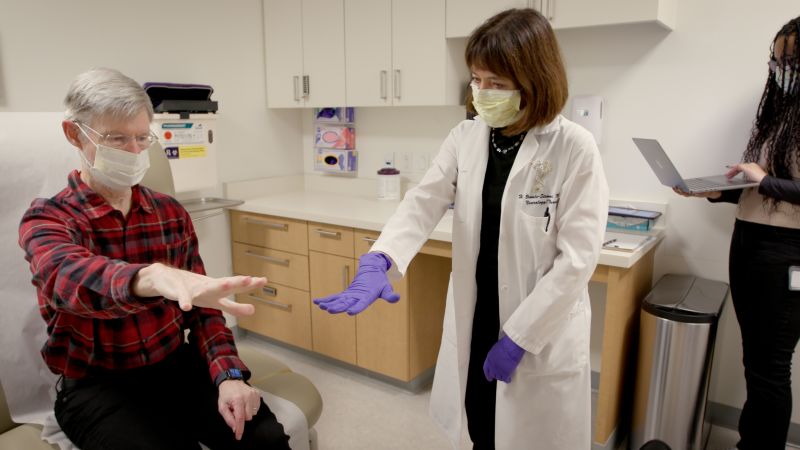
Krehbiel would eventually become the first patient in a groundbreaking pivotal international clinical trial to receive an adaptive deep brain stimulation (aDBS) device.
The device senses brain activity in real time and tailors electrical pulses accordingly, like a pacemaker for the brain that only fires when needed.
“I thought, well, if you’re going to be cursed with something,” Krehbiel said, “you might as well try to contribute on your way out, so to speak, to put it morbidly.”
Dr. Helen Bronte-Stewart, a Stanford Medicine professor of neurology and neurological science, has spent her career “trying to understand how the brain controls movement, what happens when it goes wrong and how we can fix it.”
Bronte-Stewart was the global lead investigator of the international multicenter trial of aDBS for Parkinson’s patients — a study that resulted in FDA approval of the device, made by Medtronic, in February 2025. Time magazine named the BrainSense aDBS one of the “Best Inventions of 2025.”
Tens of thousands of Parkinson’s patients have received traditional deep brain stimulation over the last two decades in which leads, about the size of thin strands of spaghetti, are implanted in the brain providing electrical stimulation to control the brain’s electrical rhythms to ease tremors and other Parkinson’s symptoms. The wires are attached to a small, battery-powered device implanted under the skin of the chest.
The new device adjusts stimulation based on brain signals in real time.
“Until recently, these stimulation devices delivered a one-size-fits-all train of electric pulses to the brain around the clock,” Bronte-Stewart said. “They have helped some people but are a pretty blunt tool for trying to correct the brain arrythmias associated with Parkinson’s. Now, we have this adaptive technology that listens to brain activity and adjusts stimulation accordingly.”
The FDA approval, she said, felt like a validation of her decades of work.
“There’s a lot of joy in the discovery along the way,” she said, “when you’re doing that hard work and you see amazing interactions between these neural signals and these highly precise motor signals as people are doing complex acts.”
In fact, she said, it’s hard to fully describe what it feels like to see research conducted in her lab over many years come to fruition in the new device with it “being picked up across the world and patients are really liking it.”
“I think it’s just the beginning,” Bronte-Stewart told CNN. “There’s a lot more to do, but certainly the beginning is very exciting.”
Bronte-Stewart, who was named the first woman neurologist in Stanford’s department of neurology about a dozen years ago, added, “It’s a really interesting dance to me — that science moves innovation forward, then technology catches up, then when it’s got enough evidence, regulatory approves it.”
Scott Stanslaski, a renowned engineer at Medtronic who helped invent the aDBS device, has worked with Bronte-Stewart for more than a dozen years.
Stanslaski said she was “instrumental” in helping form the perfect public-private collaboration to help Parkinson’s patients. “I’ve had an amazing journey working with Helen,” he said. “I have so much respect for her. Not everyone that we worked with was as open to the back-and-forth collaboration with industry.”
More impressive, he said, were her interactions with the patient pioneers who were willing to undergo tests for something that had never been done before. “She really developed strong bonds with those patients, and it was amazing to see the patients develop this sense of purpose. It was really fun to watch — to see how important those research visits were to the patients themselves.”
The aDBS device is not a cure. Bronte-Stewart calls it a “wonderful, stable, long-term therapy” with the technology only getting better with the aim of slowing Parkinson’s progression.
She compares the treatment breakthrough to when the earliest pacemakers couldn’t sense a person’s heartbeat, only delivering one steady electrical rhythm. That was the case of deep brain stimulation for Parkinson’s patients for years, until the adaptive device came along.
“When it’s on and working,” she said, “then people really do [improve]. What they say is their disease goes back at least five years.”
Krehbiel, her first patient in the clinical trial, has had his device in since the summer of 2020. In the five years since, his hand tremor has almost completely disappeared. He also has cut way down on medications that made him groggy, a feeling of relief after decades.
“I just felt a lot better cognitively. My brain was less foggy. I just felt good,” he said. “It was just a psychologically cool feeling.”
He has also seen the births of three grandchildren. He still has falls and gait issues when walking, but “it sure makes life better in the sense of alleviating some of the nasty part of Parkinson’s.”
“It’s still no picnic, that’s for sure,” Krehbiel said, “but it’s a lot better than it would be.”
First Appeared on
Source link






