


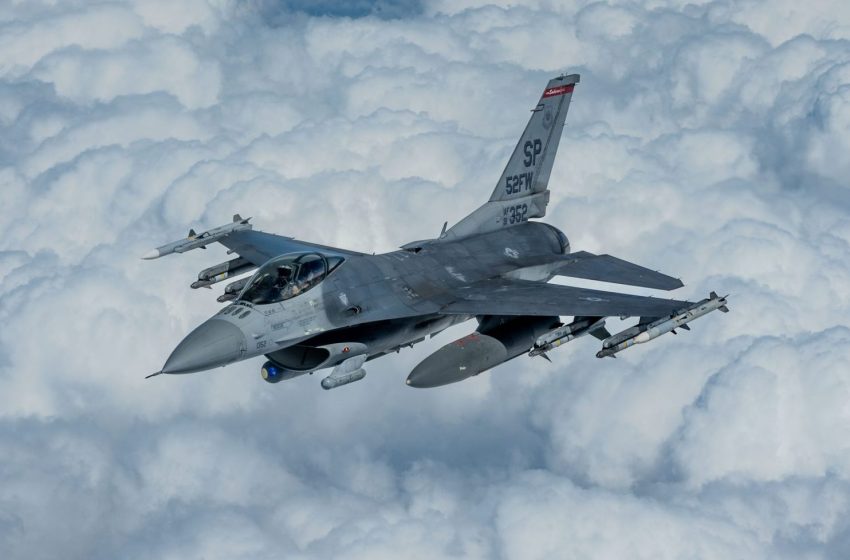
How F-16 Pilots Survived Houthi Ambush
About 15 seconds separated F-16 “Wild Weasel” pilots Lt. Col. William “Skate” Parks and Maj. Michael “Danger” Blea from life or death in the night skies over Yemen.
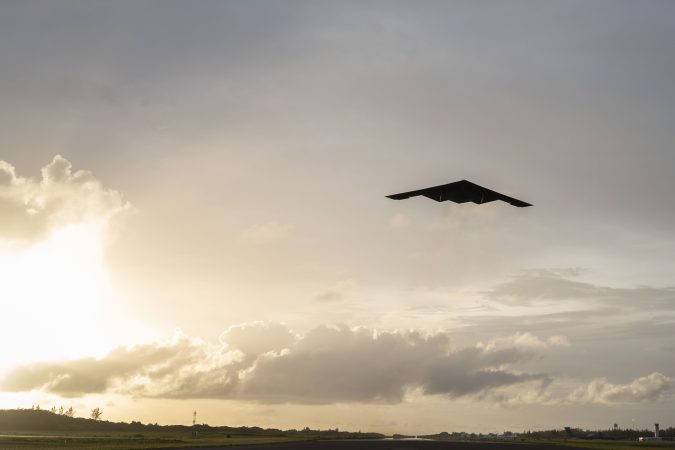
Along with multiple B-2 Spirit bombers and other aircraft, they were part of a complex mission to strike Houthi ballistic missile production facilities in Yemen on March 27, 2025. The B-2s dropped their bombs, the F-16s peeled away from their targets, hoping to soon be “feet wet” over the Red Sea.
But suddenly, they were targets. Spotting a flash from the ground below, Parks and Blea realized they were in the crosshairs of an incoming surface-to-air missile, the hunter now becoming the hunted.
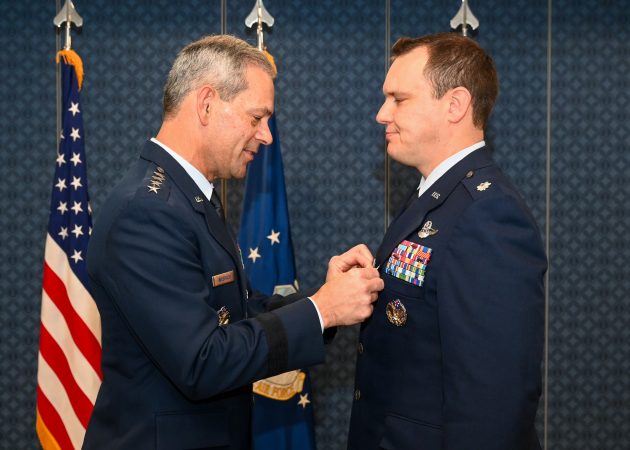
The Air Force granted Air & Space Forces Magazine interviews with Parks and Blea to discuss their harrowing mission, for which each earned a Silver Star—just two of fewer than 100 of the valor medals awarded to Airmen since the independent U.S. Air Force was founded in 1947. The Silver Star is the U.S. military’s third-ranking valor award, after the Medal of Honor and service Crosses.
Neither the two pilots nor spokespeople for the Air Force would specify the enemy or country involved, but interviews with multiple current and former U.S. officials confirmed that the actions occurred over Yemen and the Red Sea. The squadron’s actions against the Houthis are also referenced in at least one other award citation.
This account of the mission and Operation Rough Rider, the 52-day air campaign against the Houthis, is based on interviews with current and former U.S. officials with knowledge of the air campaign.
Other awards were also earned that night. A tanker crew—two pilots and a boom operator who ventured into harm’s way—earned Distinguished Flying Crosses for their efforts. The Air Force says the medals will formally be presented in March. Parks was also awarded a Bronze Star for his work during the squadron’s deployment.
The operation was noteworthy for its unusual command structure. Then-commander of U.S. Central Command, Army Gen. Michael “Erik” Kurilla, switched control of air operations in the Yemen area from Air Forces Central and the Combined Forces Air Component Commander, or CFACC, to the Joint Special Operations Command at Fort Bragg, N.C., led at the time by then-Vice Adm. Frank “Mitch” Bradley.
It was likely the first time a Middle East air campaign of this magnitude was run by JSOC, a decision that continues to be controversial among some current and retired military officers. While some former special operators say the shift was appropriate because JSOC has decades of experience taking down militant networks, critics of the move say the shift weighted the campaign too much toward hunting Houthi leaders and gave insufficient attention to developing and attacking targets the Houthis use to control the country, including air defense locations. Asked for comment, none of the commands involved, neither U.S. Central Command, Air Forces Central, nor U.S. Special Operations Command, would comment on the decision.
First In, Last Out
Operation Rough Rider, the overall campaign targeting the Houthis, launched on March 15, 2025. The aircraft carrier Harry S. Truman was based off the Yemeni coast, its deck brimming with F/A-18 Super Hornet multirole fighters and EA-18 Growler electronic attack jets. Remotely operated MQ-9 Reaper drones joined the operation.
By March 25, half a dozen B-2s were arriving on the Indian Ocean island of Diego Garcia, according to open-source data. Though the Air Force declined to comment on the role of the B-2s, people familiar with the operation say they took part in the March 27 attack.
Parks and Blea, members of the 480th Fighter Squadron based at Spangdahlem Air Base, Germany, deployed to the Middle East in October 2024 and the unit remained there until July 2025. The Spangdahlem fighters are “Wild Weasels,” trained and equipped to suppress enemy air defenses, a mission known as SEAD that dates back to the Vietnam War.
The 480th F-16s carry Active Electronically Scanned Array radars and the laser-guided rocket system known as APKWS to counter incoming drones. Their HARM Targeting System, or HTS pods, help them pick out and target enemy SAM sites.
Reflecting their roles of SEAD role and protecting other aircraft, the Wild Weasel motto is “First In, Last Out,” which is repeated as a call-and-response among the unit. Their morale patches depict another catchphrase, using only its five-letter acronym—YGBSM—below an image of a confused ferret.
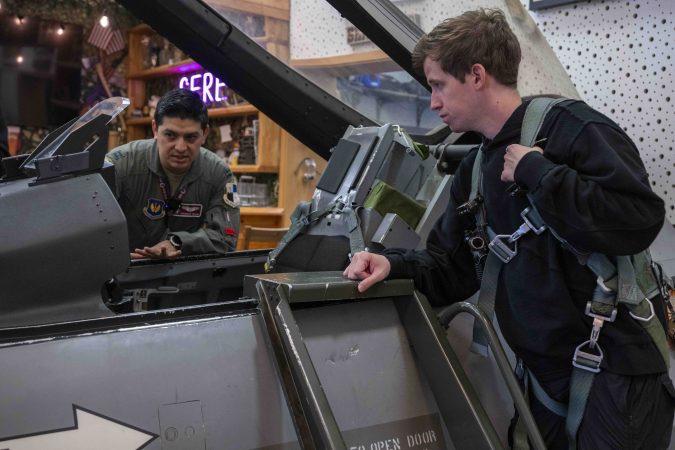
The March 27 mission was Parks’ first night operation of the campaign. As the mission commander that night, he had begun his briefings two days prior, pressing his teammates to shift their mindset from operating as multirole fighter-bombers in Operation Inherent Resolve against ISIS in Syria to instead focus on the SEAD mission in Yemen.
The U.S. military declined to identify the F-16s’ home base in the Middle East, but airspace restrictions sent them over the Red Sea as they penetrated and exited Yemeni airspace.
On the night of March 27, they followed that route along with two other F-16s from their squadron. The mission was SEAD, intended to damage or destroy Houthi air defenses while also distracting the Houthis from the other part of the attack mission.
“The Wild Weasel mantra is to have the adversaries look at us and pay attention to us,” Parks said. “That doesn’t necessarily mean that we’re desiring, wanting to, or even expecting to start getting fully shot at.”
No sooner had the mission begun than it was clear the Houthis knew an operation was underway. Initially, the ground below began to sparkle like fireworks, but which were in fact a sign that they had been observed and, as some officials later assessed, that Houthi air defenders were signaling each other.
“They know we’re here. We need them paying attention to us,” Parks said. “We need to make a personal, purposeful decision to start shifting closer to the danger area, which is not a fun decision, but it was definitely one that we knew we had to do.”
U.S. forces never fully grasped the full extent of the Houthis’ ad hoc integrated air defense, say current and former U.S. officials. Later analysis indicates the Houthis combined radar-guided SAMs with visual observers and electro-optical and infrared sensors, passive means that U.S. sensors didn’t pick up.
“We tried to understand what exactly was happening,” a senior U.S. defense official told Air & Space Forces Magazine. “We made a concerted effort to understand all the pieces of information that they were obtaining to build their picture. And I don’t think we ever had 100 percent clarity on that.”
Parks and Blea had reached their objective near the Yemeni capital of Sanaa and each fired one anti-radiation AGM-88 HARM missile each. The two HARMs were among nearly 50 fired during the campaign during almost two dozen engagements against surface-to-air missile sites and anti-aircraft artillery.
The Yemen campaign was the first by the U.S. military since 2011’s Operation Odyssey Dawn against Libya to employ HARMs.
The missiles found their targets and the Houthi air defenses appeared silenced. But as the U.S. jets began to exit the country, the Houthis were playing possum, waiting for their chance to respond.
“The main strike goes through, and it happens in an instant, and then it was over, and everything was quiet,” Parks said. The bombers’ mission was successful and the strike packages began their exit. “There’s no AAA, there’s no nothing,” Parks recalled. “The systems we’ve seen on air had turned off air, and now we’re getting ready to go home.”
But the aircraft were being tracked as they flew toward the Red Sea and the Houthis didn’t turn on their radars until they had a SAM ready to launch at the American jets, a so-called SAMbush.
“It was an ambush because we did not get much indication ahead of time,” Parks. “We only had about 15-20 seconds of indications ahead of time. So what does that tell you about what they were doing? Did they just turn it, leave it off, and then click it on and shoot? What were they doing? … It’s fair to say I do think they were using a lot of visual observation and EO/IR.”
Parks had few options, so he headed straight for the missile—a method of last resort—as he tried to confuse the munition and cause it to overshoot.
“You see this bright white light, and you see the rocket with the first missile launch, and it’s essentially directly underneath our position,” Parks said. “We have enough time to make essentially a hard turn into this missile. It goes past right underneath my left wing, close enough I can hear the rumble, and that’s something that’s stuck with me to this day.”
Parks had survived, but now Blea’s life hung in the balance.
“I watched the launch, and then I can see the missile the entire time,” Blea said. “Then I start my threat reacting, according to how we train. And then I vividly remember thinking, this is my only chance. I have one chance to make this miss.”
It did—barely. “It was flying within feet of the front of my nose,” Blea said. Thirty feet, he estimated later, a distance that is less than the length of his aircraft—an F-16 is just under 50 feet long.
For the next quarter hour, the pilots would pull defensive maneuvers and dispense countermeasures.
“It is 15 minutes of that for a total of six missiles being shot at the two of us, and just working as a team to make sure that we are always making moves in the right direction to get safe, while also making sure that we are defending from these missiles,” Blea said.
Because F-16s burn more fuel pulling Gs, the pilots now faced another challenge: Running out of gas would almost certainly lead to ejecting over hostile territory or into the Red Sea, neither one an appealing option.
In the event an F-16 engine is starved of fuel and flames out, pilots can keep their jets airborne for a few minutes using the aircraft’s emergency power unit, fueled by hydrazine. The fly-by-wire F-16 becomes uncontrollable, however, once it loses its fly-by-wire controls.
“I did not want to punch out because I ran out of gas,” Parks said. “We obviously were utilizing a much higher fuel rate. We’re on afterburner for some of these higher G maneuvers. And so, considering we did that over 10 minutes, and we were leaving already with our planned recovery fuel, it almost immediately put us well behind on fuel.”
Recognizing the risk, the Air Forces Central’s Combined Air Operations Center, which was responsible for flight safety, swung into action.
A tanker crew was dispatched closer to enemy territory and into harm’s way. Blea headed for fuel first.
“I will forever owe a debt of gratitude to the tanker crews that night, because without question, without knowing the full details of what was going on, they immediately were just willing to support,” Blea said.
Parks’ Bronze Star citation notes the accomplishments of the 480th Expeditionary Fighter Squadron. Parks was the unit’s commander, leading 56 Airmen and 12 F-16s. He is now assigned to a role at the Pentagon. The squadron was one of the first to use APKWS as drone-killing air-to-air weapons and helped develop the “innovative tactics” employed to defeat enemy drones. It also used older AIM-9M Sidewinders, claiming the first air-to-air kill by an AIM-9M in over 30 years. The unit scored 108 total aerial kills of drones and cruise missiles during the deployment.
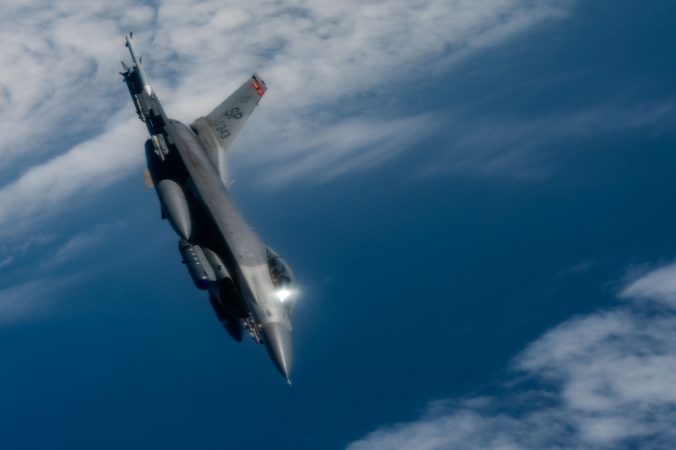
“The 480th executed a high-risk campaign against Houthi forces, employing over 134 bombs and 47 AGM-88 missiles while flying 9,000 hours and 1.4 thousand sorties under grave risk from 22 surface-to-air missile and air defense artillery engagements,” the award citation states.
But the most rewarding response came when the pilots finally landed back at base and were greeted by the dozens of maintainers and other crew who kept the aircraft flying.
“I turn the corner into a parking spot, and I see probably in the range of 30 people standing up front from there,” Blea said. “That’s kind of the first time you allow your mind to kind of go back to that moment.”
As Blea was unstrapping from his ejection seat, one of his close friends climbed up the ladder, exclaiming, “Dude, you’re home!”
Then Parks approached Blea.
“Nothing needs to be said,” Blea said, recalling the moment. “We look at each other, and we’re like, ‘Wow!’ One, what a night. And two, we’re both here. We did what we were meant to do. … We both made it.”
First Appeared on
Source link






