


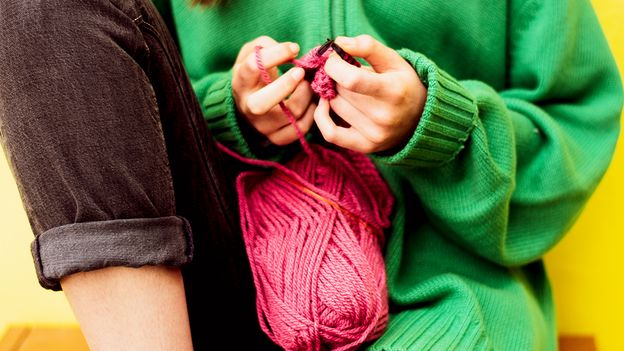
How knitting can help you kick harmful habits
Casey, 60, a technology manager in California who asked us not to use her full name, tells the BBC she was a pack-a-day smoker with a 46-year cigarette addiction before knitting helped her quit.
Casey says she spent ten years trying everything – “cold turkey, Wellbutrin, the patch, meditation, acupuncture, classes from my healthcare provider” – all to no avail. “I knew I didn’t want to go out like my mom did, literally smoking through a tracheotomy,” she says. So she took a knitting class through her local elementary school’s lifelong education programme. She started small – her first project, supposed to be a potholder, turned out as “the world’s ugliest rhomboid” – but soon graduated to long scarves. Casey found knitting was a good substitute for the “ritual and the repetitiveness” of smoking, she says. “It scratched that itch.”
“Three weeks into having quit, I had gotten off a really stressful work call, and my immediate thought was, ‘I need to smoke a cigarette to decompress’,” says Casey. “Instead, I grabbed my knitting and did like four rows, and the thought was gone. The need [for a cigarette] was gone. That’s when I knew this is for real. And I cried.” Now, she’s more than two years cigarette-free and is knitting and purling away on a pair of socks, a hat, and a blanket.
Similarly, the studies conducted in substance abuse centres so far are promising, if not conclusive. One study in 2024 found that women in substance abuse treatment centres smoked fewer cigarettes after participating in a “knit to quit” program. But since the group also listened to talks about the health risks of smoking during their meetings, “we can’t say for sure that knitting was the causal influence”, says Allison West, an associate professor of public health at John Hopkins University in the US and lead author of the study.
Another study from 2007 introduced knitting to women in a residential treatment for chemical dependency, including alcohol abuse, heroin, and prescription drugs. While some of the new knitters were initially discouraged by the learning curve, many said it became an essential coping tool as they juggled withdrawal symptoms, court appointments, and family obligations. Knitting “keeps me here when I want to run”, one participant told researchers.
First Appeared on
Source link






